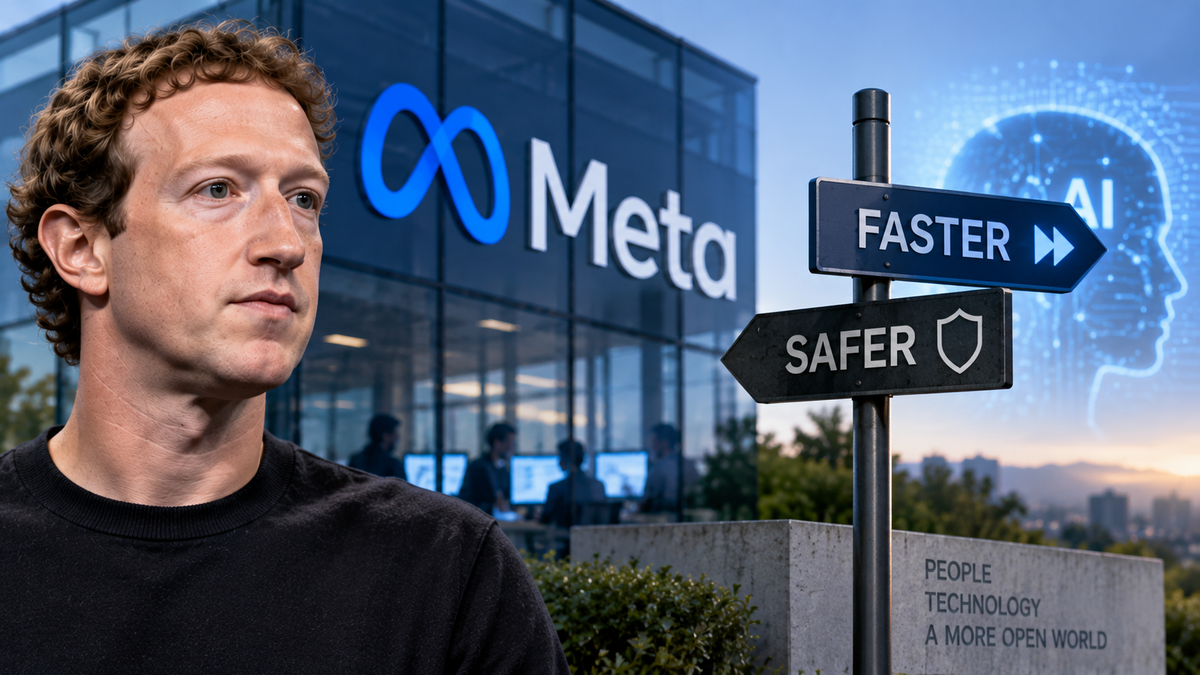
Meta chief Mark Zuckerberg has rejected the idea that leading artificial-intelligence companies need to coordinate a collective slowdown, arguing that individual developers already have strong reasons to delay or change products when safety concerns arise.
Zuckerberg made the argument in a post on X as the technology industry debates how quickly increasingly capable AI systems should be developed and released.
His position is that safety decisions should be made by individual laboratories based on the risks of their own systems rather than through an agreement among major competitors to slow capability development together.
As an example, Zuckerberg said Meta delayed its Muse AI agent for several months while the company worked on safety and security issues. He also pointed to the use of independent evaluators as a practice that can provide outside scrutiny of advanced systems.
The comments come amid a broader debate among AI executives over whether the pace of development itself has become a safety problem. Anthropic chief executive Dario Amodei has called for leading companies to slow capability development, an idea that has also drawn support from other prominent technology figures.
A coordinated slowdown, however, raises a separate set of questions. If major competitors jointly agree to restrict the pace or direction of development, regulators could examine whether that cooperation affects competition.
US Federal Trade Commission chair Andrew Ferguson has expressed skepticism about giving AI companies antitrust protection for such coordination.
The disagreement reflects two problems that are increasingly difficult to separate. AI companies are under pressure to move quickly because competitors are releasing more capable systems, attracting users and spending heavily on infrastructure. At the same time, developers face growing demands to show that powerful models and agents can be deployed safely.
Zuckerberg’s argument does not amount to saying companies should never slow down. His example of Meta delaying Muse makes the opposite point: a company may need to pause a particular product when its own safety work shows that more time is required.
The dispute is instead over who should make that decision and whether the largest AI developers should coordinate their pace.
As AI systems become more capable, that distinction is likely to matter more. Regulators will have to consider both safety and competition, while companies will have to show that voluntary safeguards are strong enough to work even when commercial incentives reward speed.