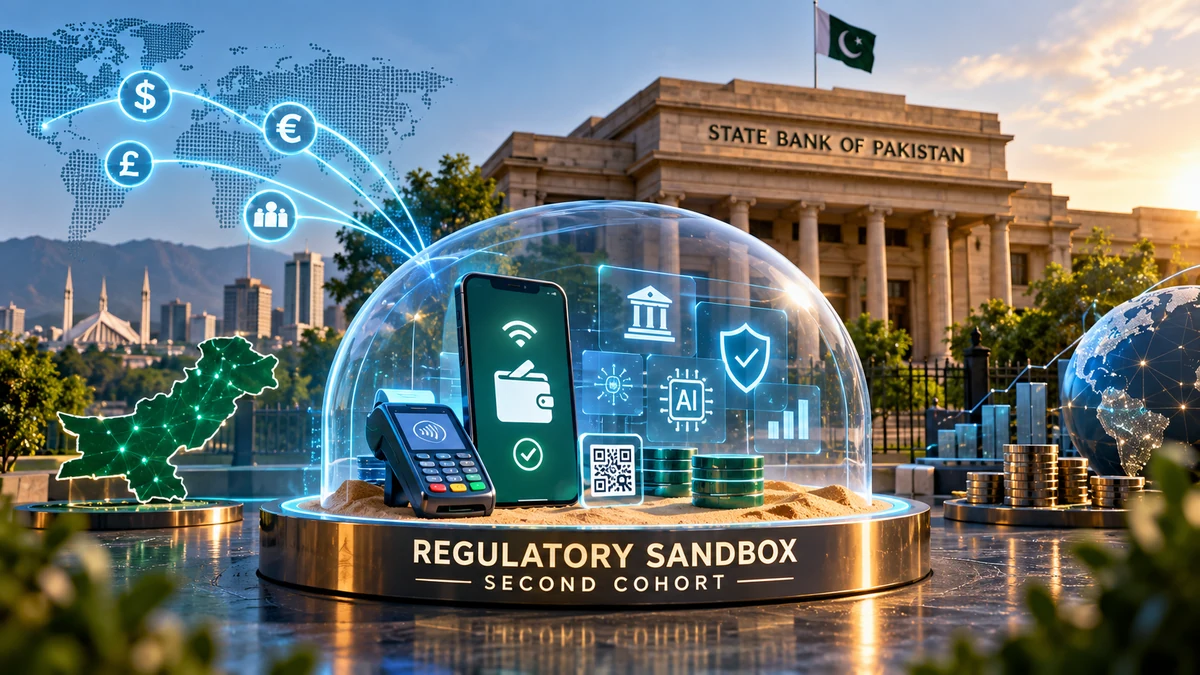
The State Bank of Pakistan has launched the second cohort of its Regulatory Sandbox, opening a new testing window for financial innovations involving artificial intelligence, payments, inward remittances and next-generation financial services.
The central bank said the second cohort is intended to support responsible innovation in digital financial services while maintaining consumer protection and financial stability.
Applications will be accepted until November 30, 2026.
The cohort covers four areas: AI in financial services, innovations in payments, technology-enabled inward remittances and NextGen Financial Services as an open theme. SBP said proposals must fall within the scope of the announced themes to be considered.
A regulatory sandbox allows selected firms or innovators to test new financial products, services or technologies in a controlled environment under regulatory oversight. The approach can help regulators understand emerging technologies before deciding whether existing rules need to be clarified or updated.
SBP launched its Regulatory Sandbox initiative in August 2025 as part of its Vision 2028 programme.
The first cohort concluded in June 2026 after four solutions were demonstrated in the areas of open banking and technology-enabled inward remittances. Shortlisted participants tested their solutions with oversight, guidance and support from SBP teams.
For the second cohort, the inclusion of artificial intelligence broadens the programme into an area that is increasingly relevant to financial institutions for customer service, risk assessment, fraud detection and other uses. The announcement itself does not approve any particular AI product or company; individual proposals still have to go through the sandbox selection process.
The payments and inward-remittance themes also target areas where digital technology can reduce friction in transactions and cross-border money transfers.
Interested individuals and firms can apply using the procedure and application material provided by the State Bank.
The second cohort is therefore a testing and regulatory-learning programme rather than a general commercial approval. Successful participation allows selected solutions to be tested under defined conditions, while broader deployment remains subject to the applicable regulatory requirements.