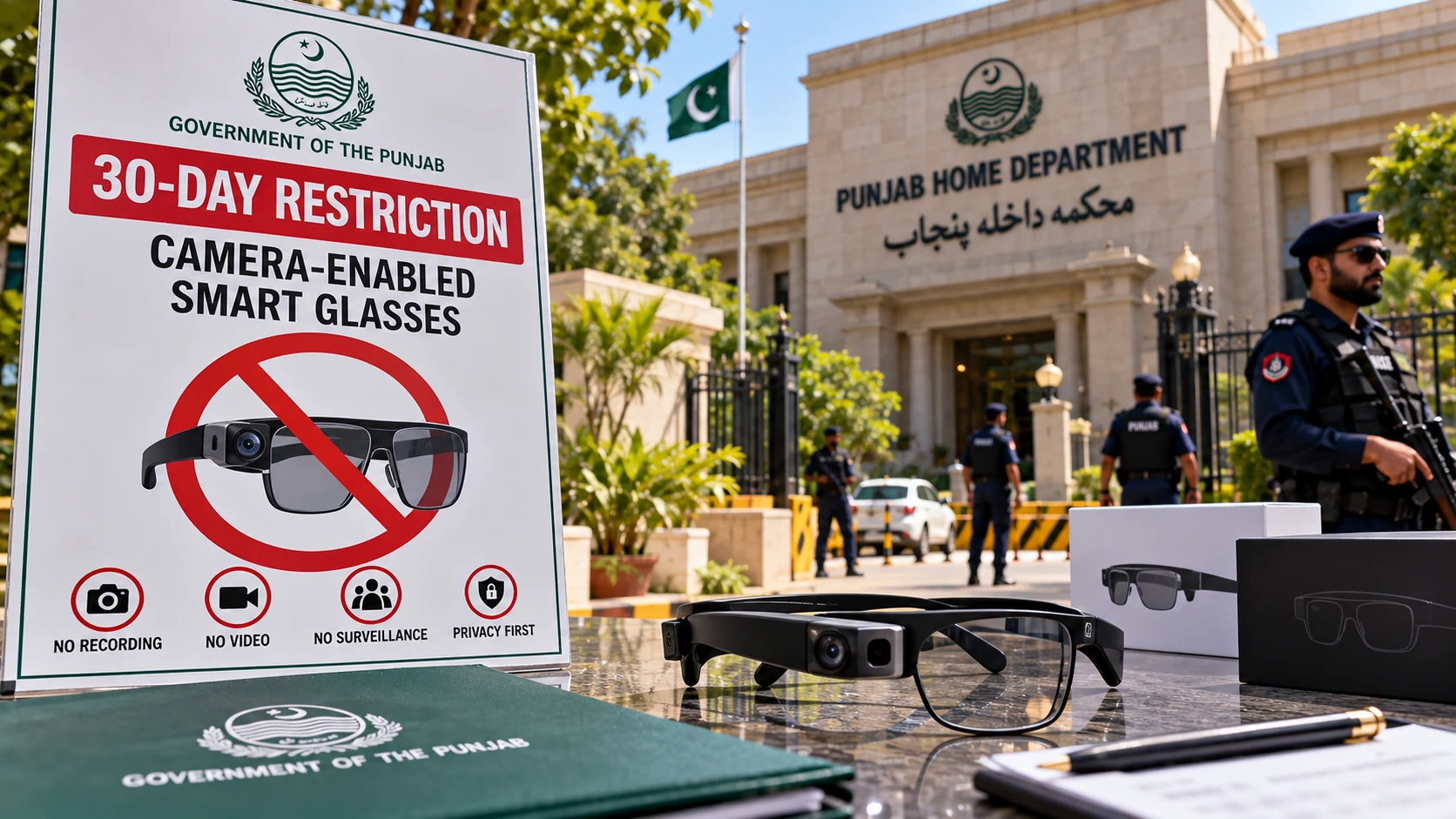
Punjab has imposed a 30-day restriction on camera-enabled smart glasses with concealed recording capabilities and miniature cameras disguised as ordinary objects, bringing a growing debate over wearable technology, privacy and surveillance into the province’s regulatory spotlight.
The provincial Home Department issued the order on October 20 under Section 144 of the Code of Criminal Procedure. It restricts wearing or operating specified recording devices and also bars their sale or offer for sale through shops and online channels during the period covered by the order.
The measure applies across Punjab and takes immediate effect, according to the reported notification. Authorised law-enforcement personnel are exempt.
Which devices are affected?
The order identifies smart glasses capable of hidden recording as well as miniature recording devices concealed in objects such as pens and keychains. It is directed at covert recording capabilities, not every device with a camera.
The notification specifically excludes laptops, handheld tablets, mobile phones and terminal equipment approved by the Pakistan Telecommunication Authority.
The order also addresses commercial distribution. Retailers, wholesalers, traders and distributors have been told not to sell or offer the specified products, whether online or in physical outlets, during the restriction period.
Privacy concerns behind the decision
The provincial government cited risks involving unauthorised recording, transmission of sensitive information, and violations of personal privacy and dignity, particularly for women and children. It identified locations including examination centres, healthcare facilities, courts, airports, shopping centres and sensitive government premises as areas where covert recording could pose heightened concerns.
The debate reflects a broader technological challenge. Wearable cameras are becoming smaller and easier to integrate into everyday accessories, while the people around a device’s user may not always know that recording is possible. Such products can have legitimate uses, but concealed recording can also be used for harassment, blackmail or the unauthorised capture of confidential material.
Punjab’s order comes as a public-interest case concerning camera- and microphone-equipped smart glasses is being considered by the Lahore High Court. The court proceedings have raised questions about the import and sale of devices whose recording functions may be difficult for bystanders to detect.
A temporary restriction, with longer-term questions
The 30-day order is a preventive measure rather than a permanent legislative framework. It may be withdrawn earlier, and any continuation would require further government action under the applicable law.
Longer-term regulation will have to distinguish between transparent, consent-based use of wearable cameras and deliberately concealed surveillance. It will also need to address practical questions: how authorities identify prohibited products, what notice retailers receive, and how consumers can understand which devices remain lawful.
For now, sellers and users in Punjab should consult the actual Home Department notification before trading in or using camera-equipped wearable products.
Source: Dawn reporting on Punjab Home Department notification and Lahore High Court proceedings (21 October 2026): https://www.dawn.com/news/2038582