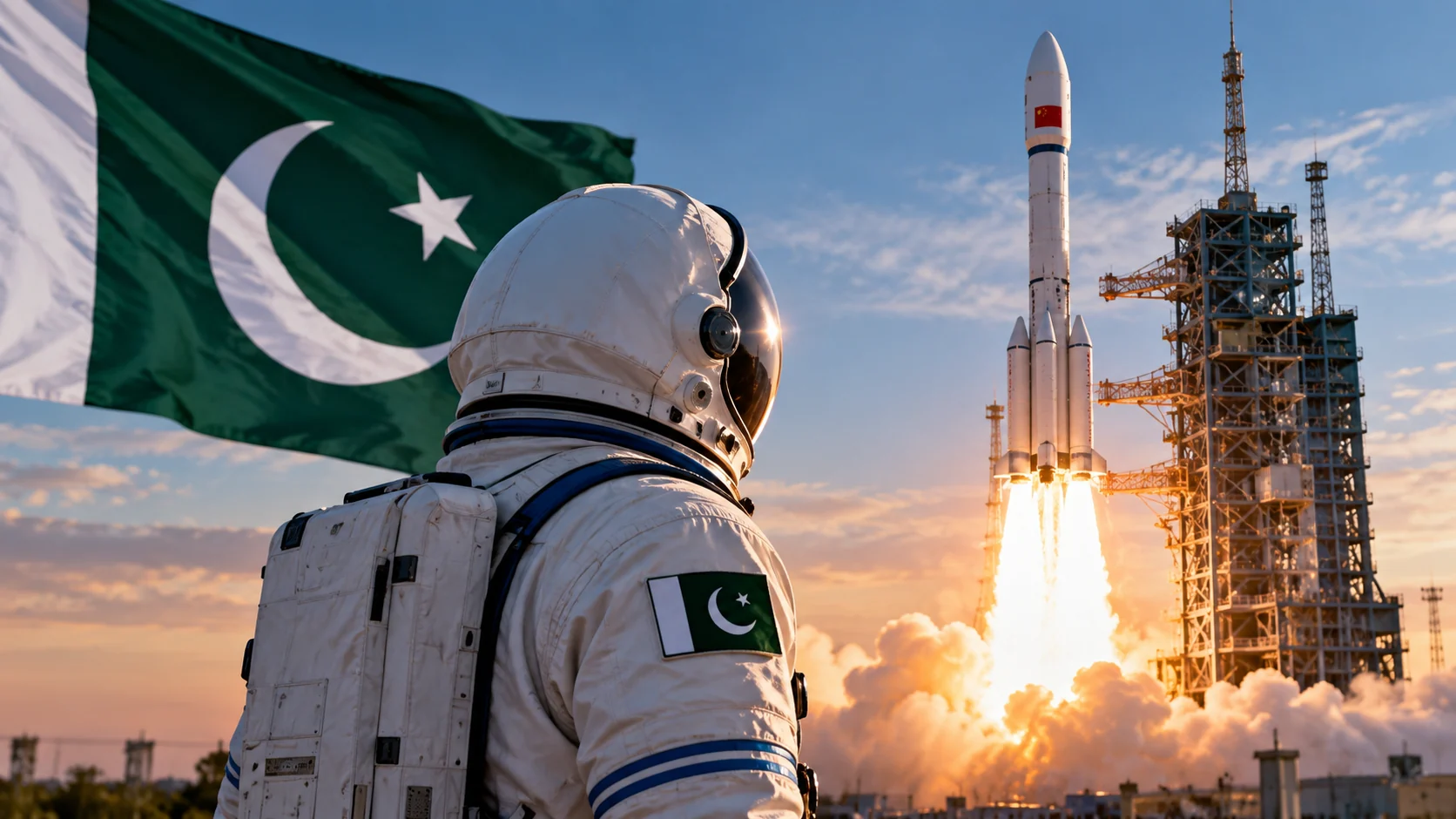
Pakistan’s first astronaut is expected to travel into space on November 25 under a joint programme with China, Planning Minister Ahsan Iqbal has said, marking a potentially significant milestone in the country’s space programme.
Speaking at the closing ceremony of World Space Week in Narowal on Sunday, Iqbal said the mission would reflect Pakistan’s growing cooperation with China in space research and technology.
The announcement comes as Pakistan seeks to expand its space capabilities beyond satellite operations and develop a greater role in scientific research and human spaceflight.
Two Pakistani candidates, Zeeshan Ali and Khurram Daud, were selected earlier this year for training under China’s human spaceflight programme. Both have been undergoing training in Beijing, although authorities have yet to identify which candidate will take part in the mission.
The selected astronaut is expected to serve as a payload specialist, conducting scientific experiments during the flight.
China has not separately confirmed November 25 as the final launch date or announced the Pakistani participant. The schedule therefore remains subject to official confirmation.
Expanding Pakistan’s space programme
Iqbal also outlined Pakistan’s longer-term ambitions, including a proposed lunar landing by 2035, as the government seeks to strengthen the country’s scientific and technological capacity.
Pakistan has maintained a space programme for decades through the Space and Upper Atmosphere Research Commission (SUPARCO), with much of its work focused on satellites, remote sensing and communications.
Cooperation with China has become an increasingly important part of that programme. Pakistan is also expected to contribute a rover to China’s planned Chang’e-8 lunar mission.
Beyond exploration, Iqbal highlighted the wider applications of space technology in agriculture, environmental monitoring, communications and national development.
Satellite-based information can support crop assessments, weather forecasting and disaster management, making space research relevant to several of Pakistan’s economic and public-service priorities.
The minister also announced plans for a space museum at the University of Narowal, intended to encourage greater interest in science and technology among students.
If the proposed November mission proceeds, it would represent Pakistan’s first participation in human spaceflight and a new stage in its longstanding scientific partnership with China.
For now, attention will turn to confirmation of the flight schedule and the selection of the astronaut who will represent Pakistan.