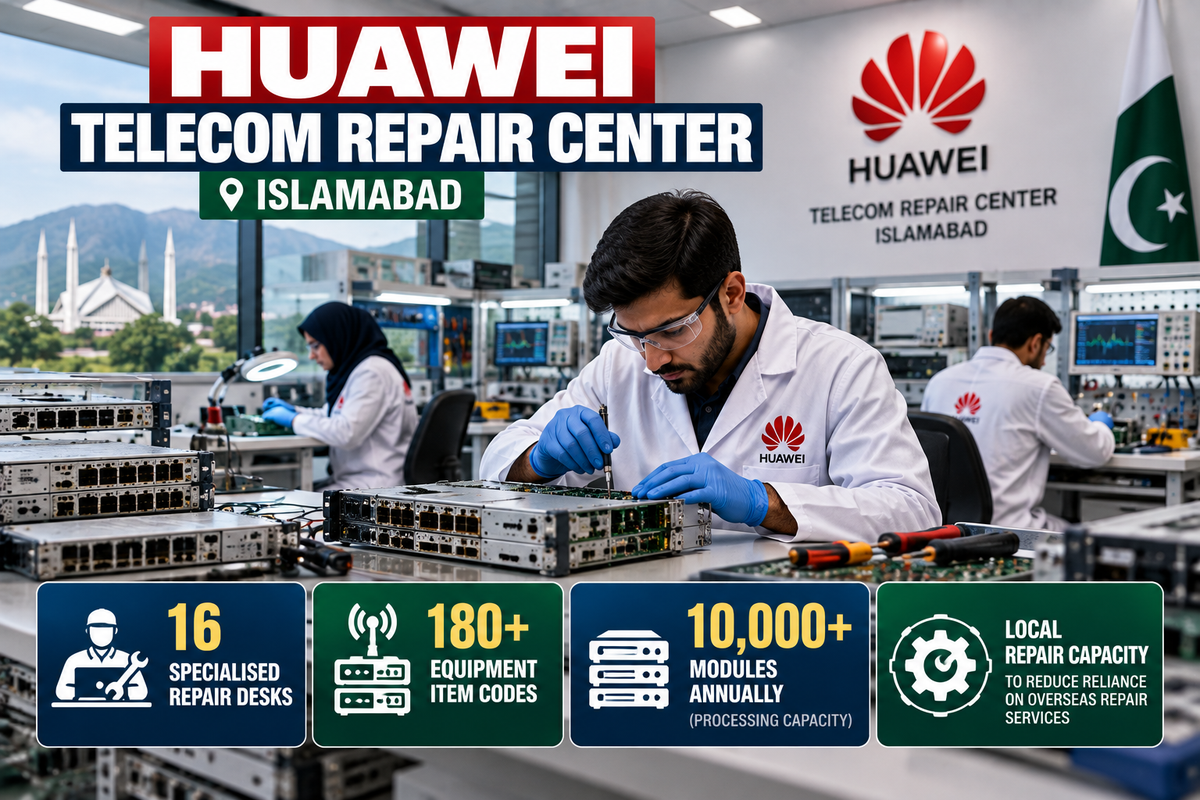
ISLAMABAD — Huawei has opened a national-level Spare Parts Repair Center in Islamabad with capacity to process more than 10,000 telecom equipment modules a year, adding local repair, testing and troubleshooting capability for hardware deployed across Pakistan.
Federal Minister for Information Technology and Telecommunication Shaza Fatima Khawaja inaugurated the facility on September 24 alongside Huawei Pakistan CEO Ethan Sun.
The centre has 16 specialised repair desks and supports more than 180 equipment item codes across wireless, microwave, digital power and access-network technologies, according to the Ministry of IT and Telecommunication and the Press Information Department.
Local repair instead of sending equipment overseas
The facility is designed to diagnose, repair, test and maintain Huawei telecom equipment within Pakistan. Local processing can reduce the need to send faulty modules abroad, shortening the logistics chain between a network fault, equipment repair and return to service.
Huawei says the centre can process more than 10,000 modules annually and return more than 6,000 repaired components to service each year, with an average repair success rate of about 60%.
Those figures describe the facility’s stated capacity and expected repair performance; they are not a count of modules already repaired since the centre opened.
The supported equipment spans several parts of telecom networks. Wireless and access-network hardware connects users to networks, microwave equipment can form part of transmission links, and digital power systems support the infrastructure that keeps telecom sites operating.
Sixteen specialised repair desks
The 16 repair desks are backed by Huawei diagnostic platforms used for fault detection and load testing. The ministry says the centre is staffed by locally based hardware specialists who have received Huawei training, including training from the company’s headquarters in China.
Developing this capability locally has two practical implications. The first is turnaround time: equipment can be assessed and repaired without the delays involved in international shipment. The second is technical capacity, because local engineers gain hands-on experience maintaining equipment already used in Pakistan’s telecom networks.
The government and Huawei have also presented the centre as a way to improve network resilience during emergencies, when rapid repair of failed equipment can become more important. Actual resilience gains will depend on inventory, staffing, repair success and operators’ ability to move equipment between the field and the facility quickly.
Separate from Huawei’s global services operation
The repair centre is distinct from Huawei’s Global Service Center in Islamabad. The GSC supports international customers through remote technical and network services, while the new repair facility focuses on physical telecom equipment used domestically.
For Pakistan’s telecom sector, the immediate development is therefore specific: a local national-level facility is now available for Huawei equipment repair, with 16 specialised desks, support for more than 180 item codes and stated annual processing capacity above 10,000 modules.