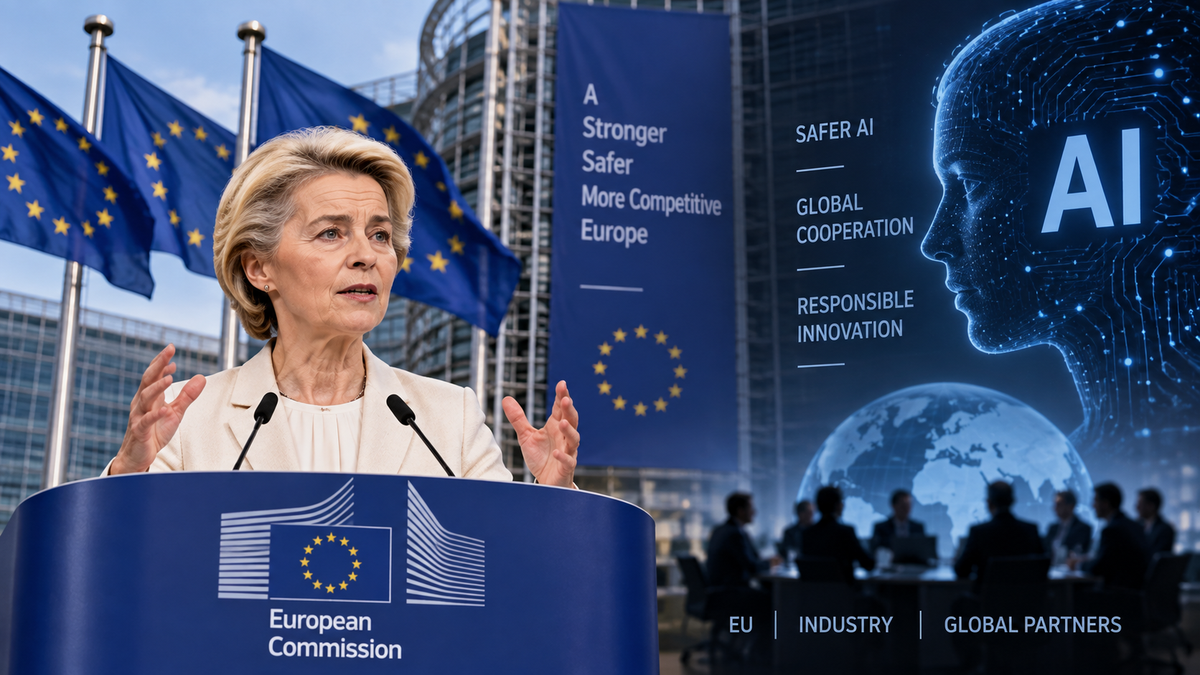
STRASBOURG: European Commission President Ursula von der Leyen has backed calls to slow the development of the world’s most advanced artificial-intelligence systems and said she will bring leading AI laboratories together for talks on managing the risks of increasingly powerful models.
Speaking to the European Parliament on Wednesday, von der Leyen said concerns about frontier AI had become more urgent as models gained capabilities that could be misused in areas such as advanced cyberattacks.
She said she would invite the main frontier laboratories to discuss how governments could support industry efforts to moderate the pace of development at the technological frontier.
The intervention places the European Union more directly into a debate that has intensified inside the AI industry itself.
Anthropic chief executive Dario Amodei last week called for companies to slow the rate at which they advance the capabilities of their most powerful models. His position drew support from OpenAI chief executive Sam Altman and xAI owner Elon Musk.
Meta chief executive Mark Zuckerberg has taken a different view, arguing that leading AI companies do not need to coordinate a collective slowdown and should instead delay or modify individual systems when their own safety assessments identify problems.
The disagreement is increasingly becoming a central question for the industry: whether safety can be managed company by company while development continues at speed, or whether the most advanced laboratories need a broader agreement to slow the frontier itself.
Von der Leyen indicated that Europe is sympathetic to the second argument.
She warned that increasingly capable models could enable hacking at levels previously considered unrealistic and said such systems would eventually become available to hostile actors.
Her comments also reflect Europe’s broader attempt to establish itself as a major rule-setter for artificial intelligence.
The EU has already adopted a wide-ranging regulatory framework for AI, with different requirements based on the risks associated with particular systems and applications. Von der Leyen said that framework gave Europe a foundation from which to help shape wider international efforts.
She identified model evaluation, verification and AI security as areas in which Europe could work with countries including the United Kingdom and Canada.
Any attempt to coordinate a slowdown among private AI companies would nevertheless raise difficult practical questions.
The leading laboratories are competing for users, investment, computing infrastructure and technical leadership. A company that voluntarily slows development could lose ground if its competitors continue advancing.
Formal coordination between competitors can also create competition-law concerns, particularly if governments are seen as encouraging companies to agree collectively on how quickly products or technologies should develop.
That makes von der Leyen’s proposed talks potentially important. Rather than simply calling on companies to slow down, European officials will have to determine what “pacing the frontier” means in practice, how compliance could be measured and how safety coordination can coexist with competition rules.
The EU’s intervention also shows how quickly the AI safety debate has moved beyond technology companies and research laboratories.
The argument is increasingly becoming a matter of government policy — and a potential source of divergence between jurisdictions — as regulators decide whether existing safety measures are sufficient for systems whose capabilities continue to advance.
Von der Leyen has not announced a binding European slowdown. For now, the immediate step is consultation with the companies building the most advanced models. What emerges from those discussions could help determine whether calls to slow frontier AI remain voluntary industry proposals or begin to take a more formal regulatory shape.