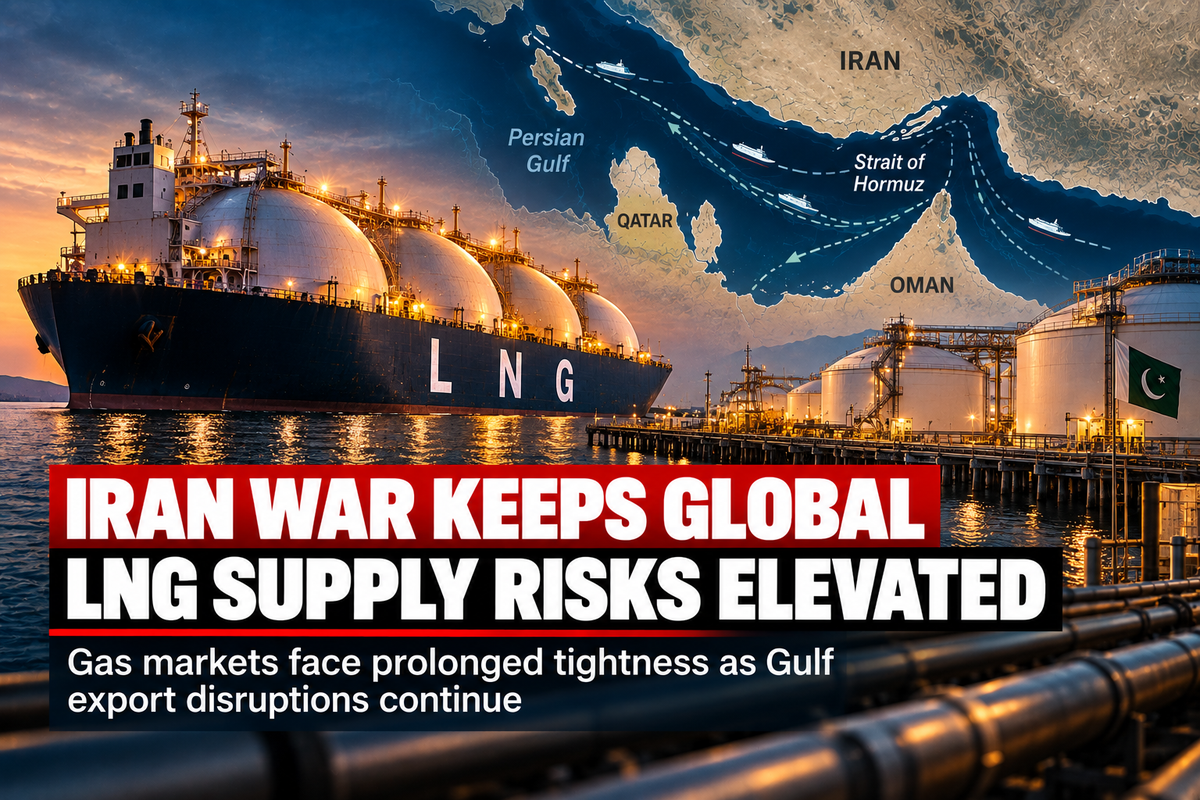
LONDON: Global gas markets are pricing in tight supplies beyond the coming winter as the Iran conflict continues to disrupt Gulf liquefied natural gas exports and uncertainty persists around Qatar and the Strait of Hormuz.
Forward gas prices indicate that traders expect elevated prices and supply risks to persist through next summer before easing, according to Menelaos Ydreos, secretary general of the International Gas Union.
The outlook comes as Europe seeks to rebuild gas inventories while competing with Asian buyers for LNG cargoes.
Qatar is particularly important to the market because it is one of the world’s largest LNG suppliers and normally ships cargoes through Hormuz.
Qatar expansion also faces disruption
QatarEnergy has separately warned that the Hormuz crisis could delay parts of its North Field LNG expansion because equipment needed for later project phases has been unable to reach the country.
The company has said the first train of its North Field East expansion remains expected to begin production in the first half of 2027, while subsequent trains depend more heavily on how the Hormuz situation develops.
Qatar is also dealing with damage to LNG infrastructure at Ras Laffan.
The combination of disrupted exports, damaged capacity and uncertainty over future project schedules has kept global gas markets sensitive to every change in the Gulf security situation.
The International Energy Agency has also described the Middle East crisis as a major supply shock to natural gas markets, with LNG movements through Hormuz still below normal levels.
Pakistan exposed to Gulf LNG disruption
The issue has direct relevance for Pakistan because Qatari LNG is an important part of the country’s gas supply.
A Qatari LNG cargo aboard the Shandong Redwood crossed Hormuz earlier this month en route to Pakistan, illustrating that shipments have not stopped completely despite the disruption.
That distinction is important: the current risk is not a total halt in Gulf LNG trade, but a prolonged period of constrained and uncertain supply.
For Pakistan, extended tightness can affect procurement costs and the reliability of cargo schedules, particularly when global buyers are competing for available LNG.
A sustained reopening of Hormuz would ease one of the largest immediate risks to Gulf gas trade. Until then, energy markets are likely to continue pricing a premium for uncertainty around the route.