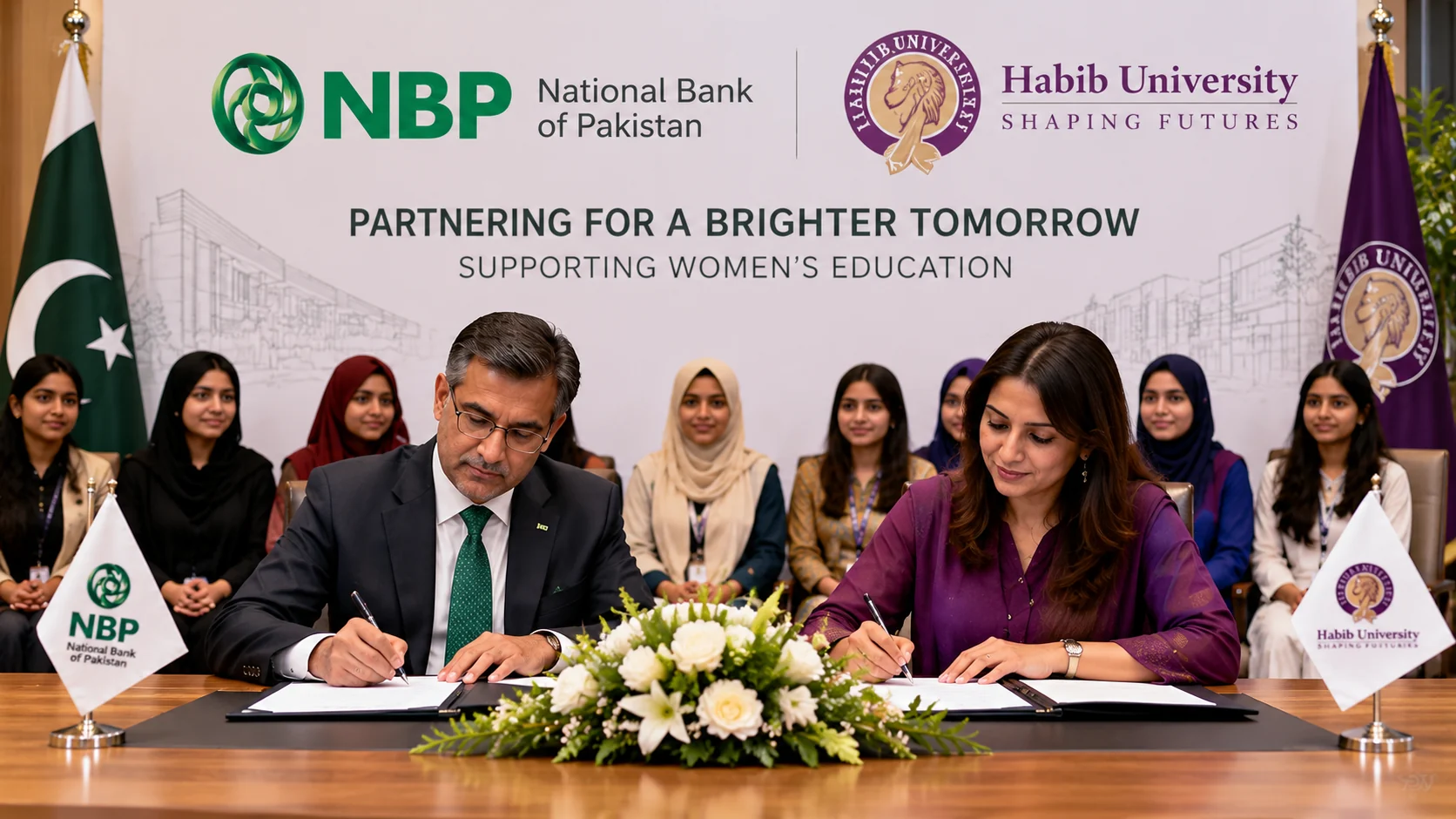
National Bank of Pakistan and Habib University Foundation have entered into a partnership to support the undergraduate education of 13 female students, with particular emphasis on applicants from rural and underserved communities.
The agreement was formalised at Habib University’s campus in Karachi and is intended to help selected students pursue four-year degree programmes.
The initiative brings together a major public-sector bank and a private university foundation in an effort to widen access to higher education for young women.
Four years of academic support
Under the memorandum of understanding, NBP will support the four-year academic journey of 13 female students from different parts of Pakistan.
The programme is designed to prioritise talented students who may face financial or geographical barriers to university education.
For students from underserved areas, admission to a university is only one part of the challenge. Tuition expenses, accommodation, transport and the broader cost of studying away from home can make completing a degree difficult.
Longer-term educational support can therefore be more meaningful than a one-time award.
Expanding opportunities for women
Women’s participation in higher education has implications beyond individual academic achievement.
Graduates can contribute to professional fields, research, entrepreneurship and public service, while stronger educational opportunities can expand career choices for families and communities.
The partnership specifically highlights women from rural and underserved backgrounds, where access to universities and professional networks may be more limited.
NBP Chairman Naved A. Khan described education as a means of creating opportunities and supporting wider social development.
Habib University representatives also welcomed the agreement as a step towards sustained institutional cooperation.
What prospective students need to know
The announcement establishes the scale and broad purpose of the partnership but does not set out a public application process in the material reviewed.
Prospective applicants should therefore rely on official announcements from Habib University and NBP rather than assuming that a new scholarship application window is open.
Further details about eligibility, selection criteria and covered expenses would help families assess the programme.
Although the initial number of beneficiaries is limited, the arrangement provides a model for cooperation between financial institutions and universities.
Sources: National Bank of Pakistan–Habib University Foundation partnership announcement, October 21, 2026; Business Recorder coverage.