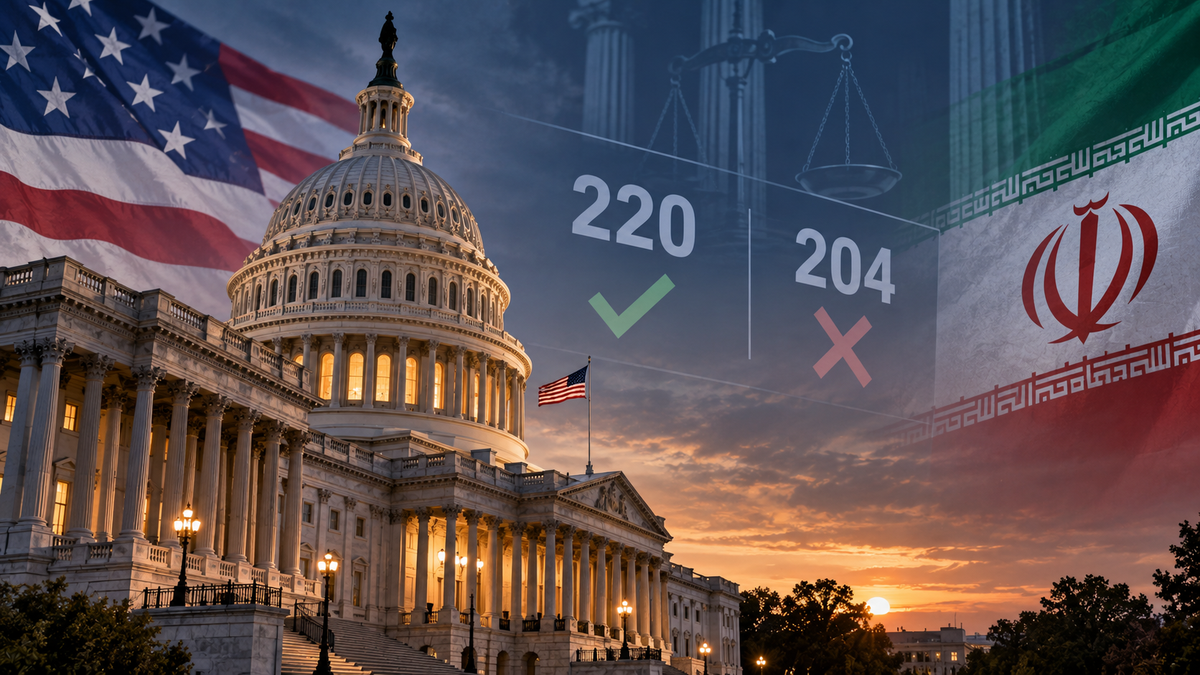
The US House of Representatives has again voted to direct the president to remove American forces from hostilities with Iran, as congressional pressure over the war continues to grow.
The House approved H. Con. Res. 93 by 220 votes to 204 late on September 15. Official House records show 213 Democrats and seven Republicans voted for the resolution, while 203 Republicans and one independent voted against it. Nine members did not vote.
The measure invokes the War Powers Resolution and directs the president to remove US armed forces from hostilities with Iran. It represents another attempt by lawmakers to assert Congress’s constitutional role over the use of military force.
The vote does not, by itself, end US military operations. A concurrent resolution does not become law through presidential signature in the same way as legislation, and the administration’s position on its war powers remains contested. The practical effect therefore depends on the wider constitutional and political confrontation between Congress and the executive branch.
It is not the first House vote on the issue this year. In May, a similar resolution failed on a 212-212 tie. Another measure passed in July by 214-208. The September vote widened the majority, with seven Republicans joining Democrats.
The debate is taking place as the financial and economic costs of the conflict become clearer.
The Congressional Budget Office estimated that US operations against Iran had cost about $38 billion through August 1 and could add roughly $3 billion a month if activity continued at a similar pace. The CBO analysis also warned that the conflict’s effect on energy prices could add about half a percentage point to US inflation during the first three months of 2027.
The war has also increased demand for precision weapons and other munitions. Replacing some depleted stocks could take years, although the Defense Department has disputed suggestions that the conflict has left the United States unable to meet other military requirements.
For lawmakers supporting the resolution, the central question is whether continued hostilities require explicit congressional authorization. Opponents have argued that the president retains authority to conduct the operations and that restricting military action could weaken the US position during an ongoing conflict.
The 220-204 vote does not settle that dispute. It does, however, show that the House has now produced a clear majority for a war-powers resolution on Iran, adding another institutional challenge to the administration as the conflict’s military and economic costs continue to accumulate.