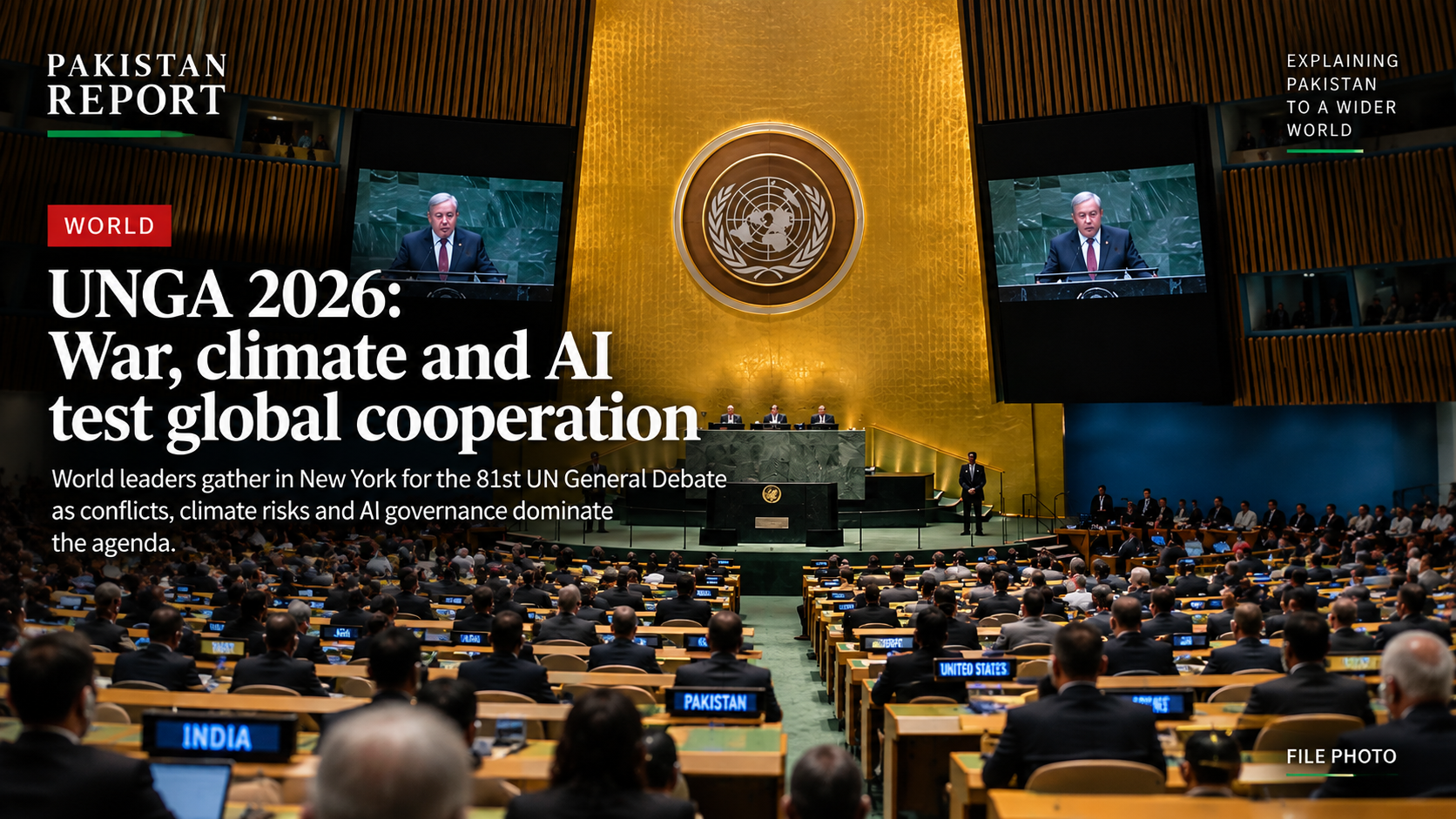
World leaders are gathering in New York for the United Nations General Assembly’s high-level week as armed conflicts, climate pressures and rapid technological change test the international system, with Pakistan preparing to put its own foreign-policy priorities before the global forum.
The General Debate of the 81st session begins on September 22 and will be held from September 22 to 26 before concluding on September 28 at United Nations Headquarters in New York.
This year’s theme — “Restoring Trust, Managing Transformation: A United Nations That Delivers for All” — reflects a central challenge facing the organisation: governments continue to rely on the UN as the principal global diplomatic forum even as geopolitical divisions make collective action increasingly difficult.
War and international security will occupy much of the diplomatic agenda, but the session’s priorities extend beyond conventional geopolitics. Sustainable development, climate pressures, public health, sea-level rise, nuclear weapons and artificial-intelligence governance are among the issues confronting governments during the high-level period and the wider 81st session.
Pakistan arrives with a broad agenda
Pakistan is expected to use the General Assembly and meetings around it to advance its positions on regional and international issues, including Palestine, Kashmir, peace and security, climate change and counterterrorism.
For Islamabad, the General Assembly provides something few other international gatherings can: simultaneous access to governments from almost every region of the world. Bilateral and multilateral meetings around the formal debate can be as important diplomatically as speeches delivered in the Assembly Hall.
The General Assembly includes all 193 UN member states, each with one vote. Its resolutions generally do not carry the binding force associated with decisions of the Security Council, but the Assembly remains an important venue for diplomacy, coalition-building and demonstrating international support for particular positions.
Climate and development remain central
Climate pressures remain part of the wider UN agenda as governments confront increasingly severe floods, heat, drought, storms and sea-level rise.
During high-level week, the General Assembly will hold a September 23 meeting marking the 40th anniversary of the Declaration on the Right to Development. A September 24 high-level meeting will focus specifically on the existential threats posed by sea-level rise, with the UN seeking sustained, coordinated and adequately financed action.
For Pakistan, these discussions have direct relevance. The country has repeatedly faced severe flooding, extreme heat and other climate-related stresses while arguing internationally for stronger adaptation support, resilience financing and recognition of the disproportionate burden borne by climate-vulnerable developing economies.
A September 25 high-level meeting will address pandemic prevention, preparedness and response, another area in which governments are debating how international institutions should prepare for shocks that cross national borders.
AI becomes a diplomatic issue
Artificial intelligence has also moved firmly onto the UN’s policy agenda.
The president of the 81st session has identified digital governance, AI, science and technology as one of six priority pillars. The UN’s stated focus includes both the opportunities created by AI and risks involving inequality, bias, surveillance and misuse, alongside the need to narrow the digital divide.
That makes AI increasingly a foreign-policy and development question rather than simply a technology-sector issue. International decisions could influence governance standards, access to technology and the ability of developing economies to participate in the emerging AI economy.
A test of multilateralism
Khalilur Rahman of Bangladesh is presiding over the General Assembly’s 81st session, which formally opened on September 8.
The General Debate will not resolve wars, climate change or disagreements over artificial intelligence in a single week. It will, however, show which priorities governments are prepared to put on record and where meaningful international cooperation remains possible.
For Pakistan, the week offers an opportunity to state its positions before a global audience while pursuing the bilateral and multilateral diplomacy that takes place around the General Assembly itself.