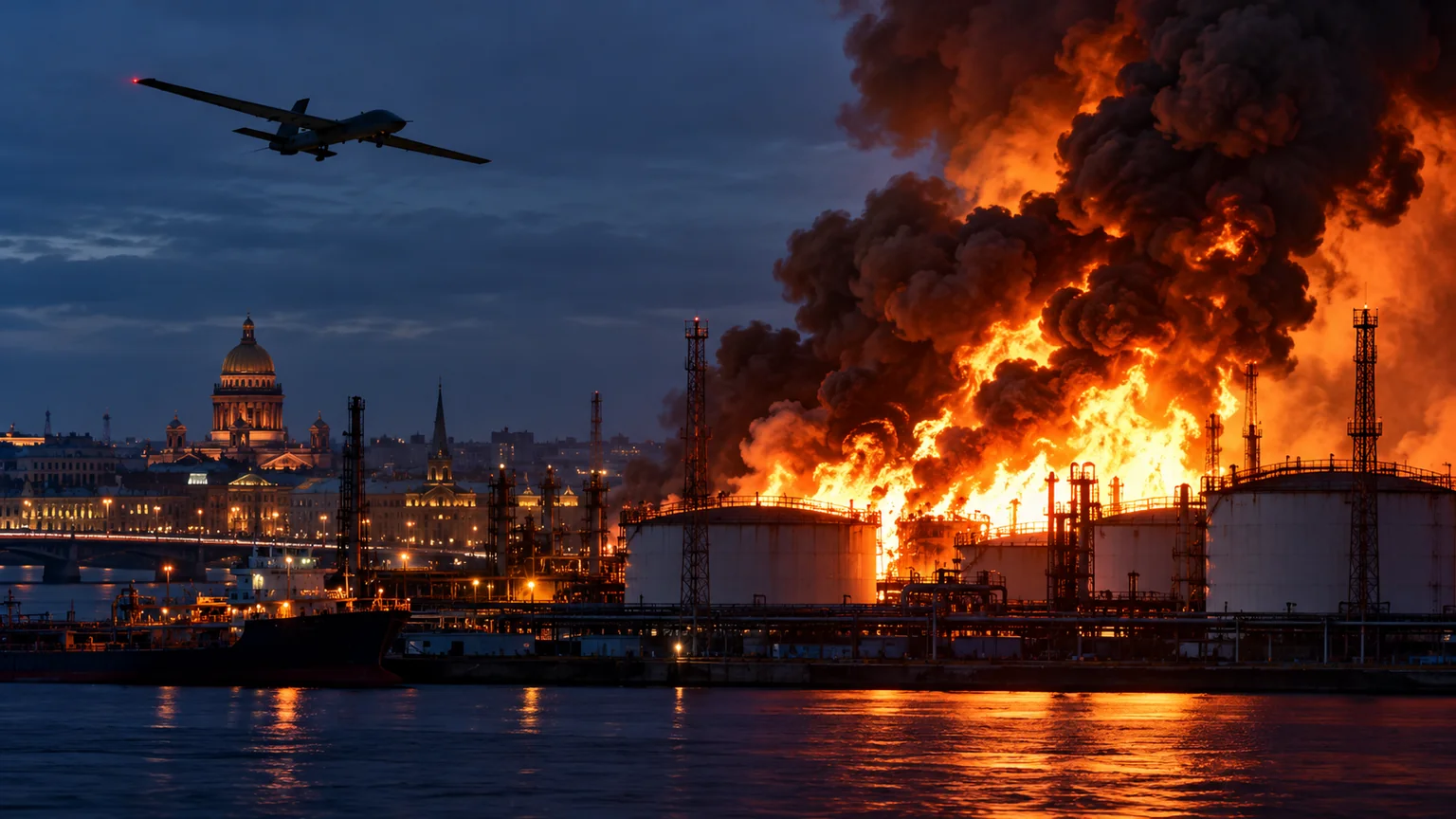
Ukraine launched a massive overnight drone offensive against Russia on Sunday, with Russian authorities reporting more than 1,000 incoming drones as fires broke out at major oil facilities in St Petersburg.
The attack marked one of the largest aerial operations of the war and brought renewed disruption to Russian energy infrastructure, a key source of revenue for Moscow.
Russia’s Defence Ministry said its air defences intercepted 1,015 Ukrainian drones across multiple regions. Fires were reported at the Petersburg Oil Terminal and the Ruchi oil depot, according to the Associated Press.
One person was killed and five others injured in the attacks, while emergency crews worked to contain the fires.
Russian oil infrastructure comes under pressure
The strikes targeted facilities involved in storing and handling petroleum products, extending Ukraine’s campaign against infrastructure supporting Russia’s economy and military operations.
St Petersburg is one of Russia’s most important commercial and industrial centres. Its port infrastructure plays a significant role in the movement of oil products and other exports.
Attacks on oil terminals and storage depots can disrupt fuel distribution, increase operating costs and force Russia to devote additional air-defence resources to protecting industrial sites.
The latest operation also reportedly affected facilities associated with Russian technology companies Ozon and VK.
Ukraine has increasingly used long-range drones to strike targets deep inside Russian territory, seeking to offset Russia’s larger military resources and impose economic costs far from the front line.
Russia continues attacks on Ukrainian energy sites
The escalation came as Russian strikes continued against Ukrainian cities and energy infrastructure.
In Ukraine’s Zaporizhzhia region, a Russian attack killed a woman and injured a child, according to Ukrainian officials cited by the Associated Press.
Energy facilities have become a central battleground as both countries attempt to weaken each other’s ability to sustain the war.
Ukrainian President Volodymyr Zelenskyy has accused Moscow of continuing attacks on Ukraine’s energy network despite recent discussions of an energy ceasefire.
He said Russia had carried out 76 strikes against Ukrainian energy facilities during the preceding week, challenging claims that the two sides were observing a halt to such operations.
Energy ceasefire dispute deepens
The latest attacks follow an energy ceasefire announced by US President Donald Trump on October 11.
The proposed arrangement was intended to reduce strikes against critical energy infrastructure while diplomatic efforts continued.
However, the competing accusations and renewed attacks have raised questions about whether the arrangement can hold.
Zelenskyy has urged Washington and European governments to maintain pressure on Moscow, arguing that easing sanctions could strengthen Russia’s ability to continue the war.
The Ukrainian president has also warned against steps that could provide additional revenue to Russia’s energy sector.
War raises fresh concerns over global energy security
The escalation comes at a sensitive moment for international energy markets, already facing uncertainty from conflict and supply disruptions in the Middle East.
Russia remains a major global energy producer, and attacks on its oil infrastructure have implications beyond the immediate military confrontation.
Disruption to storage terminals, refineries and export facilities can affect fuel supplies, shipping operations and market expectations, particularly when geopolitical tensions are already pushing energy prices higher.
For energy-importing economies, including Pakistan, prolonged instability in international oil markets can increase pressure on import costs and domestic fuel prices.
Diplomacy continues amid intensified fighting
Despite the latest attacks, diplomatic contacts between Ukraine and the United States remain active.
Zelenskyy said on Sunday that he had spoken with US envoys Steve Witkoff and Jared Kushner about recent diplomatic discussions and forthcoming initiatives aimed at ending the war.
The conversation followed meetings in Florida and reflected continuing US efforts to find a negotiated settlement.
But the scale of Sunday’s drone offensive demonstrates how far the conflict remains from a sustained reduction in hostilities.
As Russian and Ukrainian forces continue targeting strategic infrastructure, the war is increasingly being fought not only along the front line but also across the energy and industrial networks that support both economies.
Sources: Associated Press; Reuters.