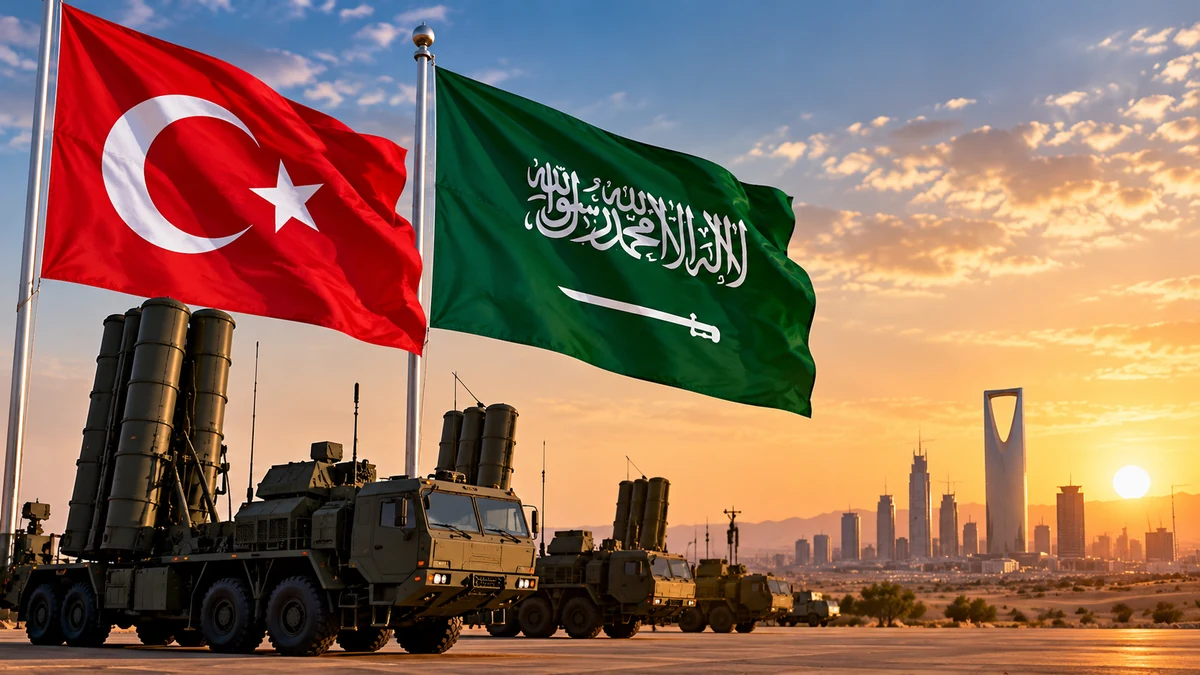
Türkiye is providing Saudi Arabia with mainly defensive and technical military assistance as Riyadh responds to attacks by Yemen’s Houthi movement, according to officials cited by Reuters on Wednesday.
The reported support includes military equipment, intelligence sharing and weapons systems, alongside assistance with strategic planning, logistics and surveillance. Officials described the measures as intended to strengthen Saudi Arabia’s defensive capabilities rather than as a confirmed deployment of Turkish combat troops.
A Turkish official told Reuters, on condition of anonymity, that assistance under the emerging security arrangements had so far been limited to equipment, intelligence and weapons systems, with no other form of deployment taking place under the alliance.
A US official briefed on the matter said the Turkish contribution also included drone operators, intelligence, surveillance and reconnaissance, and assistance with adjusting defensive measures. The precise number of personnel, equipment models and operational locations was not publicly established in the reporting.
The developments follow the Mecca Joint Defence Agreement signed by Türkiye, Saudi Arabia and Pakistan in August. Under the arrangement, the three countries committed to regard an armed attack on one member as an attack on all, according to Reuters.
The countries subsequently held political and military discussions in response to Houthi attacks. On Monday, they said they had agreed to begin implementing their collective-defence commitments and prepare for rapid deployment of military forces and capabilities to Saudi Arabia.
That announcement should not be confused with confirmation that every type of deployment had already occurred. Reuters reported that Türkiye’s parliament had not yet ratified the agreement, and officials said Turkish assistance was being provided largely through bilateral channels in the meantime.
Turkish Foreign Minister Hakan Fidan said the countries had discussed Saudi Arabia’s defensive needs during an extraordinary meeting in Riyadh. He said defence and military officials had contributed to discussions on operational and technical questions.
Officials have referred to air-defence capabilities among the areas of support, but the information publicly available does not identify a specific Turkish missile battery as deployed to Riyadh. Nor does it substantiate claims that Turkish fighter aircraft are operating over the Saudi capital as part of this assistance.
Pakistan’s role in the agreement is significant because it places Islamabad within the same emerging collective-defence framework. Reuters also cited Pakistani and regional officials as saying that Ankara and Islamabad had supplied equipment used by Saudi Arabia in Yemen. The report did not provide a complete public inventory of those transfers.
The military cooperation is unfolding alongside renewed fighting in Yemen. Reuters reported that Yemeni government forces, supported by Saudi-led coalition air operations, had begun a counter-offensive aimed at recovering strategic territory near the Bab el-Mandeb Strait.
The strait connects the Red Sea with the Gulf of Aden and is a major route for international trade and energy shipments. The conflict’s proximity to the waterway gives developments in Yemen implications beyond the immediate battlefield, particularly for shipping security.
The Houthis, an Iran-aligned movement, have carried out missile and drone attacks on Saudi targets and threatened maritime traffic. Saudi Arabia’s response and the involvement of regional partners have added a wider security dimension to the confrontation.
The extent of Türkiye’s future participation will depend in part on political and legal steps, including parliamentary ratification of the trilateral agreement. For now, the reported contribution is principally technical, intelligence-related and defensive, with no verified basis for portraying it as a large Turkish combat deployment.