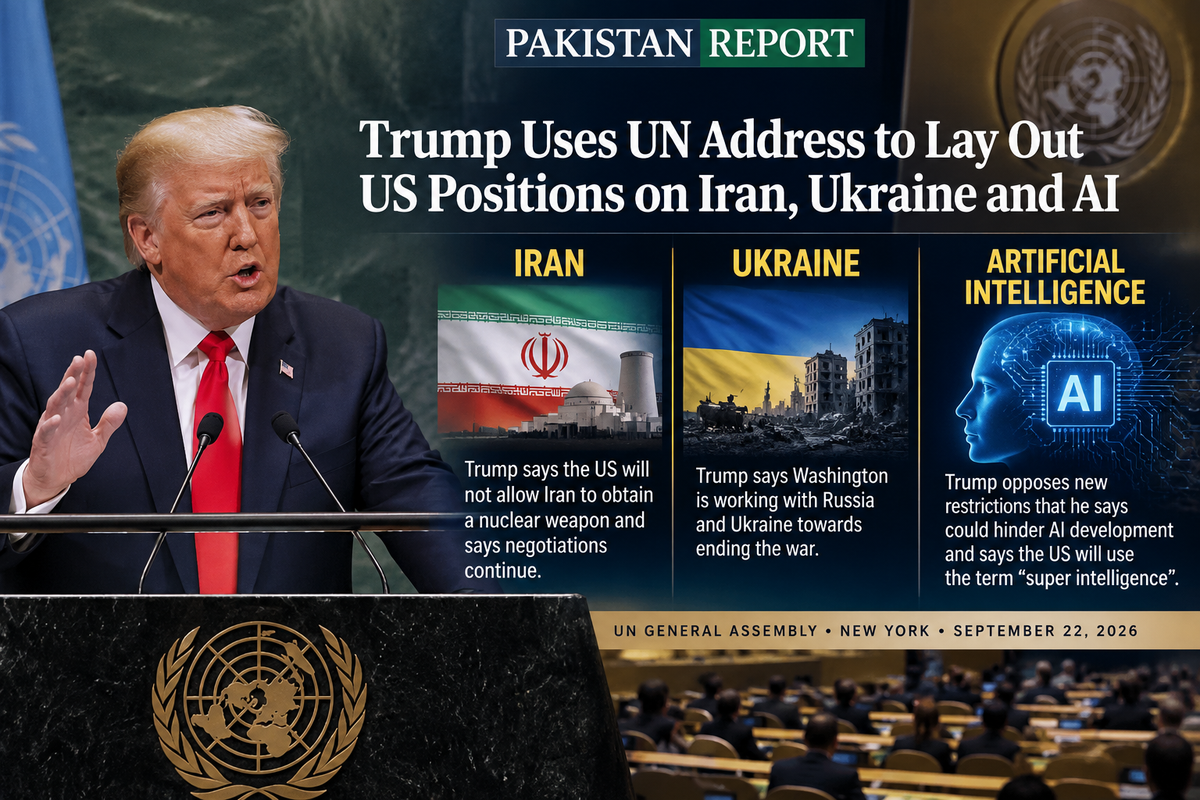
NEW YORK: US President Donald Trump used his address to the United Nations General Assembly to set out Washington’s positions on Iran, the war in Ukraine and artificial intelligence, combining calls for diplomacy with warnings over nuclear proliferation and criticism of international institutions.
Addressing the 81st session of the General Assembly on Tuesday, Trump reiterated that the United States would not allow Iran to acquire a nuclear weapon and defended his administration’s approach towards Tehran.
His remarks came as Washington and Tehran remained in contact over their strained relationship. Trump said separately on the sidelines of the UN gathering that talks with Iran were continuing and expressed confidence that a settlement could eventually be reached.
The Iranian nuclear issue featured prominently in the speech, with Trump portraying it as a central security concern for his administration. The White House’s account of the address quoted him as saying he had remained committed to preventing Iran from obtaining a nuclear weapon.
Ukraine diplomacy remains on agenda
Trump also addressed Russia’s war in Ukraine, saying his administration was working towards ending the conflict.
His comments came as diplomacy surrounding the war remained a major focus of meetings in New York. Trump presented his administration’s efforts as part of a broader push to resolve international conflicts, although no new settlement or agreement on Ukraine was announced in the speech.
The conflict has remained one of the most difficult foreign-policy issues facing Washington, with negotiations complicated by differences over territory, security arrangements and the terms of any eventual settlement.
Trump rejects global restrictions on AI
Artificial intelligence formed another significant part of Trump’s address.
The US president rejected what he described as attempts to establish a global system of control over AI and said his administration would use the term “super intelligence” for the technology.
Trump argued against restrictions that he said could impede technological development, while presenting US leadership in AI as an economic and strategic priority.
The comments highlighted an emerging debate over how governments should respond to increasingly capable AI systems.
Trump’s speech extended beyond the three issues. He criticised the International Criminal Court and aspects of the UN system, discussed US policy towards Latin America and transnational drug cartels, and defended his administration’s wider foreign-policy record.
The address came at the opening of the annual UN General Assembly debate in New York, where conflicts in the Middle East and Ukraine, institutional reform and emerging technologies are among the issues confronting world leaders this year.