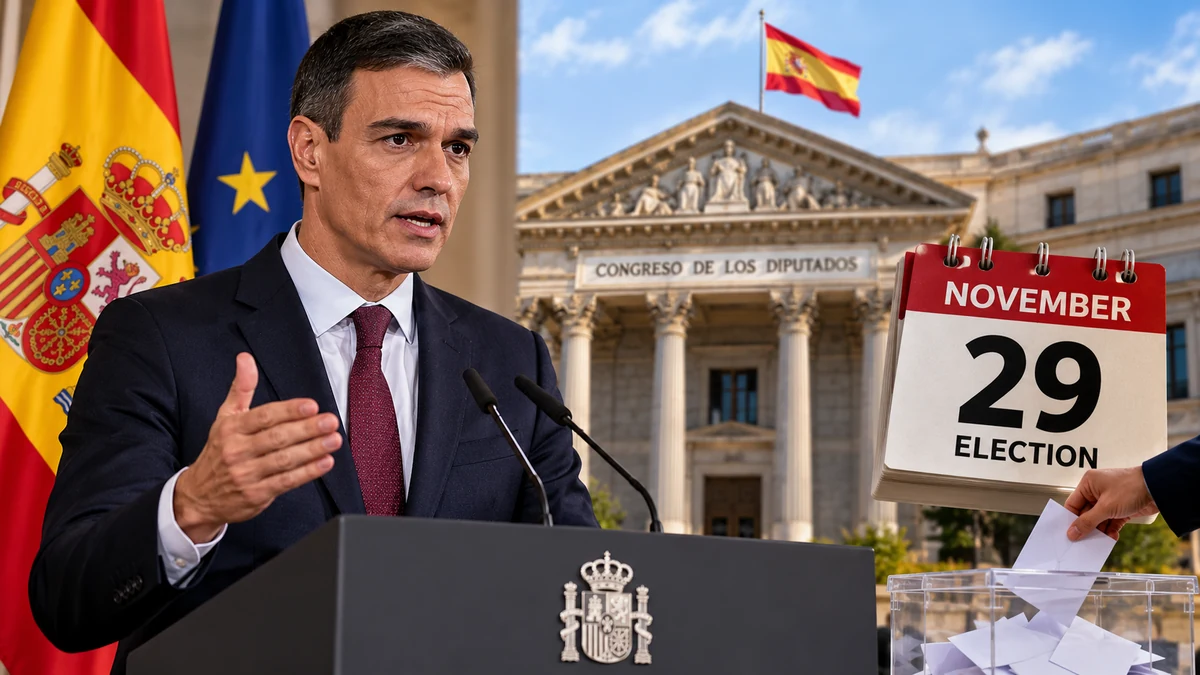
Spanish Prime Minister Pedro Sánchez has called a snap general election for November 29, sending Spain into an early national vote as his government struggles to secure sufficient parliamentary support for its domestic agenda.
Sánchez announced the decision after informing King Felipe VI and calling an extraordinary meeting of the Council of Ministers to begin the process of dissolving parliament.
The election will take place on Sunday, November 29.
In his announcement, Sánchez said Spain needed a broader parliamentary majority to carry out pending reforms and continue the government’s programme.
The decision follows a parliamentary defeat for government proposals intended to address Spain’s housing crisis.
Housing affordability has become one of the country’s most important political issues, with protests drawing attention to high rents and difficulties faced by younger households in accessing housing.
Reuters reports that Sánchez is attempting to turn that public frustration into electoral momentum despite his Socialist Party trailing in most opinion polls.
The election represents a significant political gamble.
Sánchez has governed through complex parliamentary alliances, but maintaining enough support to pass legislation has become increasingly difficult.
His Spanish Socialist Workers’ Party, or PSOE, will face the conservative People’s Party led by Alberto Núñez Feijóo, while Vox is also positioned to play an important role in determining whether the right can secure a governing majority.
Recent polling cited by Reuters has generally placed the PSOE behind the People’s Party. However, polling before an election does not determine its outcome, and the eventual composition of parliament will depend on the November vote.
Spain elects 350 members to the lower house of parliament, meaning 176 seats are required for an absolute majority.
The November election will therefore determine not only which party finishes first but also which political bloc can assemble sufficient parliamentary support to form a government.
The result will be closely watched elsewhere in Europe as political parties across the continent confront pressure over housing, living costs, economic policy, immigration and defence.
For Sánchez, calling the election early means asking voters to resolve the parliamentary uncertainty rather than continuing under the existing balance of power.
Spain’s government has now formally set that decision for November 29.
Pakistan Report illustration.