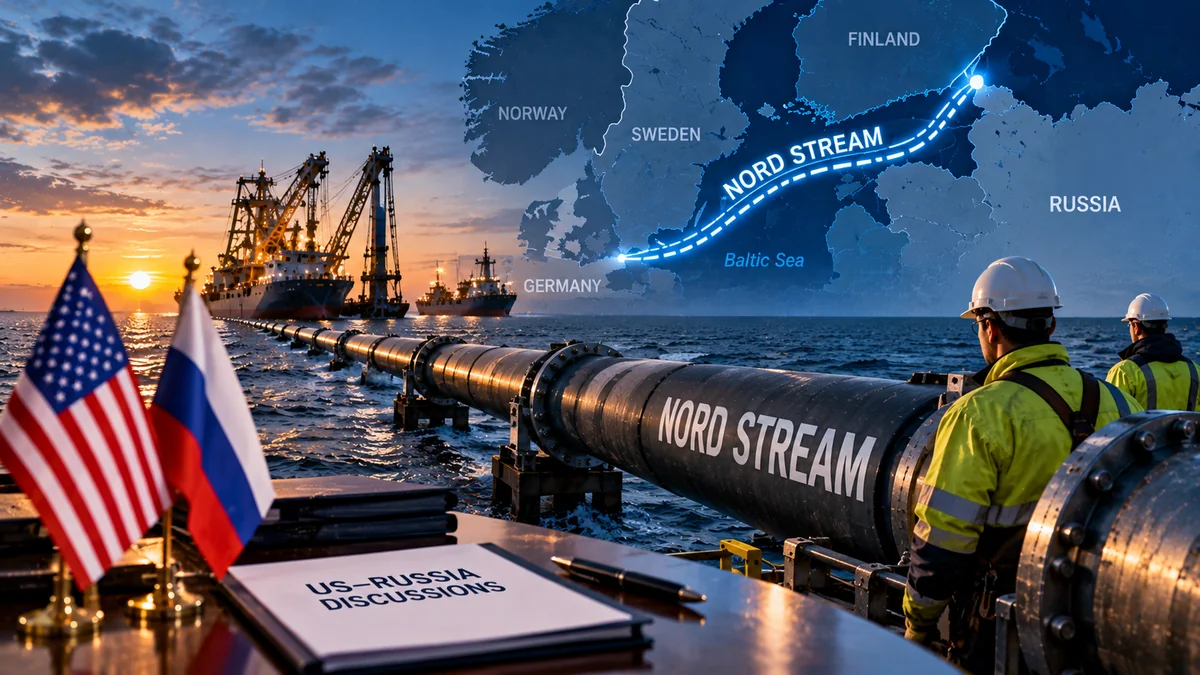
Senior figures from the United States and Russia have discussed the possibility of involving an American investor in the Nord Stream gas pipelines, according to Reuters, raising questions about potential future energy arrangements even as the war in Ukraine continues.
Reuters reported on Thursday, citing five people with knowledge of the situation, that discussions involved US Special Envoy Jared Kushner and Kirill Dmitriev, an adviser to Russian President Vladimir Putin. The account describes exploratory talks, not a completed investment agreement or a decision to resume gas deliveries to Europe.
The pipelines once formed a major route for Russian natural gas to Germany. Their operation was disrupted amid the deterioration in relations following Russia’s invasion of Ukraine in 2022, and explosions damaged pipeline infrastructure later that year.
Any attempt to restore flows faces immediate legal and political obstacles. The pipelines are subject to sanctions imposed by the United States and European Union, while the German government opposes reopening the route.
A White House official told Reuters that any arrangement would need to be negotiated through relevant US agencies and benefit American taxpayers and businesses. The same official said there had been no recent Nord Stream discussions, illustrating that the extent and timing of contacts are contested.
Reuters also quoted a US official as saying the obstacles made a deal unlikely in the medium term. Germany’s economy and energy ministry said the country had developed alternatives to Russian gas and did not want the pipelines reopened.
Ownership presents another complication. Russian state-controlled Gazprom holds a controlling interest in the company associated with the pipelines, while European entities also hold stakes. Any transaction involving those interests would require a clear legal structure and compliance with sanctions.
The reported discussions are part of a wider debate about whether economic arrangements could play a role in diplomatic efforts concerning the war. That argument remains disputed across Europe, where governments differ over how future relations with Russia should be handled.
For European energy buyers, a possible revival of Russian pipeline gas would carry implications for supply planning, investment and dependence on particular sources. Those potential effects remain hypothetical unless sanctions, ownership issues and political opposition are resolved.
The latest report therefore establishes that discussions have been described by informed sources, while also documenting official qualifications and opposition. It does not establish that Nord Stream will reopen, that a US investor has purchased a stake or that European governments have agreed to resume imports.