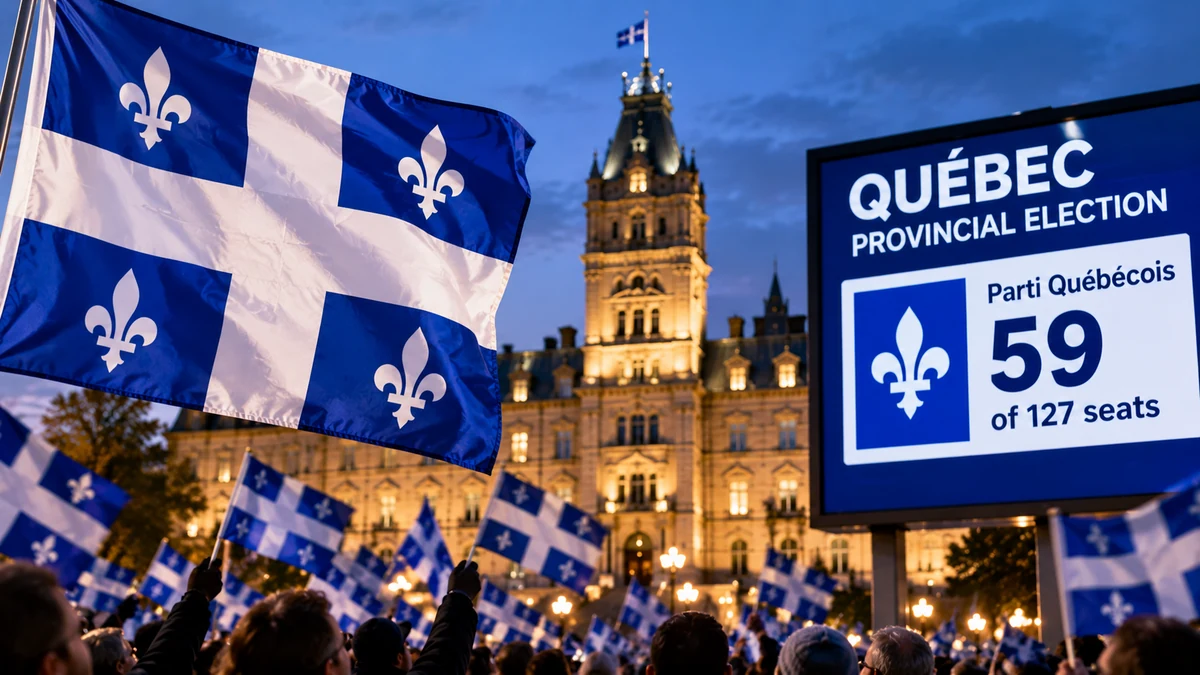
The sovereigntist Parti Québécois has won Quebec’s provincial election but fallen five seats short of a majority, leaving the party dependent on opposition support for major legislation and any future independence referendum.
Provisional results reported by Reuters showed the Parti Québécois, led by Paul St-Pierre Plamondon, winning 59 of the 127 seats in Quebec’s National Assembly. A majority requires 64 seats.
The result returns the Parti Québécois to government after more than a decade, but as a minority administration. The party increased its representation sharply from seven seats.
Plamondon has pledged to hold another referendum on Quebec independence, although he has said he would wait until U.S. President Donald Trump is no longer in office. Because the Parti Québécois does not control a majority of the legislature, Reuters reported that opposition support would be required to proceed with a referendum vote.
The result therefore gives the sovereigntist party control of the provincial government without giving it an automatic legislative path to an independence vote.
Quebec held previous referendums on sovereignty in 1980 and 1995, and both were defeated. The 1995 vote was particularly close. Current public support for independence remains well below a majority, according to polling cited by Reuters.
The election also has implications for Canadian Prime Minister Mark Carney, whose government has emphasized national unity while dealing with trade pressure from the United States. Carney congratulated Plamondon and said he looked forward to working with the incoming Quebec government on economic issues affecting the province.
The Parti Québécois won 27.9% of the vote, according to Reuters, benefiting from a fragmented contest among several major parties. That result underlines the difference between winning the largest number of seats and securing either a majority of seats or majority public support for the party’s sovereignty objective.
The election result does not mean Quebec has voted to leave Canada. It gives the Parti Québécois a mandate to form a provincial government, while any referendum would require additional political and legislative steps.
The immediate consequence is a minority government in Quebec. The longer-term constitutional question will depend on whether the Parti Québécois can secure sufficient legislative support for its referendum plans and how the political environment develops during its term.
Pakistan Report illustration.