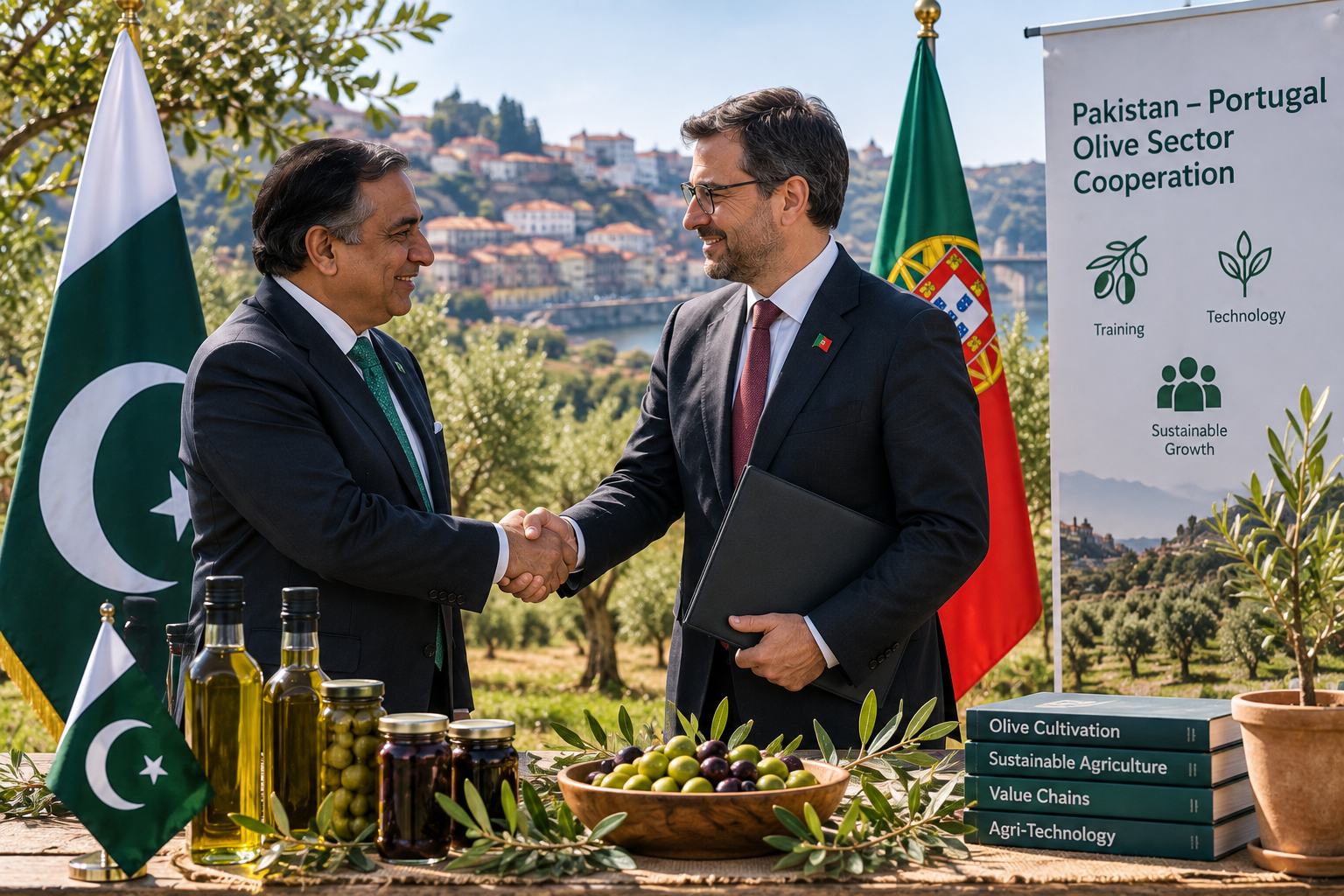
Pakistan and Portugal have discussed closer technical cooperation in olive cultivation and oil processing, including specialist training and exchanges between agricultural experts, according to a September 10 official announcement.
The Islamabad meeting brought together Pakistan’s food-security ministry and Portugal’s ambassador. Pakistan proposed a joint working group to identify priorities for research, training and business cooperation.
The working group is a proposal, while a possible memorandum of understanding remains under discussion. The announcement does not record a signed investment contract or a confirmed training schedule.
From orchards to processing
The areas raised included planting material, orchard management, irrigation, harvesting and oil extraction. Pakistan expressed interest in sending technical specialists to Portugal and receiving Portuguese experts to assess local conditions.
Processing, packaging and quality assurance also featured in the talks. That gives the proposed cooperation a wider focus than increasing the number of olive trees: it includes the steps needed to turn harvested fruit into a marketable product.
Further discussion is expected around a prospective visit by Portugal’s agriculture minister, although the release gives no date.
Why technical exchanges matter
The International Olive Council’s technical programme links cultivation with processing efficiency, resource use and the preservation of olive varieties. Its work includes training and expert missions tailored to local priorities.
The council identifies water and energy use, mill operations and the management of production by-products as connected parts of the sector. It also supports the conservation of genetic resources and research on varieties, alongside practical improvements from the orchard to the mill.
This provides useful context for the proposed exchanges. Matching techniques to growing conditions and processing requirements is a technical task; access to machinery alone does not establish what a farm or mill can produce economically.
The council’s programme is background on how technical cooperation works. It is not confirmation that the IOC is participating in the Pakistan–Portugal proposal.
Quality is a separate part of market development
The IOC’s standards and methods collection covers chemical testing, sensory assessment and quality-management guidance for mills and packing plants.
These resources distinguish growing and processing capacity from the work needed to assess the resulting oil. They also show that quality management extends across different stages of production, rather than resting on the label attached to a finished bottle.
For Pakistani producers considering new markets, the relevant questions therefore include both production costs and the capacity to document product quality. The talks establish no new export permission or certification for Pakistani olive oil.
What happens next
The next concrete steps would be agreement on the proposed working group, named technical partners and a programme of visits or training. Any formal memorandum would clarify the scope of cooperation and the responsibilities of each side.
For now, the development is an opening for practical agricultural collaboration. Its value to growers and processors will depend on which activities are agreed and delivered.
Sources
- Ministry of National Food Security and Research via PID — Pakistan–Portugal olive-sector talks, PR No. 122, September 10, 2026: proposed exchanges, working group and prospective agreement.
- International Olive Council — Olive Growing, Olive Oil Technology and Environment Unit, technical cooperation, resource management and genetic resources; consulted September 11, 2026.
- International Olive Council — Standards, Methods and Guides, testing and quality-management resources; consulted September 11, 2026.