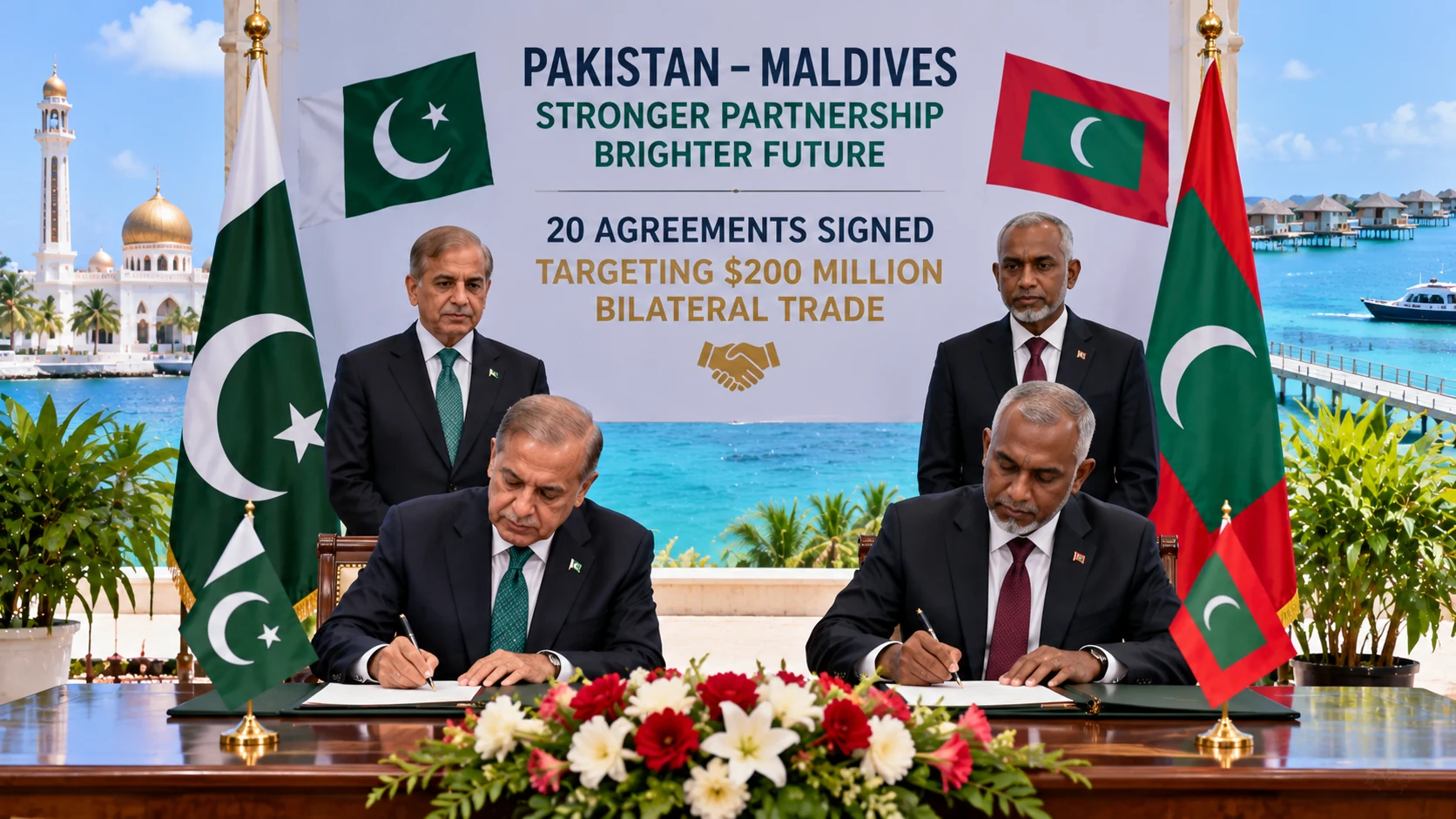
Pakistan and the Maldives have set an ambitious target to raise bilateral trade to $200 million within two years, following high-level talks in Islamabad that produced 20 agreements and memorandums of understanding across economic, social and security sectors.
Prime Minister Shehbaz Sharif and Maldivian President Mohamed Muizzu met on October 21 during the Maldivian leader’s state visit. Their discussions covered investment, tourism, food security, pharmaceuticals, maritime links and wider private-sector cooperation, according to an official statement from Pakistan’s Press Information Department.
The government statement placed current bilateral trade at about $13.4 million, making the new target a substantial increase rather than a modest adjustment. A separate state news agency account cited approximately $13.9 million; both figures underline how small the existing trade relationship remains.
From agreements to commercial links
The two sides exchanged 20 documents covering fields including healthcare, education, technical training, tourism, civil aviation, agriculture, fisheries, defence, maritime security, law enforcement and cultural cooperation. The breadth of the package reflects an attempt to deepen relations beyond ceremonial diplomacy.
Businesses need workable transport routes, competitive prices, clear import requirements and reliable payment arrangements.
The leaders also discussed improving air and maritime connectivity and convening the Joint Economic Commission at an early date. Better transport links would be particularly relevant for time-sensitive goods and tourism-related services.
Where Pakistan sees opportunity
The prime minister indicated that Pakistan was prepared to supply essential food commodities and pharmaceuticals to the Maldives, including through government-to-government arrangements. Such products could provide an initial route for expanding trade, subject to commercial terms, quality standards and logistics.
Tourism and training offer other possibilities. The Maldives has a globally recognised tourism industry, while Pakistan is seeking to build international partnerships in education, technical services and professional development. Cooperation in these areas may not appear fully in merchandise-trade statistics but could still strengthen the economic relationship.
Pakistan also announced 20 additional undergraduate scholarships annually for Maldivian students. In environmental cooperation, Islamabad pledged 100,000 olive cuttings and 100,000 seeds of other plants over the next year, with a longer-term objective of supporting the cultivation of one million plants through technical assistance.
Strategic and regional dimensions
As Indian Ocean states, Pakistan and the Maldives have a shared interest in maritime connectivity and regional security. Their agreements on maritime security, fisheries and defence place economic cooperation alongside practical concerns about the sea routes on which island economies depend.
The leaders also discussed international developments and reiterated support for dialogue and respect for sovereignty, according to the Pakistani statement.
Progress towards $200 million in trade will require sustained growth from a low base, not simply the signing of additional documents.
For Pakistan, the visit offers a chance to build a more substantial relationship with a smaller but strategically situated Indian Ocean partner.
Sources: Pakistan Press Information Department, official statement (21 October 2026): https://pid.gov.pk/site/press_detail/34445 ; Associated Press of Pakistan (21 October 2026): https://www.app.com.pk/national/pakistan-maldives-agree-to-raise-bilateral-trade-to-200-million-in-two-years/