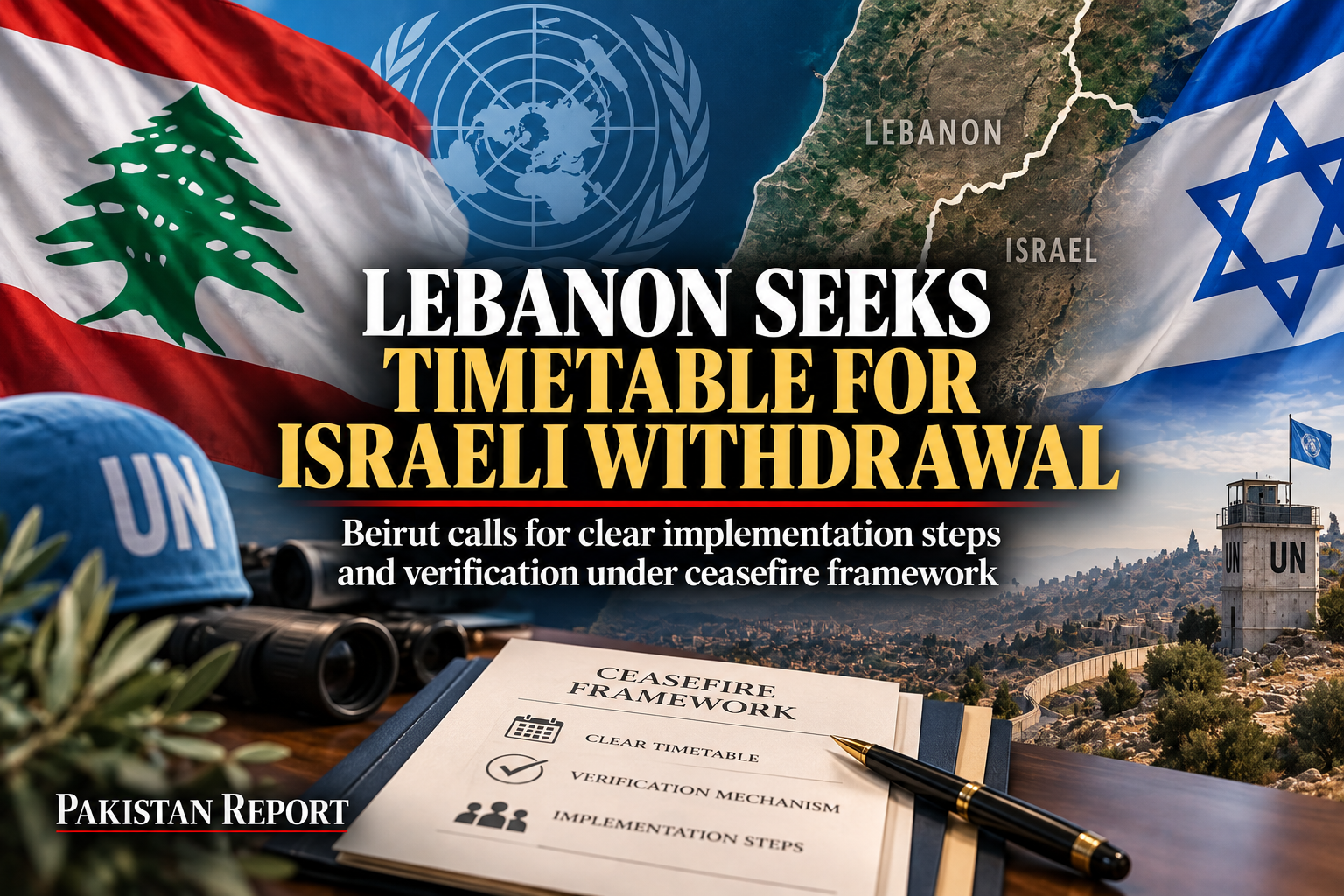
Lebanese Prime Minister Nawaf Salam has called for a clear timetable and verification mechanism to implement the framework governing Lebanon’s ceasefire arrangements with Israel, placing the completion of Israel’s withdrawal from Lebanese territory at the centre of Beirut’s demands.
Addressing the United Nations General Assembly in New York, Salam said the success of the framework should be judged by implementation rather than declarations of intent. He called for its provisions to be translated into practical steps under a defined timetable and subject to a mechanism capable of verifying compliance.
The demand adds an implementation-focused dimension to Lebanon’s longstanding call for a full Israeli withdrawal. Salam also called for the release of Lebanese detainees, the return of displaced residents to their towns and villages and reconstruction in areas damaged during the conflict.
Beirut puts implementation at the centre
Salam’s remarks framed the issue as one of sovereignty as well as ceasefire enforcement. Lebanon’s position is that Israeli forces should withdraw from Lebanese territory up to the country’s internationally recognised border, while the Lebanese state assumes authority over security and weapons on its side of the frontier.
He also reiterated the government’s position that weapons should ultimately be held exclusively by the state and that decisions over war and peace should rest with Lebanon’s constitutional institutions. That commitment is relevant to the parallel question of armed groups operating outside direct state control, including Hezbollah.
The two tracks remain closely connected. Lebanese officials have argued that progress on withdrawal and security arrangements is necessary for a durable settlement, while implementation of state authority and disarmament commitments remains a central part of the wider framework.
Salam did not present the timetable as an already agreed schedule. His speech was a Lebanese demand for clearer sequencing, implementation and verification, rather than an announcement that Israel had accepted a new withdrawal calendar.
UN role remains important
Verification has become increasingly significant as Lebanon and Israel dispute compliance and responsibility for delays. The United Nations has long played a monitoring and liaison role in southern Lebanon, and Lebanese officials have stressed the need to avoid a monitoring vacuum as arrangements in the area evolve.
The UN has also documented the Lebanese government’s phased efforts to extend state authority and address weapons held by non-state groups, while recording Lebanon’s objections to the continued Israeli presence and Israeli military activity.
The framework therefore involves more than a single withdrawal demand. It links Israeli withdrawal, Lebanese state authority, security arrangements in the south and mechanisms for monitoring implementation.
Salam’s General Assembly intervention did not resolve those disputes. It did, however, sharpen Beirut’s position: Lebanon wants the existing framework converted into measurable steps, with a timetable and a mechanism capable of determining whether those steps have actually been carried out.