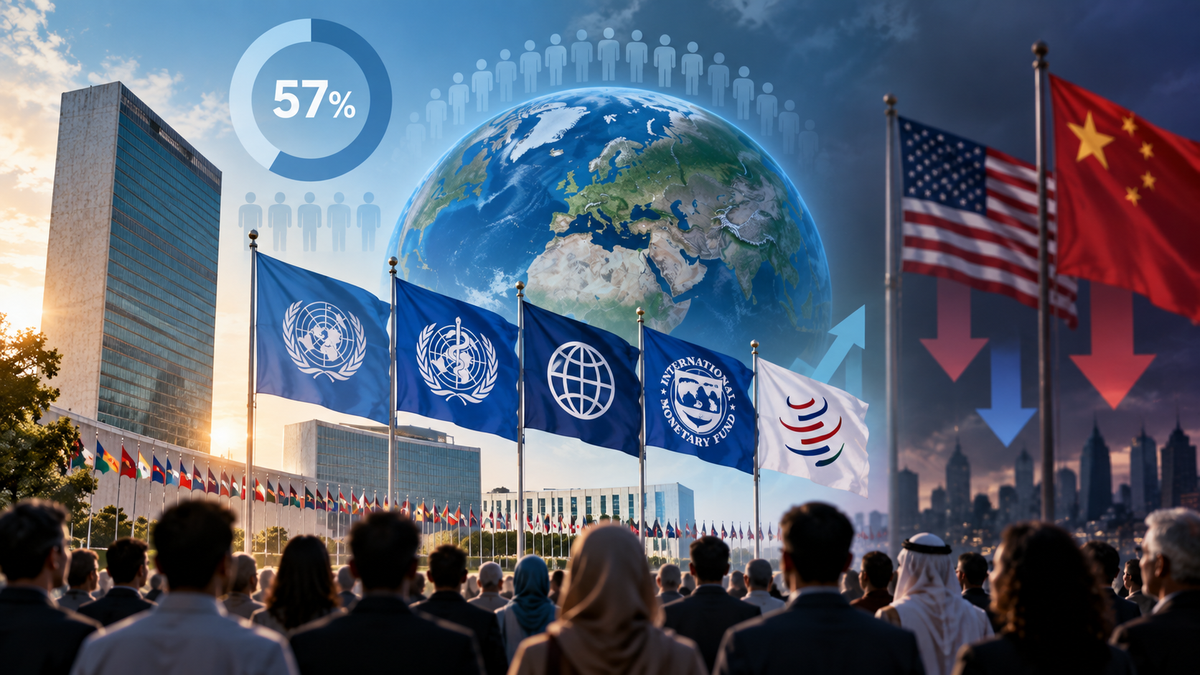
Public confidence in major international institutions has risen even as people across much of the world have become more pessimistic about economic conditions and less comfortable with the idea of the United States or China exercising global leadership, according to a new survey spanning 34 countries.
The poll, commissioned by the Rockefeller Foundation and involving more than 35,000 respondents, found that 57% favour countries cooperating to address international problems such as security, even when doing so requires compromises with national interests.
The findings point to an apparent distinction in public attitudes: dissatisfaction with the direction of the world has increased, but that has not translated into a broader rejection of international cooperation.
Around 70% of respondents said the world had become worse over the previous year. Economic confidence was also subdued, with only 38% optimistic about their country’s economy over the next five years.
Against that backdrop, however, confidence increased in several of the institutions created to manage international economic, health and political cooperation.
The survey recorded higher levels of trust in organisations including the United Nations, World Health Organization, World Bank, International Monetary Fund and World Trade Organization compared with the previous year’s results.
Attitudes towards individual countries playing a leading international role were markedly different.
Sixty per cent of respondents said they would be comfortable with Canada exercising global leadership, followed by Japan at 58% and Australia at 55%. The corresponding figures were 39% for the United States and 37% for China, while 26% expressed comfort with Russian leadership.
Those numbers do not mean respondents necessarily want Canada, Japan or Australia to replace the world’s largest powers. Rather, they provide a measure of how comfortable people in the countries surveyed are with different states assuming greater international leadership.
The results arrive at a time when the international system is under pressure from wars, economic uncertainty, trade disputes and intensifying competition among major powers.
That environment makes the survey’s findings on multilateral institutions particularly notable. Organisations such as the UN, IMF and World Bank are frequently criticised by governments and political movements from very different perspectives, including over their effectiveness, representation and influence.
Yet the poll suggests that concern about the state of the world can coexist with support for institutions designed to manage problems collectively.
The findings also reveal important limits to any simple conclusion about a shift in global opinion. The survey covers 34 countries rather than every country, and attitudes differ considerably between national populations. Polling also measures public sentiment at a particular moment rather than predicting how governments themselves will behave.
What the results do show is a broad appetite among those surveyed for countries to continue working together despite widespread pessimism about the global outlook.
That is particularly relevant as governments confront problems — from economic instability and energy security to climate change and technological competition — that are difficult for individual countries to manage entirely on their own.
The survey therefore presents a more complicated picture than one of straightforward retreat from international cooperation: people appear increasingly uneasy about the direction of the world and about leadership by its biggest powers, while at the same time showing greater confidence in several of the institutions built to coordinate international action.