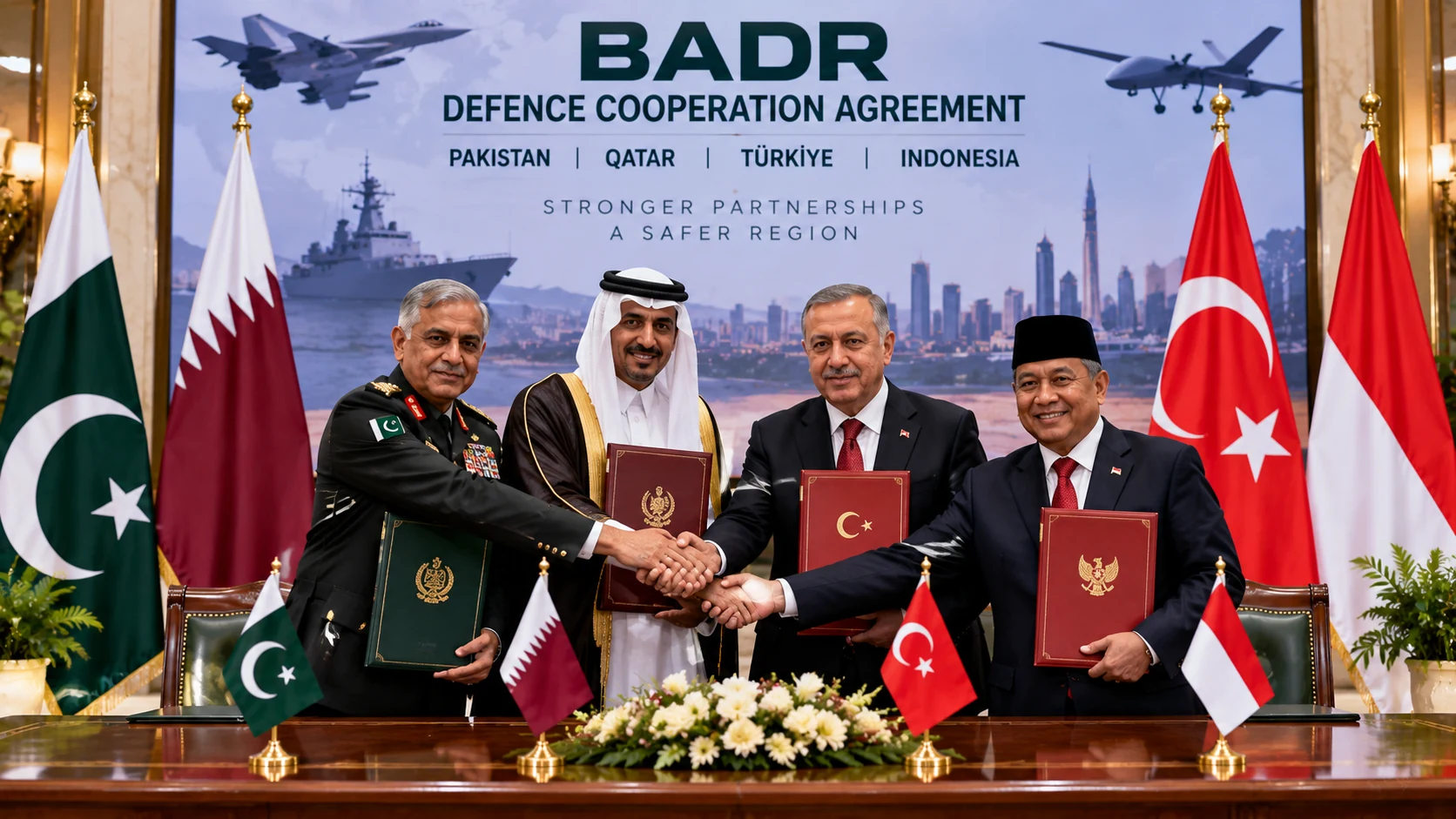
Pakistan has joined Turkiye, Qatar and Indonesia in a four-country defence cooperation initiative aimed at expanding military production, technical training and research, adding a new multilateral dimension to Islamabad’s security and industrial relationships.
The Badr memorandum of understanding was signed in Doha on Wednesday, October 21, according to the Turkish Ministry of National Defence. Pakistan was represented by Defence Minister Khawaja Muhammad Asif, while ministers or senior defence officials represented the three partner countries.
The agreement’s stated priorities are wider than military exercises alone. They include strengthening defence capabilities, developing industrial cooperation, advancing research and development, and sharing expertise in technical training. For Pakistan, the potential significance lies in linking established bilateral defence relationships through a common framework.
Defence industry at the centre
The Turkish ministry described Badr as a platform for combining the participants’ defence-production capabilities and developing solutions suited to modern military systems. That ambition matters because military cooperation increasingly depends on manufacturing capacity, maintenance networks, technology transfer and reliable component supplies, rather than equipment purchases alone.
Pakistan has its own defence-manufacturing base and longstanding military links with several of the signatories. Turkiye has an increasingly prominent defence technology industry, while Qatar and Indonesia bring distinct procurement requirements, investment possibilities and regional relationships. A joint framework could create opportunities for companies and research institutions to work across those markets.
Those opportunities, however, are not the same as confirmed contracts. The public announcement did not provide project budgets, production allocations, procurement commitments or a timetable for specific systems. Such details will determine how quickly the memorandum translates into measurable industrial activity.
What the four-country format changes
The choice of a quadrilateral arrangement is noteworthy. Instead of relying solely on separate agreements between capitals, the participants have established a shared channel that can potentially coordinate training, research and industrial planning. It also connects countries located across South Asia, Southeast Asia, the Gulf and Europe.
For Pakistan, cooperation could support specialist training and create openings for domestic manufacturers seeking international partnerships. Joint research could be particularly relevant where costs and technical risks are too high for one partner to carry alone. But intellectual-property rules, export approvals, financing and production responsibilities would all require practical arrangements beyond the initial memorandum.
The signatories have presented Badr as a cooperative initiative to strengthen their respective capabilities and contribute to stability. There has been no public indication in the announcement that it establishes a collective-defence obligation or automatically commits any member to another country’s military operations.
The next test
The agreement gives Pakistan another diplomatic and industrial avenue in a changing regional security environment. Its success will be judged less by the signing ceremony than by the emergence of joint projects, regular training programmes and concrete commercial outcomes.
For Islamabad, the immediate task is to turn broad commitments into arrangements that benefit its armed forces, engineers and defence manufacturers while retaining clarity about costs, responsibilities and strategic objectives.
Sources: Turkish Defence Ministry statement reported by Anadolu Agency (21 October 2026): https://aa.com.tr/en/world/turkiye-qatar-indonesia-and-pakistan-sign-defense-cooperation-pact/4095836 ; Reuters (21 October 2026): https://www.reuters.com/world/asia-pacific/turkey-qatar-pakistan-indonesia-sign-defence-cooperation-accord-ankara-says-2026-10-21/