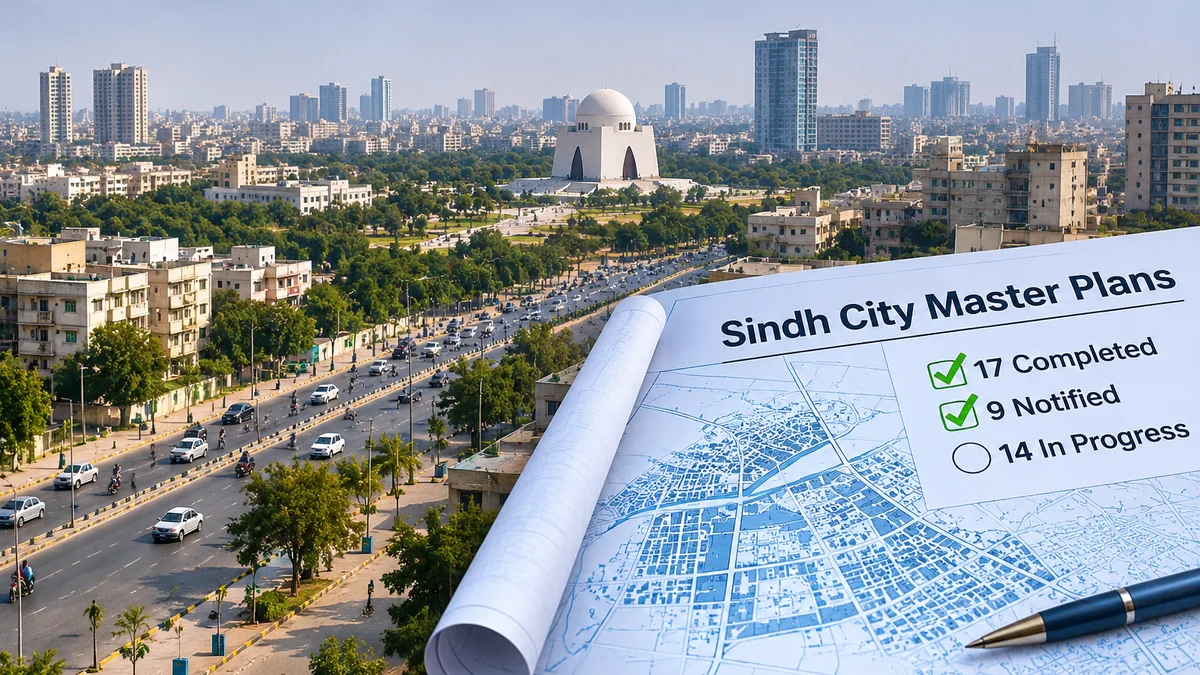
KARACHI: The Sindh government is working on master plans for 31 cities, including Karachi and Hyderabad, as part of an effort to address unplanned development, traffic congestion and pressure on urban services.
Chief Minister Syed Murad Ali Shah discussed the initiative at the Sindh Cities Forum 2026, held in Karachi on 31 October to mark World Cities Day.
The event was organised by the Sindh Master Planning Authority in collaboration with NED University and UN-Habitat.
According to Local Government Minister Syed Nasir Hussain Shah, master plans for 17 cities have been completed, while work on the remaining 14 is in its final stages.
The provincial government has formally notified plans for nine cities: Sukkur, Larkana, Mirpurkhas, Umerkot, Mithi, Islamkot, Dadu, Nawabshah and Naushahro Feroze.
Karachi presents a difficult planning task
Work on master plans for Karachi and Hyderabad is continuing.
The chief minister said international consultants had been engaged for Karachi’s plan, where existing construction and infrastructure problems make urban planning particularly challenging.
He acknowledged that successive governments, including his own, had contributed to the city’s difficulties.
Shah pointed to encroachments on roads, service lanes and stormwater drains as examples of how existing infrastructure had been undermined.
He recalled the flooding of Yousuf Goth in 2020, saying commercial activity had spread onto areas originally intended for drainage and road access.
The chief minister also highlighted delays caused by relocating electricity, water and sewerage infrastructure during development projects.
He said incomplete records of underground utility networks had complicated construction work, although the government had undertaken geographical information system surveys to improve mapping.
Focus on transport and public services
Shah called for better coordination between government departments, planners, utility providers and residents.
He said future development plans needed to account for traffic management, parking, drainage and the provision of essential services.
The provincial government is also pursuing projects involving roads, public transport, water supply, sanitation, healthcare and education.
Officials said the master-planning programme was intended to provide a framework for deciding how residential, commercial and industrial areas should develop.
Although plans for several cities have been completed, the government has not announced a final completion date for Karachi’s master plan.
The effectiveness of the initiative will depend on how the approved plans are implemented and enforced as Sindh’s urban population continues to grow.