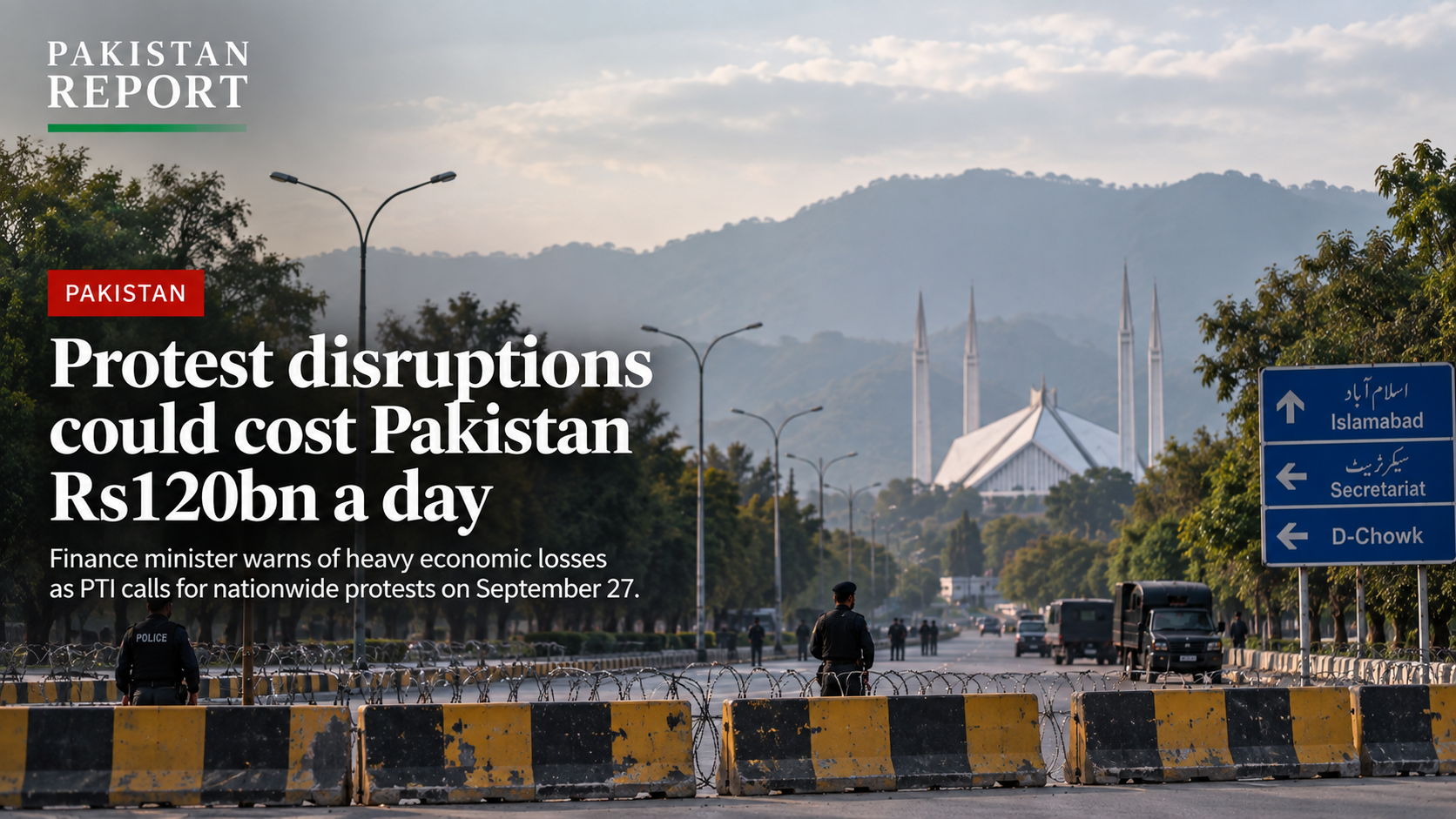
Planned protests and sit-ins could cost Pakistan’s economy around Rs120 billion a day, Finance Minister Muhammad Aurangzeb has warned, putting an unusually large price tag on potential political disruption as opposition groups mobilise around the federal capital.
Aurangzeb said the estimate was prepared with the Planning Commission’s economic wing and drew on previous disruptions as well as current economic conditions. The figure is a government estimate of possible losses rather than a measurement of losses already incurred.
According to figures presented by the finance minister, services would account for the largest share of the projected impact, at around Rs86 billion a day. The estimate covers areas including financial services, communications, transport, retail, wholesale trade and hospitality.
Industry could lose around Rs25 billion a day through disruption affecting construction, finished goods, raw materials and supply chains, while agriculture could account for around Rs9 billion.
The warning comes as Pakistan Tehreek-i-Insaf prepares for a nationwide protest and march towards Islamabad on September 27, while Jamaat-i-Islami has also mobilised over the petroleum development levy.
PTI says its mobilisation is intended to press for the release of its jailed founder, former prime minister Imran Khan, and what the party describes as the supremacy of the Constitution.
The federal government has said it will prevent road blockages and disruption in Islamabad. Interior Minister Mohsin Naqvi has urged PTI to abandon its planned march and has said the government will use available legal measures in responding to the mobilisation.
Why disruption can become expensive
The economic effect of a major protest is not limited to businesses located along the route.
Road closures can delay freight, prevent employees from reaching workplaces and interrupt deliveries of raw materials and finished goods. Telecommunications restrictions, where imposed, can affect digital businesses, while uncertainty can cause shops and other businesses to shorten operating hours.
Those effects can spread beyond Islamabad when major highways and freight routes are affected.
Aurangzeb also highlighted Pakistan’s information-technology exports while discussing the potential consequences of disruption, arguing that connectivity problems can impose costs on a sector that depends on reliable access to international clients and digital services.
The Rs120 billion figure should nevertheless be understood as a projection. Measuring the economic cost of protests is difficult because some activity may be delayed rather than permanently lost, while estimates can also include indirect effects across several industries.
Protest rights and economic activity
The confrontation also raises a broader question about balancing political assembly with the rights of residents and businesses.
Ahead of the planned September 27 protest, the Islamabad High Court said citizens and political parties have a constitutional right to peaceful assembly while stressing that this right cannot be exercised in a way that infringes the fundamental rights of others.
The court’s judgment addressed rights including free movement, trade and business, as well as access to hospitals, educational institutions, courts and workplaces. It directed that roads, highways and other public places within or leading to Islamabad should not be occupied in a manner that obstructs those rights.
That legal position does not determine the eventual economic impact of the planned mobilisation. The actual cost will depend on its duration, geographical reach and whether transport, connectivity and normal commercial activity are materially disrupted.
For now, Rs120 billion should therefore be read as the government’s estimate of what could be at stake each day under significant disruption — not as a bill the economy has already paid.