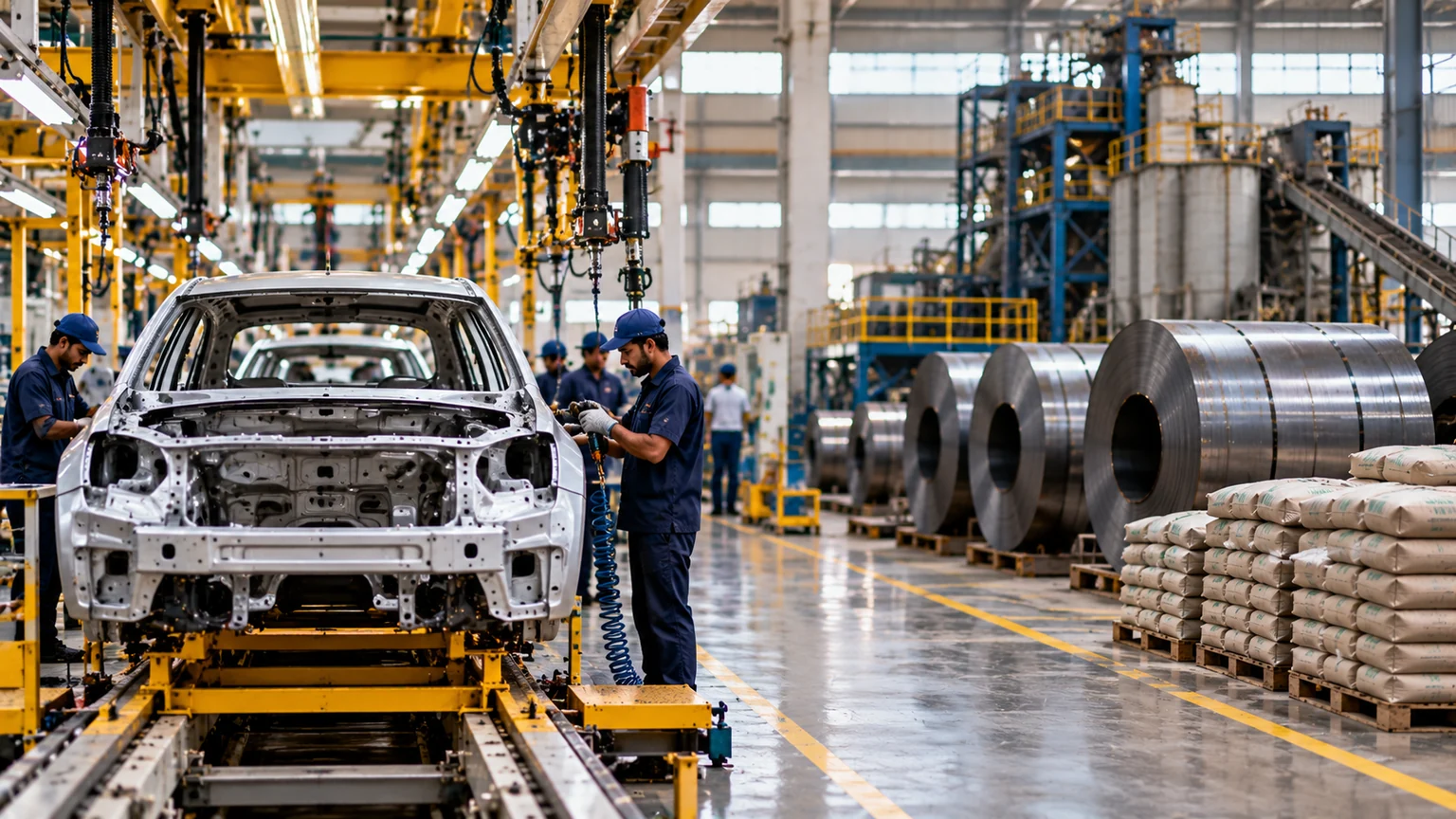
ISLAMABAD, October 31, 2026 — Pakistan’s large-scale manufacturing sector recorded sharply different performances across industries during the first two months of the current financial year, with automobile, garment and petroleum production expanding while steel, fertiliser and pharmaceutical output declined.
Figures from the Pakistan Bureau of Statistics (PBS), reviewed alongside the Finance Division’s October economic update, show that overall large-scale manufacturing grew 1.85% during July–August 2026, compared with the same period a year earlier.
The modest aggregate increase concealed substantial differences between individual industries.
Automobile manufacturing grew 32.45% during the two-month period, while garment production increased 16.69% and petroleum products output rose 15.48%.
Other transport equipment manufacturing expanded 37.04%, and furniture production increased 31.08%.
In contrast, iron and steel production fell 11.48%, fertiliser output declined 7.55%, and pharmaceutical manufacturing contracted 14.57%.
Food manufacturing decreased 8.86%, while chemicals output fell 10.78%, according to the provisional manufacturing data.
The contrasting figures indicate that the industrial recovery has been concentrated in selected sectors rather than spread evenly across the manufacturing economy.
Pakistan’s overall manufacturing index also weakened in August compared with the preceding month.
The Quantum Index of Manufacturing stood at 113.19 in August, down from 119.10 in July, representing a month-on-month decline of 4.96%.
Compared with August 2025, however, production was 0.67% higher.
The Finance Division’s October economic update placed the two-month manufacturing growth rate at approximately 1.9%, below the 4.8% increase recorded in the comparable period of the previous financial year.
Separate indicators for the July–September quarter suggest that some industries continued to benefit from stronger domestic demand.
Car production increased 31.8% during the first quarter, while output of trucks and buses rose 54.2%. Production of two- and three-wheelers increased 28.1%.
Domestic cement dispatches also rose 7.8%, although cement exports fell 11.3%, pointing to differing conditions in local and overseas markets.
These quarterly vehicle and cement figures cover July–September and are not directly comparable with the July–August large-scale manufacturing index.
The mixed industrial performance comes as businesses contend with high energy costs, financing expenses and uncertainty affecting international trade.
For manufacturers of steel, chemicals and fertiliser, a sustained recovery would require improvement in the conditions affecting production and demand. The latest data do not establish a single cause for the decline in each industry.
The Finance Division has identified stronger automobile and cement activity among the factors supporting economic performance, while warning that volatile international energy prices and disruptions to trade remain risks.
The sector-level figures suggest that Pakistan’s industrial outlook depends not only on whether total factory output increases, but also on whether growth extends beyond the industries currently recording the strongest gains.