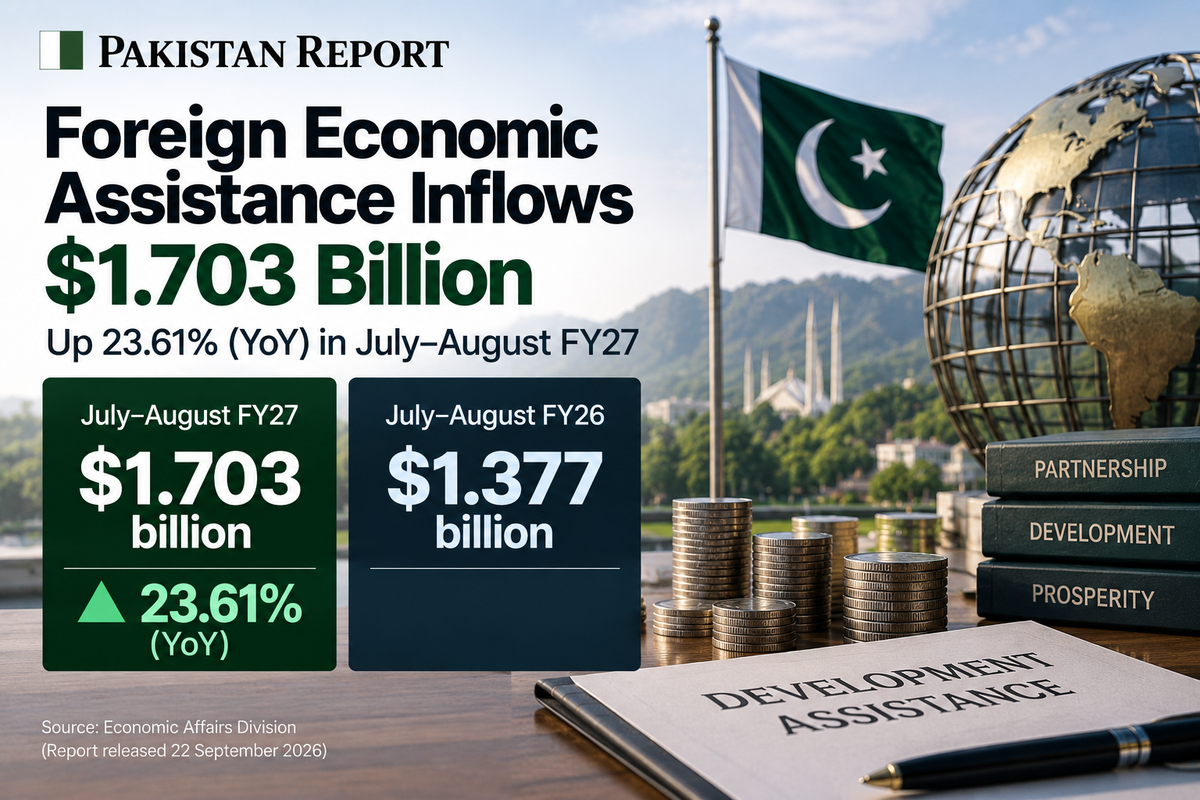
ISLAMABAD — Pakistan received $1.703 billion in foreign economic assistance during July and August 2026, up 23.61% from the same two months a year earlier, according to the Economic Affairs Division.
The comparable figure for July–August 2025 was $1.377 billion.
The increase was driven partly by commercial borrowing and investments in Naya Pakistan Certificates, which allow eligible overseas Pakistanis and other investors to place funds in government-backed savings instruments.
A $300 million commercial loan from UBL Dubai was among the major inflows. Conventional and Islamic Naya Pakistan Certificates attracted approximately $630 million, compared with about $365 million a year earlier.
However, the rise in total assistance did not extend to every source of financing.
Loans and grants from multilateral and bilateral partners amounted to around $626 million. Of that, approximately $591 million came from multilateral institutions and $35 million from bilateral sources.
The government classified roughly $1.218 billion of the overall inflows as non-project assistance, while about $485 million was allocated to project financing.
Non-project assistance can support broader financing requirements, whereas project financing is generally tied to specific development activities.
The figures exclude disbursements under Pakistan’s International Monetary Fund programme, so they should not be treated as a complete record of all foreign financing received by the country.
Foreign economic assistance helps Pakistan meet financing needs and fund development work. But the type of inflow matters: commercial loans and certificates can create repayment obligations, while grants do not.
The first two months of the fiscal year show stronger overall inflows, supported by renewed commercial borrowing. Future financing will depend on lender commitments, project progress and continued access to international markets.
Source: Economic Affairs Division, August 2026 foreign assistance report.
Commercial borrowing can provide financing, but repayment terms and costs must be considered alongside the amount received. Development loans may also be linked to specific projects and released as work progresses. The mix of funding therefore matters when assessing how much support is available for long-term economic needs.
The next monthly reports will indicate whether assistance from traditional lenders improves and whether investment in savings certificates remains strong.