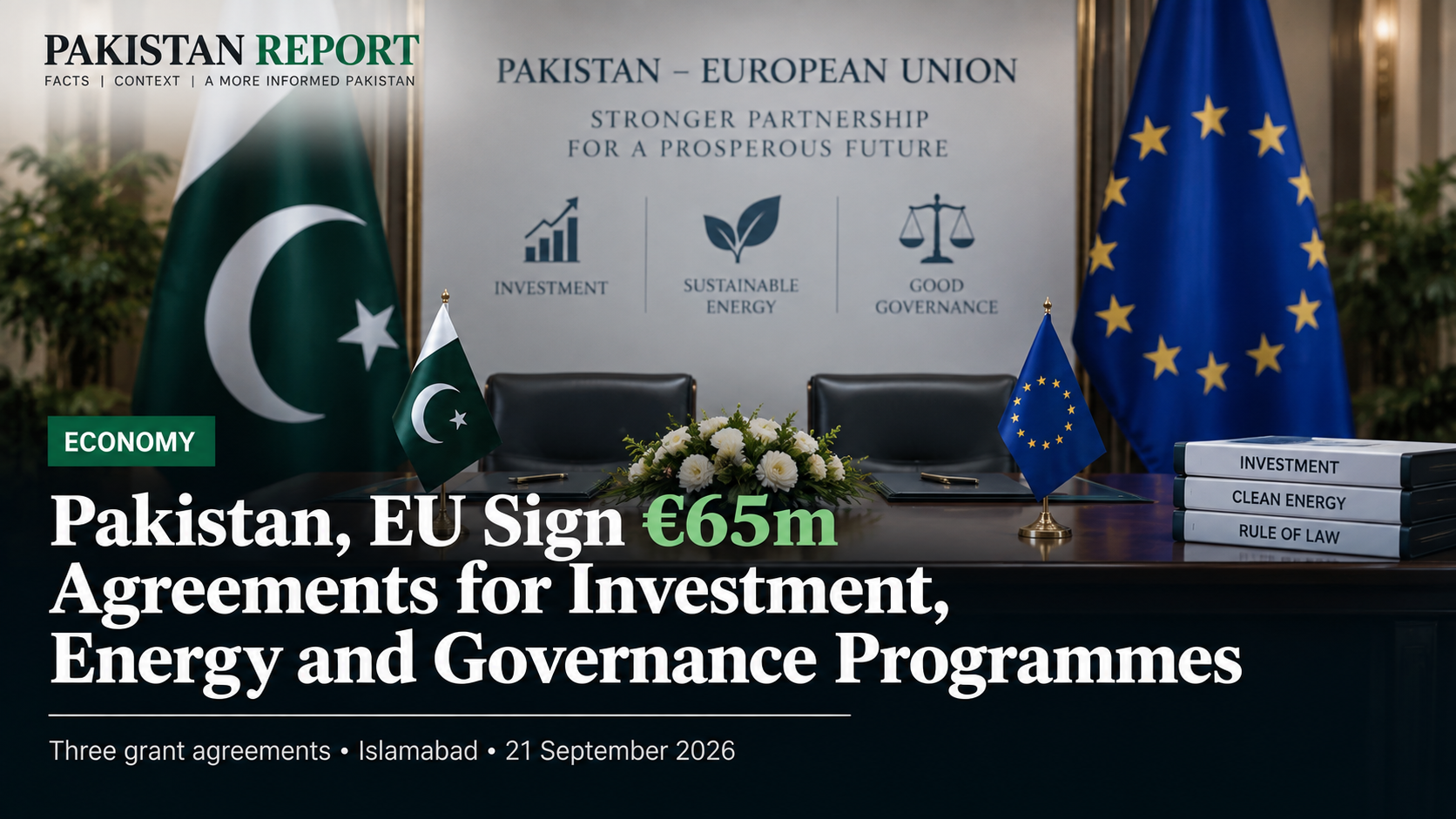
Pakistan and the European Union have signed three grant agreements worth a combined €65 million, approximately Rs20.64 billion, covering investment facilitation, energy and environmental resilience and support for the rule of law and business environment.
The agreements were signed in Islamabad on September 21 by EU Ambassador to Pakistan Raimundas Karoblis and Economic Affairs Division Secretary Muhammad Humair Karim, according to Pakistan’s Economic Affairs Division.
The financing is being provided under the European Union’s Multiannual Indicative Programme for 2021–2027 and will fund three separate programmes rather than a single project.
The government announcement did not provide an individual euro allocation for each of the three programmes, so the €65 million figure should be understood as their combined value.
Investment and financial planning
The first programme, Global Gateway Development Facilitation for Pakistan, is intended to improve Pakistan’s investment-management and financial enabling environment.
According to the Economic Affairs Division, the programme aims to help attract foreign investment by improving the tax system and strengthening the government’s long-term financial planning.
It forms part of the EU’s wider Global Gateway initiative, through which the bloc supports investment and infrastructure partnerships outside the European Union.
For Pakistan, the programme comes at a time when policymakers are seeking greater private and foreign investment while trying to strengthen public finances and reduce recurring external financing pressures.
Renewable energy and resilience in KP
A second programme will focus on energy and the natural environment in Khyber Pakhtunkhwa.
The Energy and Natural Environment Resilience programme is designed to expand renewable electricity in rural communities that are not connected to the grid. It will also provide training intended to attract private investment and increase private-sector participation in the province’s energy sector.
That gives the financing a direct service-delivery component: part of the programme is aimed at improving electricity access in off-grid communities rather than focusing only on institutional reform.
The programme will also support the sustainable management of natural resources and environmental resilience, according to the official announcement.
Justice and the business environment
The third agreement extends EU support for the rule of law and business environment across several provinces.
In Khyber Pakhtunkhwa and Balochistan, the programme is intended to improve access to police, prosecution services, courts and legal aid.
Punjab and Sindh are expected to receive support for the expansion of alternative and commercial dispute-resolution mechanisms. The stated objective is to make dispute resolution more effective and improve the environment for European and other companies considering investment.
The programme builds on previous EU assistance in the justice and governance sectors.
What was signed
The agreements represent grants rather than commercial loans, and their combined value is €65 million.
Karim said the programmes were relevant to Pakistan’s goals of attracting foreign investment, improving electricity access in off-grid areas of KP and strengthening rule-of-law and commercial dispute-resolution standards.
Karoblis said the agreements reflected EU support for Pakistan’s economic development and investment ambitions under Global Gateway, while also backing energy resilience, natural-resource management and access to justice.
The EU’s development cooperation with Pakistan covers economic development, climate resilience, governance, the rule of law, human rights and sustainable natural resources.
The latest agreements turn parts of that cooperation framework into three defined programmes with specific policy and geographic targets.
For Pakistan, their eventual significance will depend on implementation: whether the investment programme produces institutional changes, whether off-grid communities receive additional renewable-energy access, and whether the justice-sector programme improves access and dispute resolution in the provinces it covers.
For now, the concrete development is the commitment of €65 million in EU grant financing and the formal launch of the three programmes.