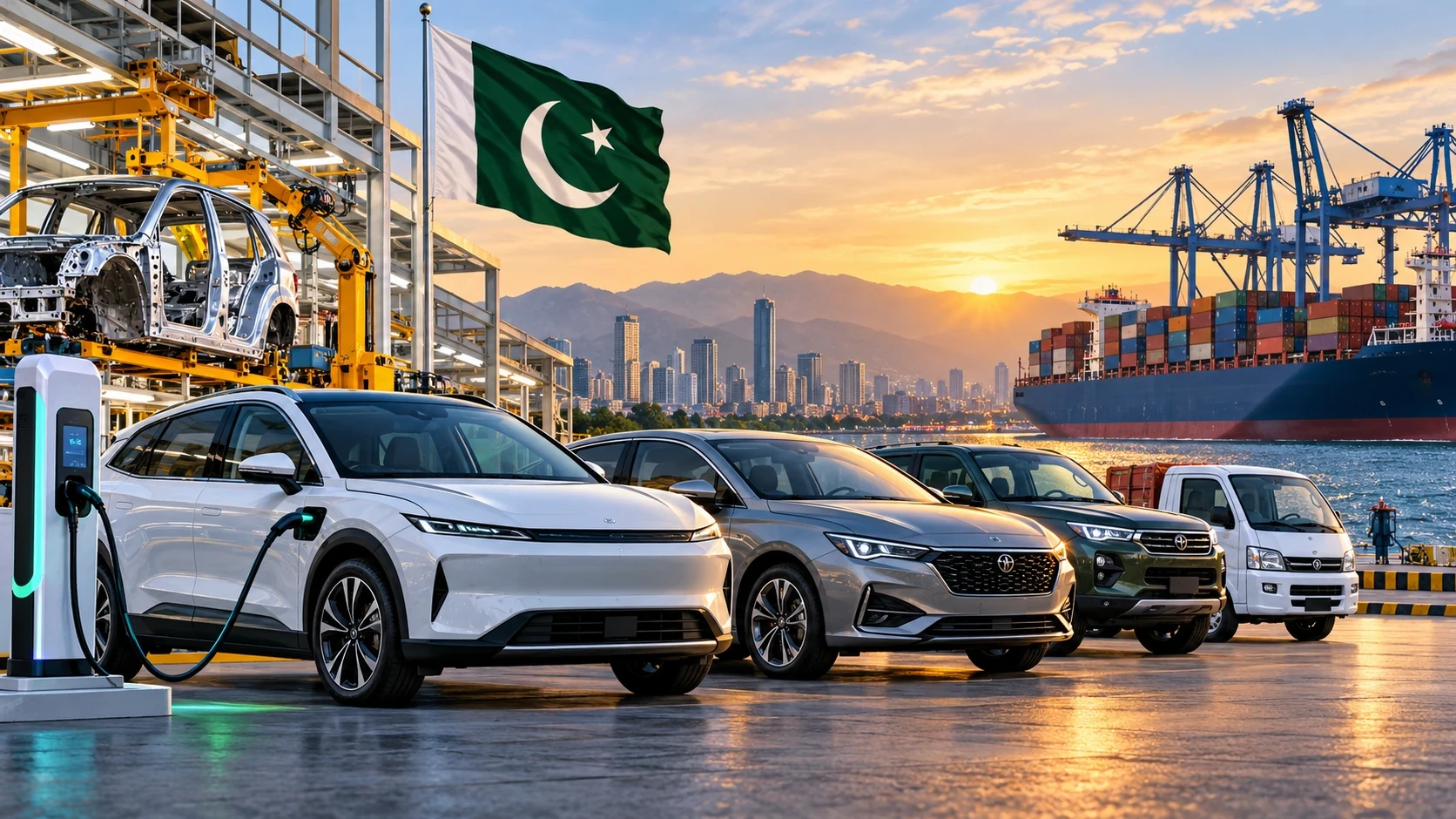
ISLAMABAD: Prime Minister Shehbaz Sharif has approved the draft Automotive Industry Policy 2026–31, setting out a five-year plan to expand Pakistan’s vehicle and auto parts exports, reduce import tariffs and encourage electric vehicle adoption through preferential taxation.
The proposed policy sets an export target of approximately $6 billion over five years and introduces mandatory export requirements for vehicle manufacturers, alongside financial incentives for companies that increase overseas sales.
The draft, approved by the prime minister on Tuesday, will proceed through further government approvals before its tax and regulatory provisions are implemented.
Lower Taxes for Electric Vehicles
One of the policy’s major proposals is a reduced sales tax structure for electric and hybrid vehicles between 2026 and 2031.
Battery electric vehicles would attract a 1% sales tax, while range-extended electric vehicles would be taxed at 6% and plug-in hybrid vehicles at 9%.
The policy also proposes a 10% federal excise duty on electric vehicles priced above $75,000, while smaller electric vehicles costing less than $15,000 would benefit from lower import tariffs.
To improve access to vehicle financing, the government plans to increase the financing limit from Rs3 million to Rs10 million and extend the maximum repayment period from three to five years.
These measures are intended to encourage electric vehicle ownership and support the development of Pakistan’s emerging electric mobility market.
Export Targets and Incentives for Manufacturers
The government wants Pakistan’s automotive industry to move beyond domestic assembly and develop a stronger presence in international markets.
Under the proposed framework, manufacturers would face mandatory export targets, with incentives linked to export performance.
Companies increasing their exports would qualify for support equivalent to 5% of export value, with an additional 10% incentive proposed for exports exceeding the previous year’s level.
Manufacturers failing to meet their targets would face penalties, while repeated non-compliance over two consecutive years could result in the cancellation of manufacturing certificates.
The policy also seeks to increase the use of locally manufactured components and encourage investment in production technology.
Import Tariffs and Industry Competition
The draft envisages progressively reducing automotive import tariffs, with rates moving towards 15% by the 2030–31 financial year.
The government expects increased competition to encourage efficiency, improve product quality and bring more choices to consumers.
However, the proposed tariff reductions have raised concerns among domestic auto parts manufacturers.
Pakistan Association of Automotive Parts and Accessories Manufacturers Chairman Abdul Rehman Aizaz has warned that cheaper imported components could weaken the competitiveness of local suppliers.
The government also expects to collect more than Rs232 billion over five years through an Automotive Development Levy on qualifying vehicles. The proceeds are intended to finance export incentives, industrial development and technology upgrades.
New Automotive Testing Institute
The policy proposes establishing the Pakistan Automotive Testing Institute to strengthen vehicle testing, certification and compliance with safety standards.
It also envisages support for research, independent inspections and quality improvements across locally manufactured and imported vehicles.
The five-year roadmap represents an effort to reshape Pakistan’s automotive industry around exports, technology, electric mobility and greater international competition.
The next stage involves obtaining the necessary federal cabinet and parliamentary approvals for the proposed measures.