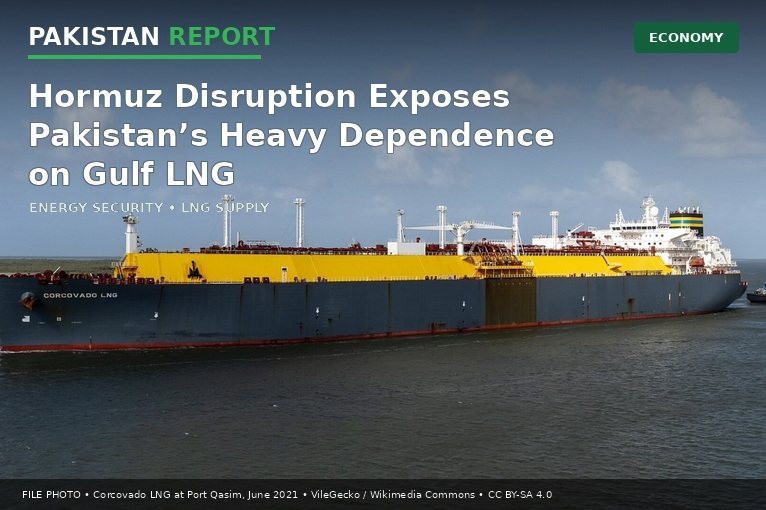
Disruption around the Strait of Hormuz has exposed how heavily Pakistan’s gas system depends on liquefied natural gas arriving from a small number of Gulf suppliers through one of the world’s most sensitive shipping routes.
Qatar and the United Arab Emirates together provide about 99% of Pakistan’s LNG, according to a Gastech report cited by Dawn. LNG, in turn, accounts for roughly 30% of Pakistan’s total gas supply.
That concentration means a disruption in Gulf production or shipping can quickly become a domestic energy problem. Imported LNG is used across power generation, fertiliser production and industry, so shortages or sharp price increases can spread through several parts of the economy.
The current disruption has already demonstrated that vulnerability. Shipping through the Strait of Hormuz has fallen sharply during the regional conflict, restricting the movement of energy cargoes from major Gulf exporters.
A concentrated supply chain
Pakistan has spent years building LNG import infrastructure to supplement declining domestic gas production. The system gave the country access to international gas markets, but it also created exposure to global prices and maritime supply routes.
The risk is particularly pronounced because Qatar is one of the world’s largest LNG exporters and most of its seaborne exports normally pass through the Strait of Hormuz. The UAE is also an important regional supplier.
A Qatari LNG cargo reached Port Qasim in September, marking a notable resumption of Qatar-linked supply to Pakistan after an extended disruption. Reuters shipping data also showed LNG vessels beginning to reappear around the strait, although overall commodity-vessel traffic remained far below earlier levels.
The wider market impact has been severe. Reuters reported that disruption from the Middle East removed roughly 36 million tonnes of LNG supply from the market and pushed Asian spot prices from around $10 per million British thermal units to nearly $30.
For price-sensitive buyers such as Pakistan, a tripling of spot prices makes emergency replacement cargoes difficult to absorb. Even when LNG is physically available from alternative suppliers, the cost can limit how much can realistically be purchased.
The issue goes beyond one cargo
The immediate question is whether regular Gulf LNG flows can be maintained. The longer-term question is whether Pakistan should remain so dependent on a concentrated group of suppliers and a single maritime chokepoint.
The Gastech report said the disruption was encouraging Asian policymakers to reconsider energy security. For Pakistan, possible responses include greater fuel diversification, additional storage, more flexible gas infrastructure and further development of domestic and renewable energy sources.
A private Pakistani gas company participating at Gastech also reported interest from international companies in gas-storage projects and long-term LNG arrangements. Such investments could improve resilience, although they would not remove the underlying exposure to international prices.
Pakistan’s LNG terminals and import contracts remain important to the energy system. The lesson from Hormuz is not that LNG can simply be abandoned, but that heavy concentration creates risk.
When almost all imported LNG comes from two Gulf states and a major share of the country’s gas supply depends on LNG, a shipping disruption thousands of kilometres away can quickly affect power, industry and the cost of energy at home.
Pakistan Explained.
Sources
- Dawn, September 18, 2026: LNG shortages hit Pakistan badly, citing Gastech’s Asia gas and LNG outlook.
- Reuters, September 15, 2026: LNG demand and Asian spot-price effects from Middle East supply disruption.
- Reuters, September 18, 2026: Strait of Hormuz shipping traffic and LNG vessel movements.