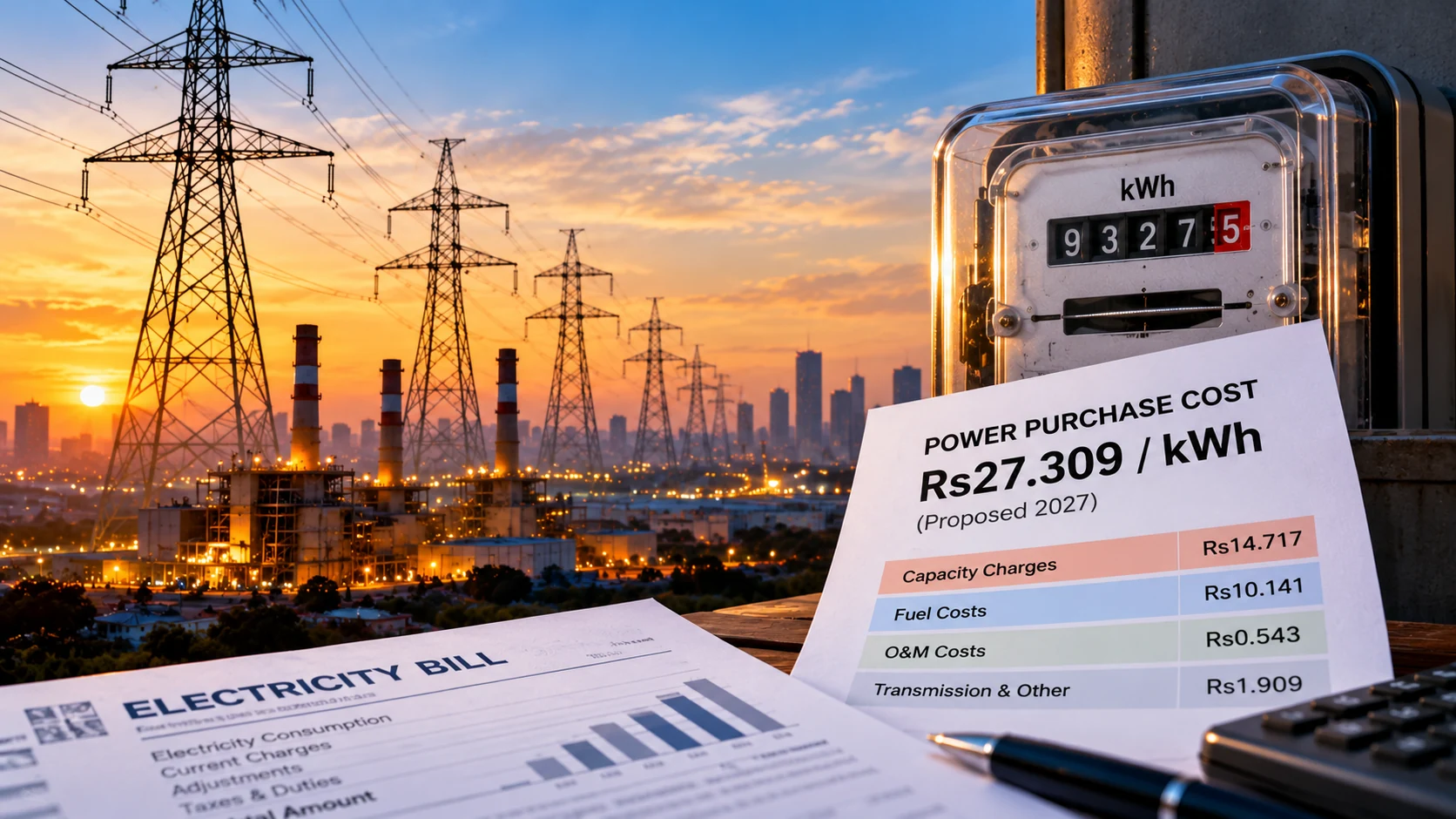
Pakistan’s electricity regulator is reviewing a proposal that puts the average cost of purchasing electricity for distribution companies at Rs27.309 per unit in 2027, with capacity payments accounting for more than half of projected expenditure.
The Central Power Purchasing Agency-Guarantee (CPPA-G) submitted its forecast to the National Electric Power Regulatory Authority (NEPRA) for January–December 2027. NEPRA published the application and hearing notice on October 17.
The proposed figure is a power-purchase cost, not a new household electricity tariff. Consumer prices also reflect distribution costs, adjustments, taxes and government policy.
Capacity charges make up the largest share
The base-case forecast puts total electricity procurement expenditure at approximately Rs3.552 trillion. Capacity charges account for around Rs1.91 trillion, nearly 54% of the total, while fuel costs are projected at approximately Rs1.32 trillion, or about 37%.
The reported per-unit breakdown is Rs14.717 for capacity payments, Rs10.141 for fuel, Rs0.543 for variable operation and maintenance, and Rs1.909 for transmission-related and other charges. Figures may differ slightly when added because of rounding.
Capacity payments relate to contracted generating capacity being available, rather than only to electricity actually produced. Consequently, lower fuel prices do not necessarily produce an equivalent reduction in the system’s overall purchasing costs.
Electricity demand changes the calculation
The forecast assumes sales of 130,081 gigawatt-hours to distribution companies during 2027, based on demand growth of 2.6%.
A significant part of the power system’s expenditure must be recovered across the electricity units sold. When sales fall below projections, the average cost per unit can increase even if total costs change little.
Under an alternative assumption of 0.7% demand growth, the reported average power-purchase cost rises to Rs27.568 per unit. Across the forecast scenarios, the estimated cost ranges from Rs25.883 to Rs29.255 per unit, reflecting differing assumptions about demand, fuel prices and other economic conditions.
What the forecast means for consumers
The Rs27.309 figure is an average procurement estimate for the power system. It is not a flat retail rate that every household will pay in 2027.
Consumer-end tariffs incorporate additional components, and rates vary by category and applicable tariff structure. NEPRA’s review will consider the assumptions behind the proposed power-purchase reference, rather than simply impose the forecast amount as a household rate.
The forecast nonetheless shows why electricity costs remain sensitive to capacity obligations as well as fuel prices. Capacity charges account for the largest share of projected expenditure, making contracted generation availability a central part of the sector’s financial picture.
The regulator’s assessment will help establish the reference costs used in the next stage of electricity pricing. The eventual effect on bills will depend on the approved consumer tariff framework.
Sources: NEPRA — tariff petitions; NEPRA — hearing notices and application.