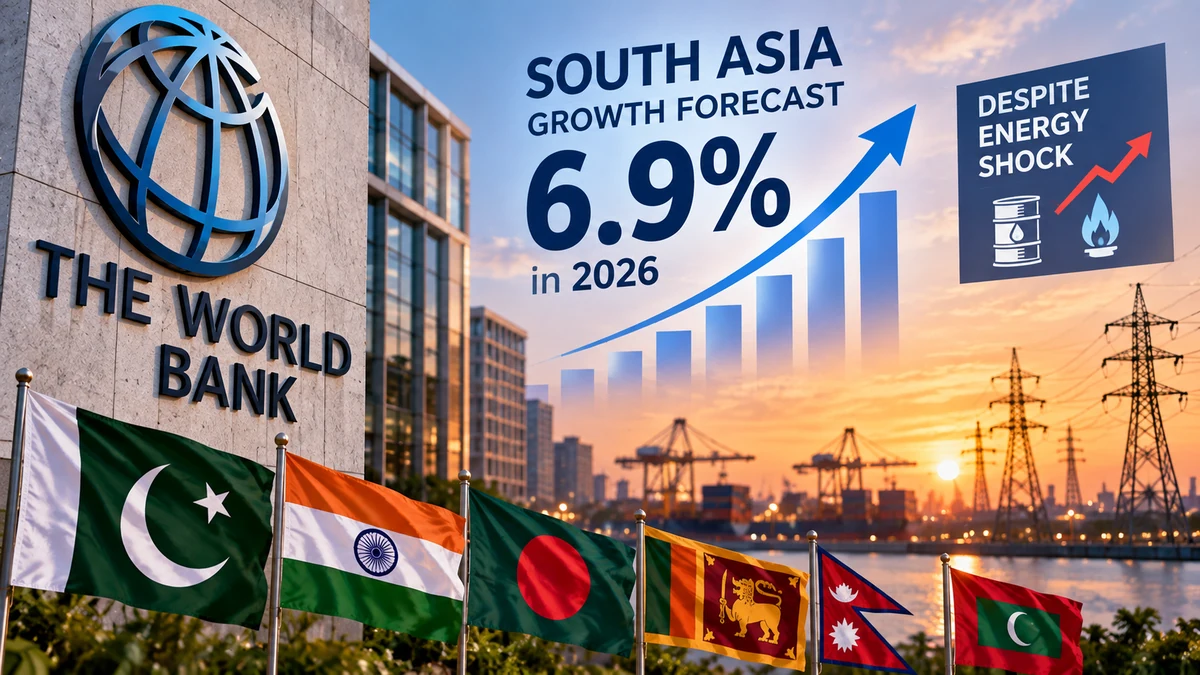
The World Bank has raised its 2026 growth forecast for South Asia to 6.9%, saying resilient consumption has helped the region withstand an energy shock better than previously expected.
The new forecast is 0.6 percentage points, or 60 basis points, above the Bank’s previous projection and 0.1 percentage point above its estimate from a year earlier, according to the October 2026 South Asia Economic Update and comments from World Bank Chief Asia Economist Franziska Ohnsorge reported by Reuters.
The upgrade comes despite high energy prices and supply disruptions affecting a region that depends heavily on imported energy.
Ohnsorge said higher energy prices had not interrupted momentum in consumption growth. Government measures that shielded consumers, strong remittances and resilient domestic demand helped cushion the impact, she said.
The stronger near-term forecast does not remove the risks facing the region. The World Bank warned that persistently high oil prices, a severe weather shock and a correction in global financial markets could weaken the outlook.
Inflation is also expected to remain elevated into 2027. Higher prices can take time to feed through fully into economic activity, meaning the resilience seen so far does not guarantee that the region will remain insulated from the energy shock.
India, South Asia’s largest economy, is expected by the World Bank to grow 7.1% in the 2026-27 financial year. That is higher than the Bank’s June forecast of 6.6%, although below the 8.6% growth recorded in 2025-26.
The regional update also points to artificial intelligence as a potential source of productivity and job growth over the medium term. The Bank said AI adoption in South Asia remains behind advanced economies but is catching up quickly.
For businesses and policymakers, the main message is a combination of stronger-than-expected current momentum and significant external risks. Consumption and remittance flows have provided support, but the region remains exposed to energy prices, weather conditions and changes in global financial markets.
The 6.9% figure is a regional growth forecast, not a forecast for Pakistan alone. Individual South Asian economies have different growth rates, policy conditions and exposure to the energy shock.
The World Bank’s upward revision therefore signals greater resilience across South Asia than it expected earlier in the year, while its risk assessment remains cautious about how long that resilience can persist if oil prices stay high or additional shocks emerge.
Pakistan Report illustration.