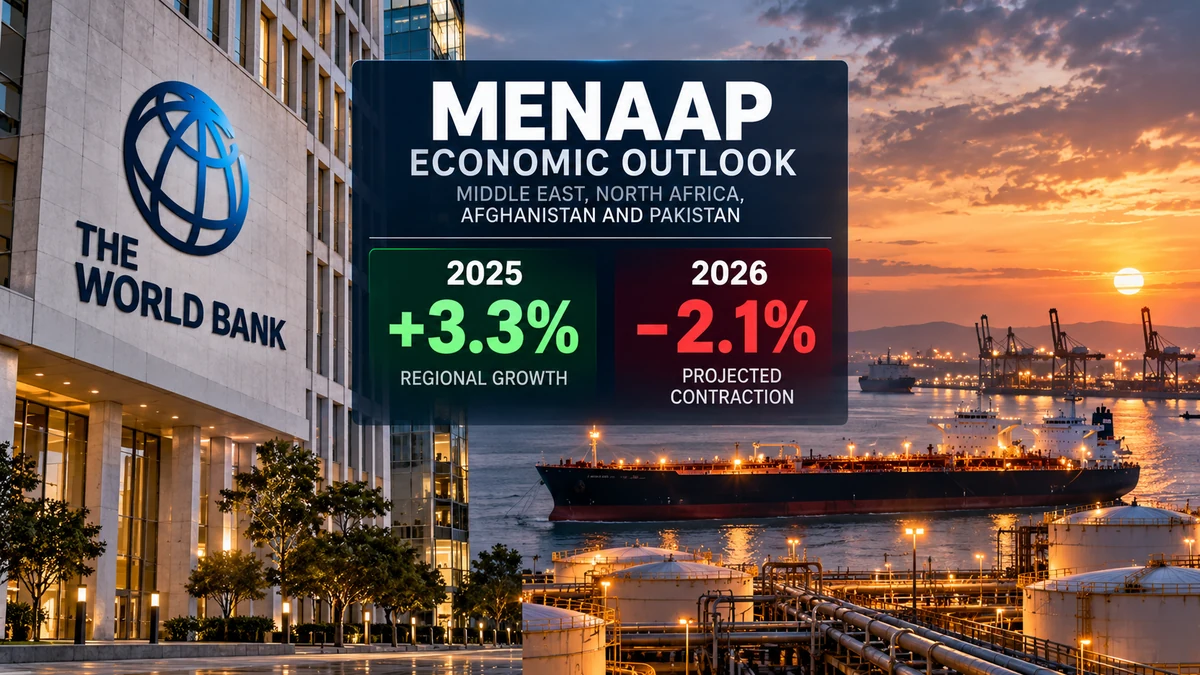
The World Bank expects the Middle East, North Africa, Afghanistan and Pakistan economy to contract 2.1% in 2026 as conflict and disruption across the Middle East weaken growth, reversing the region’s 3.3% expansion in 2025.
The forecast covers the World Bank’s MENAAP region — Middle East, North Africa, Afghanistan and Pakistan — and is not a forecast for Pakistan alone.
The Bank said Gulf oil exporters are being hit particularly hard. It projects the Gulf Cooperation Council economies to contract 4.3% in 2026 as the conflict affects production, trade and economic activity.
The deterioration marks a sharp change from the regional growth recorded last year and highlights how the consequences of the Middle East conflict are spreading beyond the areas of direct fighting.
Oil-importing economies in the wider region are expected to fare better, with growth projected at 4.3%, up from 3.9%, according to the World Bank’s regional outlook.
The Bank also sees the possibility of a strong rebound if the conflict and associated disruptions ease. Excluding Iran, regional growth could reach 7.8% in 2027, but that projection depends on conditions improving and should not be read as a guaranteed recovery.
The report also examines longer-term productivity challenges and the potential impact of artificial intelligence. The World Bank said AI could raise productivity in occupations representing as much as 20% of employment in the region, although the gains would depend on adoption, skills and broader economic conditions.
For Pakistan, the regional contraction matters because the country is included in the MENAAP aggregate and is exposed to changes in energy prices, trade, investment and remittance flows. However, the 2.1% contraction figure should not be presented as Pakistan’s individual growth forecast.
The central message of the update is that the conflict has materially weakened the regional outlook, with Gulf oil exporters facing the largest immediate hit and uncertainty remaining unusually high.
The World Bank’s figures therefore provide a regional measure of the economic damage from the conflict rather than a standalone assessment of Pakistan’s economy.
Pakistan Report illustration.