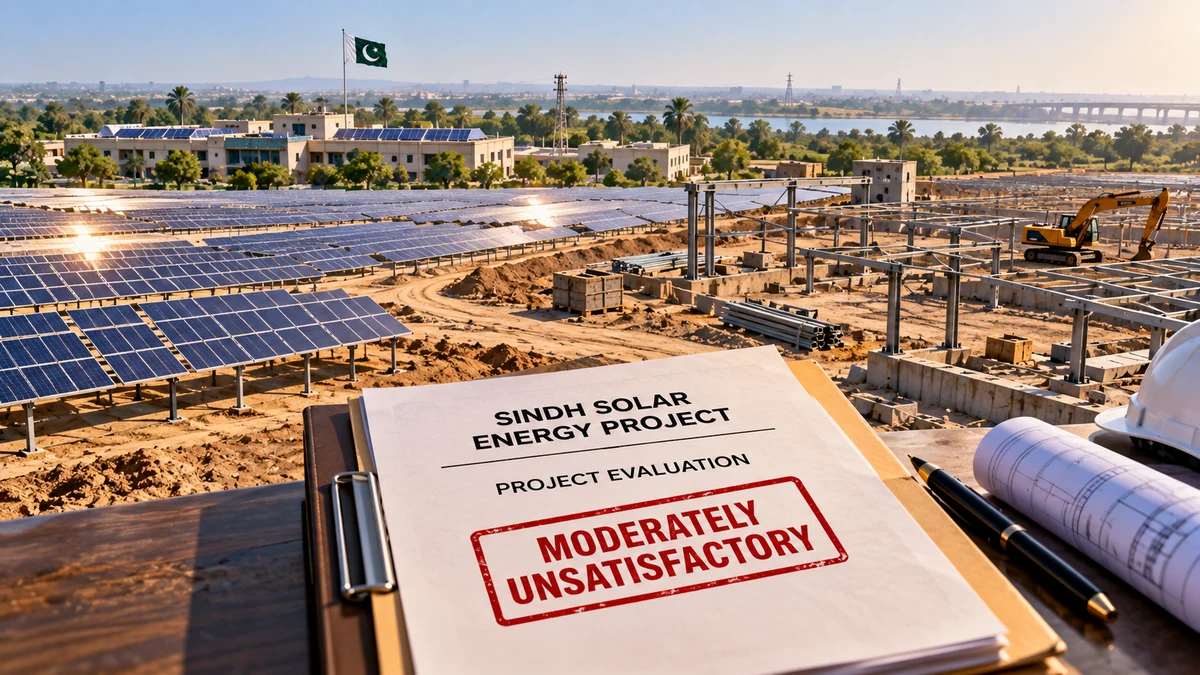
The World Bank’s Independent Evaluation Group has rated the outcome of the $93.1 million Sindh Solar Energy Project “moderately unsatisfactory,” according to its Implementation Completion Report Review.
The project had originally targeted 400 MW of utility-scale solar generation and 20 MW of distributed solar capacity. None of the three utility-scale solar plants initiated under the project had been completed by the July 2025 closing date.
The review cited delays involving land allocation, grid approvals and coordination between provincial and federal authorities, along with procurement and institutional-capacity constraints.
Performance was stronger in distributed solar. Rooftop solar installations on public buildings reached 35 MW against a 20 MW target, exceeding that target. The project also supported solarisation of priority healthcare facilities and battery storage at public facilities affected by load-shedding.
The evaluation therefore reflects uneven implementation rather than an absence of results: the distributed component exceeded its target, while the planned utility-scale generation was not completed within the project period.
The assessment provides a fresh accountability measure for a major public solar initiative and highlights how approvals, coordination and implementation capacity can affect energy-project delivery.
Pakistan Report illustration.