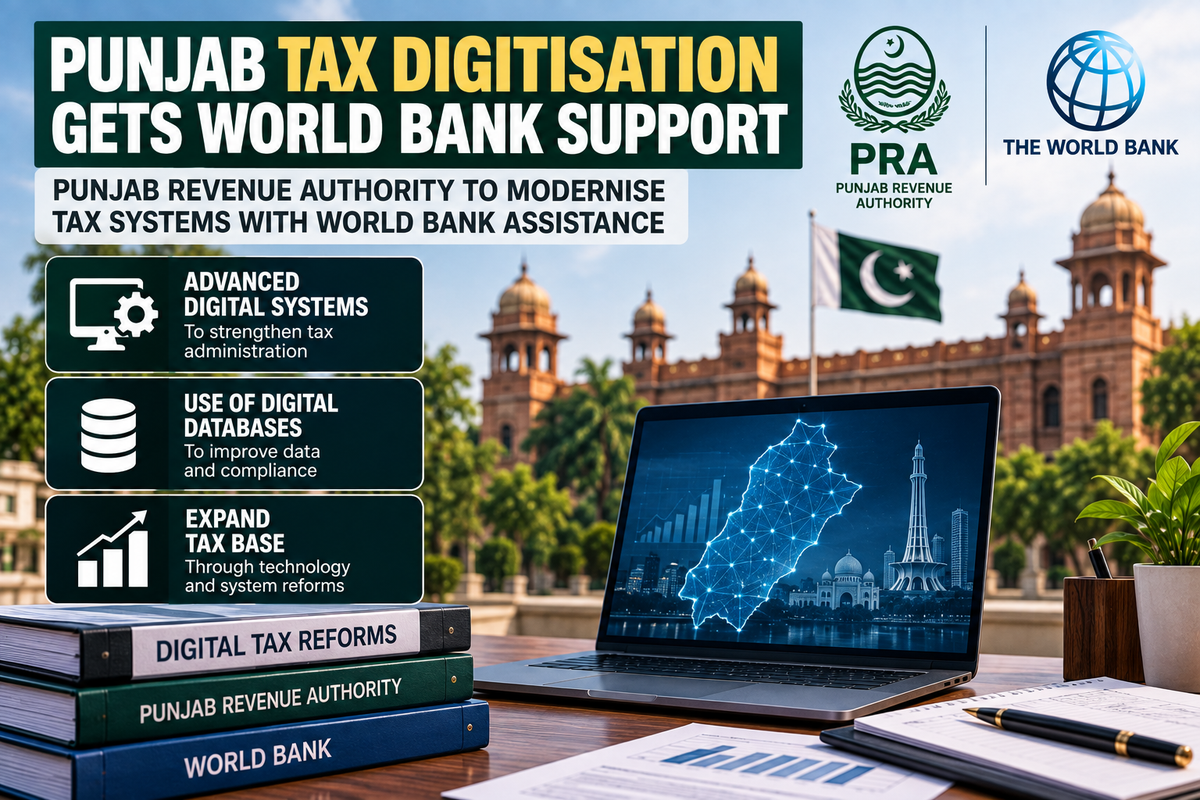
LAHORE — The Punjab Revenue Authority and the World Bank have agreed to work on advanced digital systems for tax administration, including greater use of digital databases and a reform plan intended to broaden Punjab’s tax base and improve revenue collection.
The agreement emerged from a meeting between PRA Chairman Moazzam Iqbal Sipra and a World Bank delegation led by Regional Director Michael Roggi and Manager Sylvia Solf. The discussion covered digitisation of Punjab’s tax system, data use and the Digital Economy Enhancement Project.
The development is a reform commitment and planning exercise rather than the launch of a completed new tax platform. PRA, the Punjab Information Technology Board and the World Bank are expected to develop a working plan for the next stage of digital tax reforms.
Greater use of government data
One of the areas discussed was integration of data held by different government departments. In principle, linking datasets can help a revenue authority compare tax returns, payments and business information and identify gaps that require further examination.
PRA Chairman Moazzam Iqbal Sipra said digital tools would be used to expand the tax base and bring additional businesses into the tax net. He also said digital data could help identify tax evasion, misappropriation and discrepancies in business records.
Those are intended uses of the reform programme, not evidence that every proposed data integration has already been completed. The practical scope will depend on the roadmap, legal access to datasets, technical implementation and safeguards governing how information is shared and analysed.
World Bank technical and funding support
According to the official account of the meeting, the World Bank delegation said PRA’s digital monitoring and tax-administration systems would be further strengthened. The reform plan is to be developed with World Bank technical assistance and funding support, with PITB participating alongside PRA.
The parties also discussed international tax-administration models and practices used in other countries. The stated objective is to use technology and data analytics more systematically in Punjab’s tax system rather than relying solely on conventional registration and enforcement methods.
Punjab’s provincial revenue system is separate from the Federal Board of Revenue’s federal tax administration. PRA primarily administers provincial taxes within its mandate, including sales tax on services. That makes provincial data and coordination with other government bodies relevant to efforts to identify economic activity that may fall within the authority’s tax base.
Roadmap comes before implementation
The next substantive step is development of the working plan. That should clarify which databases will be integrated, what technology will be introduced, how responsibilities will be divided between PRA and PITB, and how World Bank assistance will be applied.
Until those details are set out, the September 28 agreement is best understood as a commitment to pursue digital tax reforms with World Bank support. It establishes the direction of the programme but does not mean a new end-to-end system has already been deployed across Punjab.