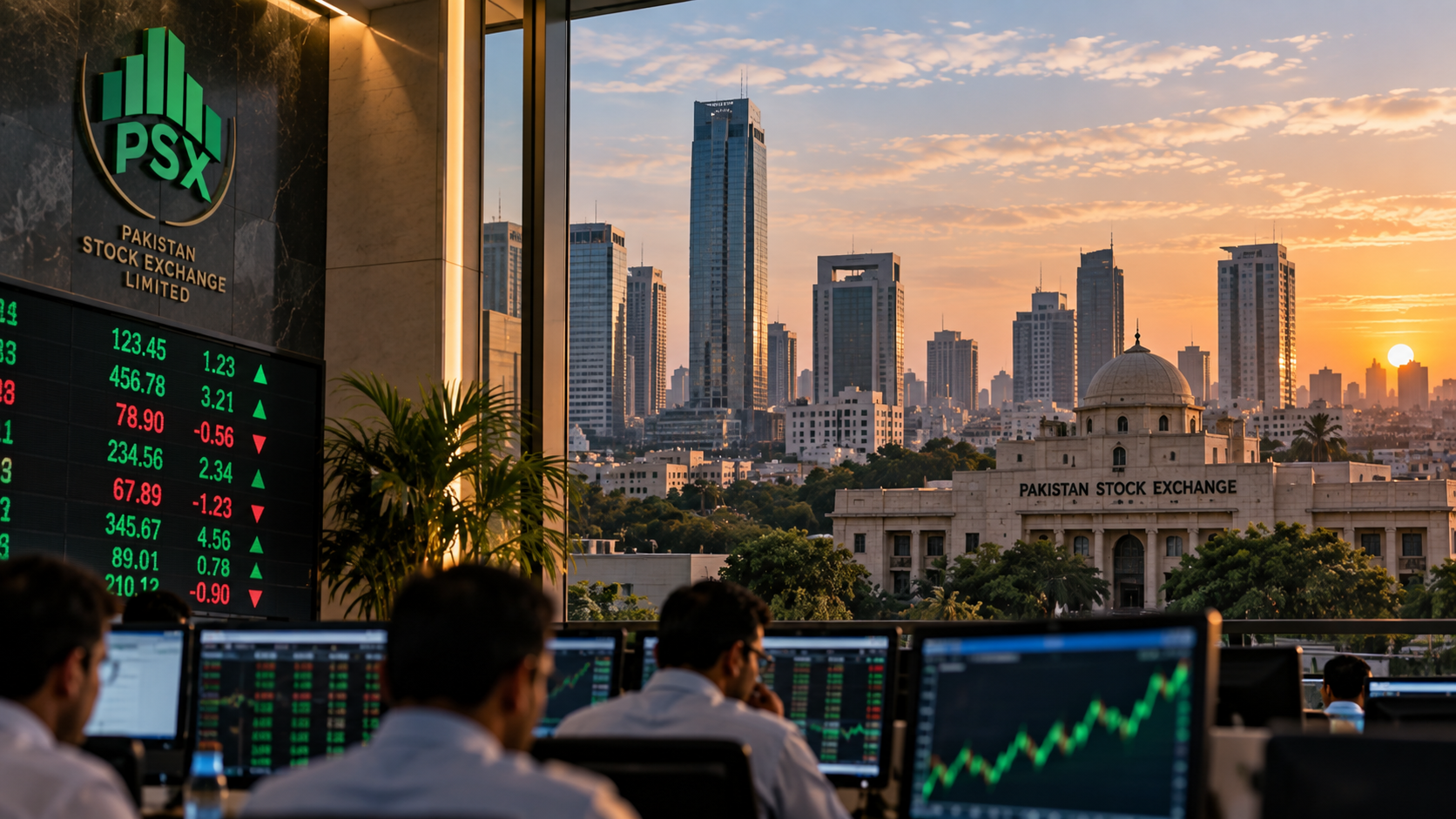
Pakistan’s stock market ended lower on Tuesday as escalating tensions in the Middle East and higher oil prices weighed on investor sentiment.
The benchmark KSE-100 index closed at 172,642.16 points, down 993.91 points, or 0.57%, from the previous close of 173,636.07.
The decline was considerably steeper during the trading session before the market recovered part of its losses.
A volatile trading session
The KSE-100 fell as low as 171,490.63 points during Tuesday’s session.
At one stage, the index was down more than 1,900 points from the previous close before recovering later in the day.
The index ultimately finished nearly 1,000 points lower.
Selling pressure was visible across the broader market, reflecting increased caution among investors.
Why did the market fall?
Market analysts linked the decline primarily to geopolitical uncertainty surrounding the Middle East.
Renewed tensions have increased concerns about energy supplies and pushed international oil prices higher.
That matters particularly for Pakistan because the country relies heavily on imported energy.
Higher international oil prices can increase Pakistan’s import costs and contribute to inflationary pressure, while also affecting expectations for businesses and consumers.
These concerns can influence investor sentiment at the stock market even before the full economic effects become visible.
Oil approaches $100
International oil markets have been under renewed pressure as conflict in the Middle East raises concerns about supplies from the region.
Brent crude traded close to the $100-per-barrel level on Tuesday as markets assessed the risk of further disruption to Gulf energy supplies.
The impact is especially important for energy-importing economies such as Pakistan.
Sustained high oil prices could increase the country’s petroleum import bill and place additional pressure on domestic fuel prices.
Why it matters
A single negative trading session does not necessarily indicate a longer-term change in the direction of Pakistan’s stock market.
However, Tuesday’s decline illustrates how quickly international geopolitical events can affect Pakistani financial markets.
Investors are now watching both regional developments and international energy prices.
If tensions ease and oil prices retreat, some of the pressure on sentiment could diminish. A prolonged conflict or further disruption to energy supplies, however, could keep uncertainty elevated.
For Pakistan, the consequences would extend beyond the stock market because energy prices affect inflation, transport costs, businesses and the country’s external payments.
What to watch
The immediate focus will remain on developments in the Middle East and movements in global crude prices.
Investors will also be watching whether the KSE-100 stabilizes after its recent losses and whether selling pressure spreads further across major sectors.
The relationship between geopolitical risk, energy prices and Pakistan’s economy is likely to remain an important theme for financial markets in the days ahead.
Sources: Pakistan Stock Exchange market data; Business Recorder; Dawn; international energy-market reporting.