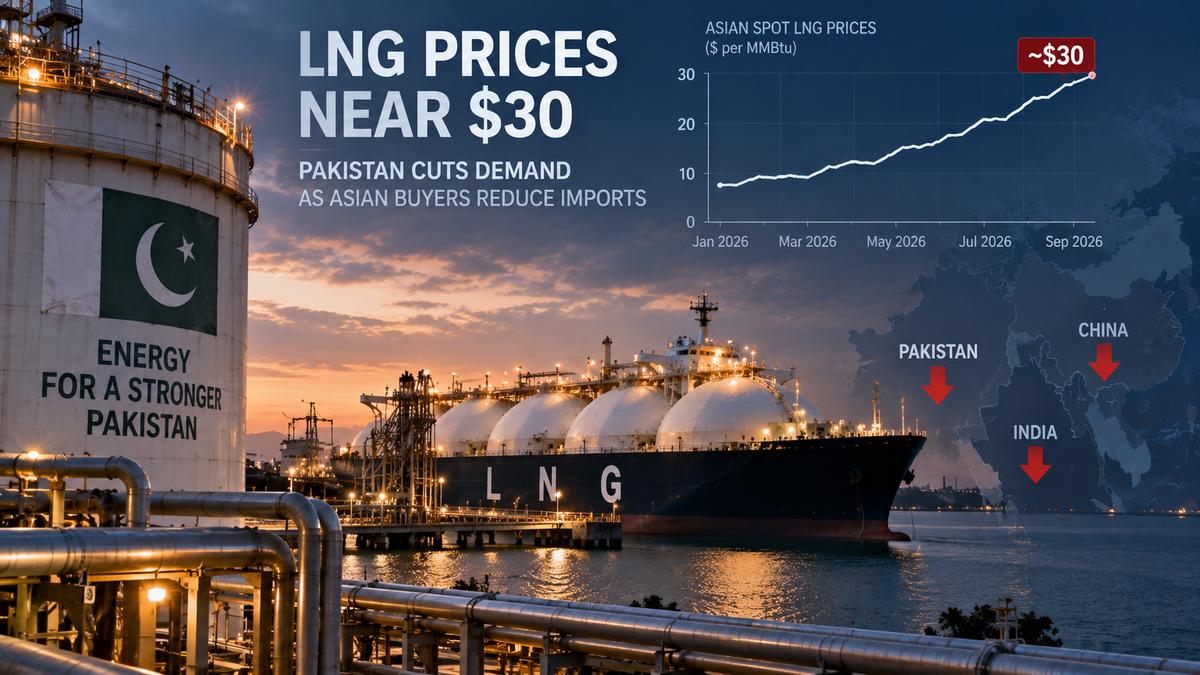
Pakistan and other major Asian gas buyers are cutting back on expensive liquefied natural gas as disruption to Middle Eastern exports drives spot prices towards $30 per million British thermal units, forcing energy consumers to reconsider how much imported gas they can afford.
LNG demand in Pakistan, China and India has fallen to multi-year lows during the US-Iran war, according to industry executives interviewed at the Gastech conference in Bangkok.
The disruption has prevented Qatar and the United Arab Emirates from exporting most of their normal LNG volumes through the Strait of Hormuz, tightening supplies available to Asian buyers.
Shell estimates that around 36 million tonnes of Middle Eastern LNG supply has been lost so far this year because of the disruption.
Asian spot LNG prices have consequently climbed from around $10 per MMBtu before the war to nearly $30, making imported gas increasingly difficult to justify for price-sensitive consumers.
For Pakistan, the problem is particularly important because LNG has played a major role in filling the gap between domestic gas production and demand from power plants, industries and other consumers.
Pakistan LNG chief executive Masood Nabi said demand could increase again as additional supply enters the market and prices become more affordable.
Although Pakistan’s expansion of solar power has helped reduce pressure on conventional electricity generation, Nabi said demand for gas remains in other parts of the economy as well as among households.
The shift is not confined to Pakistan.
Indian gas consumers have also reduced consumption or switched fuels when LNG became uneconomic, while buyers in India and China have sought alternative cargoes to replace supplies normally received from Qatar and the UAE.
The result is a form of demand destruction: gas is still needed, but customers stop buying some of it because the price has risen beyond what they are willing or able to pay.
That distinction matters for the longer-term LNG market.
Industry executives do not generally regard the current fall in Asian consumption as permanent. Instead, they expect demand to recover when Middle Eastern supply normalises and a large wave of new LNG production enters the global market.
Between 150 million and 200 million tonnes of additional LNG capacity could become available over the next four to five years, according to industry estimates cited at the conference.
PetroChina International chief executive Luo Yizhou said demand from gas-fired power stations could recover when LNG prices return to a more normal range of around $7 to $9 per MMBtu.
For Pakistan, lower international prices would provide more room to use imported gas without placing the same pressure on electricity costs and foreign-exchange requirements.
The current energy disruption has demonstrated the opposite problem. Pakistan’s power sector has been avoiding expensive spot LNG where possible and relying more heavily on domestic gas and other generation sources. Government officials said this week that spot LNG available to Pakistan had reached around $23.25 per MMBtu, already high enough to make alternative domestic supplies preferable.
The near-$30 Asian benchmark illustrates how much further prices can rise when countries compete for scarce replacement cargoes.
For Pakistan, therefore, the issue is not simply whether LNG is available on the international market. At current prices, affordability becomes almost as important as physical supply.
If Gulf exports normalise and the expected wave of new LNG production reaches the market, Pakistan could again increase purchases. Until then, expensive imported gas is likely to remain a fuel the country uses selectively rather than freely.