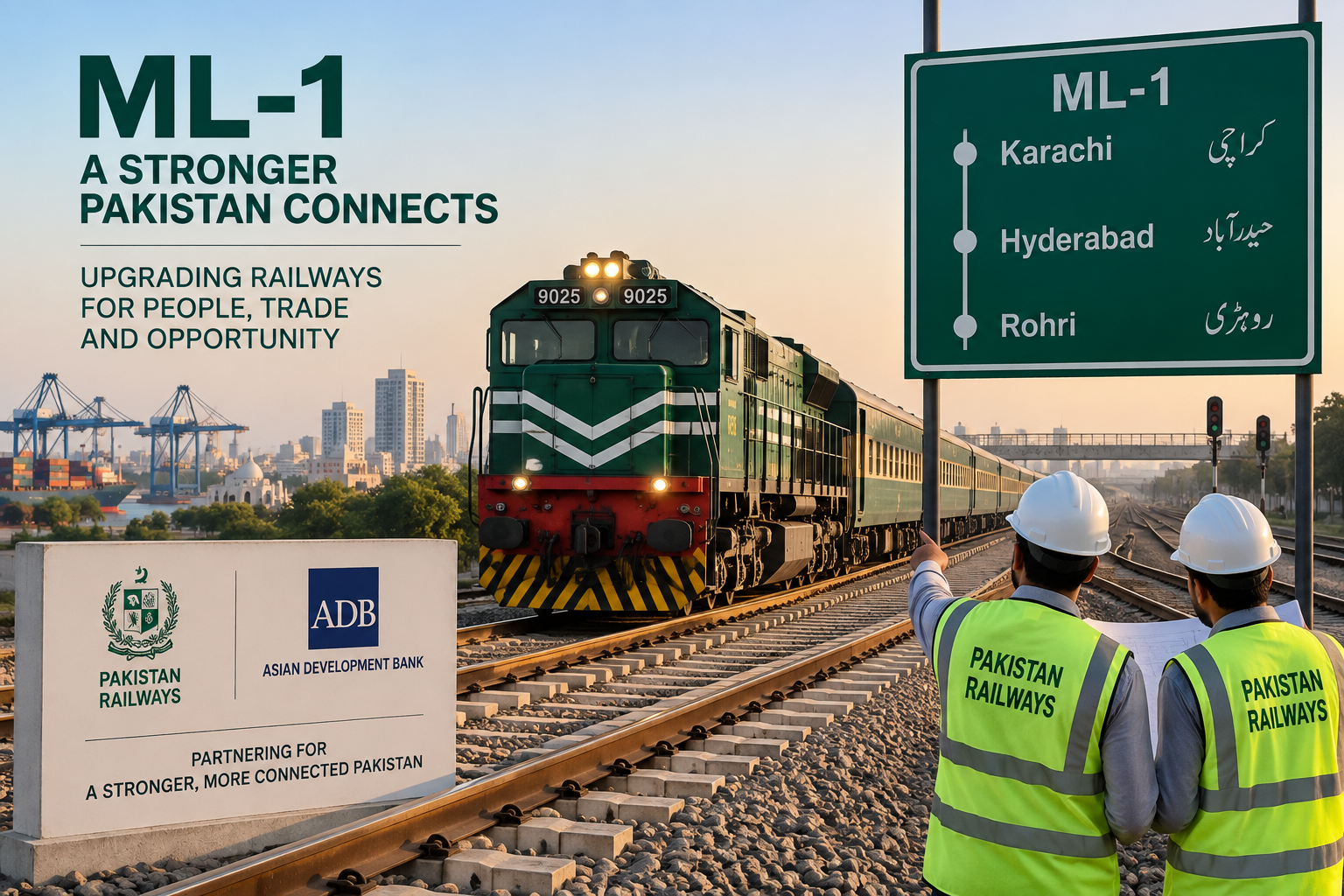
Pakistan Railways and the Asian Development Bank have completed another round of market consultations for the planned upgrade of the Karachi–Rohri section of Main Line-1, moving preparations for one of Pakistan’s largest transport infrastructure projects forward.
The second pre-market consultation attracted 134 participants, including domestic and international contractors, consultants, equipment suppliers and manufacturers.
The exercise is intended to gather industry feedback before procurement arrangements for the project are finalised.
What is being planned
The Karachi–Rohri section covers approximately 480 kilometres of Pakistan’s principal railway corridor.
The proposed upgrade includes extensive track and civil works along the route, as well as improvements to railway structures, stations, signalling and telecommunications infrastructure.
Government plans envisage new up and down tracks and measures to improve safety along the corridor.
Pakistan Railways says feedback gathered from companies participating in the consultation will be used to help shape the project’s procurement strategy.
Why the Karachi–Rohri section matters
ML-1 forms the main north-south railway corridor connecting major population centres and industrial areas across Pakistan.
The Karachi–Rohri section is particularly important because it connects the country’s largest city and principal port region with the railway network running further north.
Government officials have described the wider ML-1 upgrade as a national infrastructure priority.
Recent official discussions between Pakistan Railways and ADB have focused on financing and preparation of the Karachi–Rohri section, while the government continues to explore financing arrangements for other parts of ML-1.
ADB’s role
The Asian Development Bank is supporting preparations for the Karachi–Rohri project.
Pakistan has already secured a $10 million ADB project-readiness financing loan for preparatory work on the section, according to information provided by the government to the National Assembly.
The government has also been seeking a larger investment loan for construction.
Other international financial institutions have been approached as Pakistan explores financing options for the wider railway programme.
How much could it cost?
Recent government estimates have placed the Karachi–Rohri upgrade at roughly $2 billion to $2.5 billion, depending on the scope and stage of the estimate.
Federal Railways Minister Muhammad Hanif Abbasi said earlier this month that the government was working with an estimated cost of approximately $2.5 billion and wanted work on the section to begin during the current financial year.
Because financing, design and procurement preparations are still progressing, the eventual contract value and construction schedule should not be treated as final until the relevant agreements and procurement process are completed.
Why it matters
Pakistan’s railway system has struggled with ageing infrastructure, slow journey times and capacity constraints.
A successful ML-1 upgrade could improve passenger safety and reliability while also increasing the railway’s ability to carry freight.
Moving more freight by rail could be particularly important for businesses transporting goods between Karachi’s port region and industrial centres elsewhere in the country.
But a market consultation is a preparatory milestone — not the start of construction.
The bigger tests will be completion of financing arrangements, procurement and execution of the project.
What happens next
Pakistan Railways is expected to use feedback from the consultation as it develops the procurement strategy for the Karachi–Rohri section.
The government is simultaneously working with ADB and other development partners on financing and project documentation.
Further progress on the investment loan and procurement process will determine when physical construction can begin.
Pakistan Report will continue to track the ML-1 project as financing, procurement and construction plans develop.