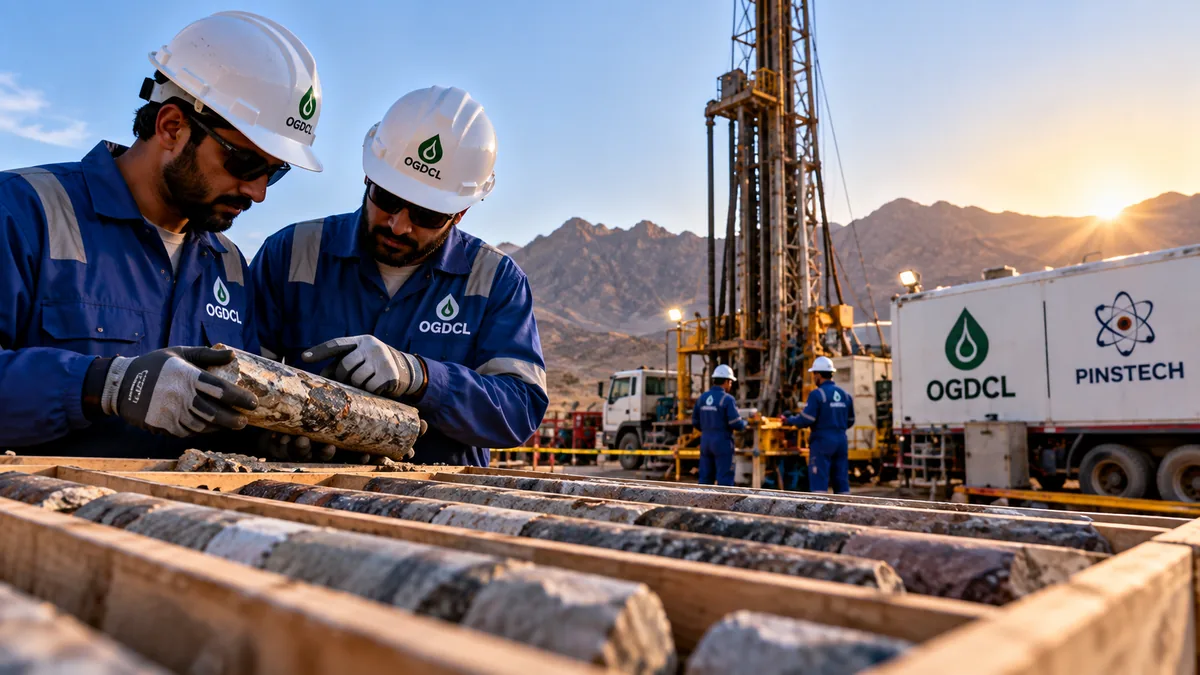
Oil and Gas Development Company Limited has begun a programme to test water and brine from selected wells for lithium, rare-earth elements and other critical minerals, after signing a contract with the Pakistan Institute of Nuclear Science and Technology.
Under the agreement, PINSTECH will provide advanced elemental and radioactive-element profiling services for samples collected from candidate OGDCL wells.
More than 2,000 samples are expected to be collected for testing, according to information released by the company and reported by Business Recorder.
What the testing will examine
PINSTECH will use Inductively Coupled Plasma, or ICP, techniques to profile produced water and brine from selected wells.
The analysis is intended to quantify lithium, rare-earth elements, precious metals and radioactive elements present in the samples. Produced water is water brought to the surface during oil and gas production, while brines can contain dissolved minerals in varying concentrations.
The programme allows OGDCL to screen existing well fluids for elements that could warrant further technical investigation.
Testing is not a commercial lithium discovery
The agreement is an exploration and analytical programme. It does not establish that OGDCL has discovered a commercially recoverable lithium deposit, nor does the planned testing show that extraction would be technically or economically viable.
Laboratory results would first have to establish what elements are present and at what concentrations. Any potential resource would then require further technical, economic and environmental assessment before a commercial project could be considered.
That distinction is particularly important because lithium has become strategically important for batteries and energy-storage technologies, while rare-earth and other critical minerals are used across electronics, energy and advanced manufacturing.
OGDCL brings existing well network into mineral screening
OGDCL is Pakistan’s largest oil and gas exploration and production company. Using samples from existing candidate wells gives the company a way to investigate whether fluids already encountered during hydrocarbon operations contain potentially useful concentrations of critical elements.
PINSTECH, which operates under the Pakistan Atomic Energy Commission, provides scientific and analytical capabilities that can be applied to elemental profiling and radioactive-element testing.
The contract therefore combines OGDCL’s well access and sample base with PINSTECH’s laboratory capabilities.
The significance of the programme will depend on the test results. Until concentrations, recovery methods and economics are established, the development should be understood as systematic testing for lithium and other critical minerals, rather than evidence that Pakistan has identified a new commercially viable lithium resource.
What to watch next
The next meaningful milestone will be the laboratory data produced by the sampling programme. Even if testing identifies elevated concentrations of lithium or other critical elements, that would be an early technical signal rather than proof of a commercially recoverable resource.
Any move beyond screening would require additional geological, engineering, economic and environmental work. Questions about recovery methods, processing costs and scale cannot be answered by the contract announcement alone. Until OGDCL or the relevant authorities publish that evidence, claims about the size or commercial value of a lithium resource would go beyond what the current programme establishes.