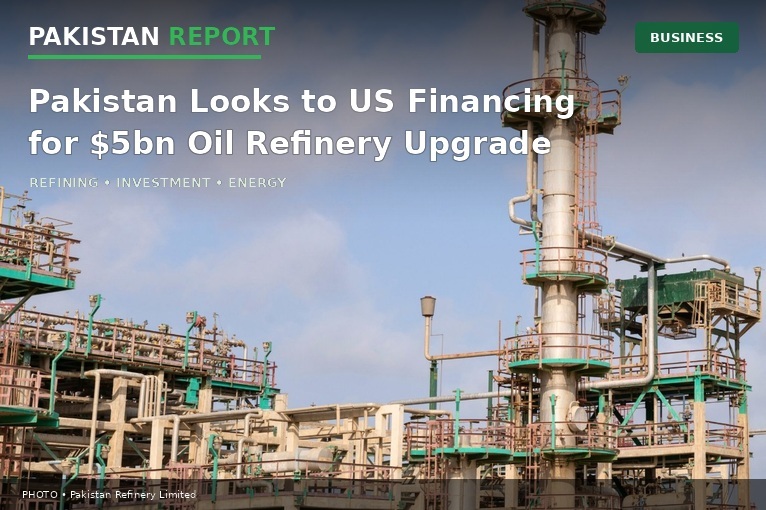
Pakistan is discussing possible financing support from the United States for a multibillion-dollar programme to modernise the country’s oil refineries, as the government moves to turn a long-delayed upgrade policy into investment projects.
Finance Minister Muhammad Aurangzeb told Reuters that discussions were under way with the US International Development Finance Corporation, or DFC, in connection with an oil-refinery upgrade programme estimated at about $5 billion.
The distinction is important: the $5bn figure describes the approximate scale of the refinery programme. It is not an approved $5bn financing package from the United States. The amount, structure and timing of any DFC participation remain under discussion.
Pakistan’s existing refineries have faced years of pressure to modernise ageing plants, improve fuel quality and reduce the country’s dependence on imported petrol and diesel. The government’s revised Brownfield Refining Policy is intended to provide the framework for those investments.
What the upgrades are meant to do
The programme covers Pakistan’s five major refineries: Pak-Arab Refinery Limited, Pakistan Refinery Limited, National Refinery Limited, Cnergyico and Attock Refinery Limited.
Under the government’s policy, the refineries are expected to install new processing units and modernise existing facilities so they can produce cleaner, Euro 5-compliant fuels. The upgrades are also intended to increase domestic production of petrol and high-speed diesel while reducing the proportion of lower-value furnace oil produced by the plants.
Government and industry estimates of the total investment requirement have varied. Market estimates have commonly placed the planned projects in the $4.5bn-$5bn range, while government statements around the revised policy have put potential investment at about $6bn.
In July, the government approved a revamped Brownfield Refining Policy after years of delays. Dawn reported that the framework was designed to attract about $6bn in investment and included measures covering investment protection, tax treatment, foreign-exchange arrangements for machinery imports and storage capacity.
The Economic Coordination Committee subsequently approved a draft upgrade agreement that provides the framework for implementing and monitoring the projects. The agreement gives participating refineries a five-year period to complete their upgrades.
Financing remains the key question
Large refinery projects require substantial foreign currency for imported equipment, engineering and construction. That makes access to long-term external financing an important part of whether the programme can move from policy approval to construction.
Pakistan has previously looked at possible investment or financing interest from partners including Saudi Arabia, Azerbaijan and Türkiye. The latest US discussions add another potential source of capital, but they do not yet amount to a final financing commitment.
The refinery programme also comes at a time when Pakistan remains exposed to swings in global oil prices. Increasing local production of higher-quality petrol and diesel would not eliminate the need for imported crude oil, but the government argues that modern plants could reduce reliance on imported finished fuels and improve the efficiency of the domestic refining system.
For the five refineries, the next phase will depend on signed upgrade agreements, financing arrangements and the ability to execute complex projects within the policy timetable.
For Pakistan, the broader test is whether a reform discussed for years can now attract the capital required to modernise a strategically important part of the energy system.
Sources
- Reuters, September 17, 2026: Pakistan eyes bigger China swap line, expects US financing decision soon.
- Dawn, July 28-29, 2026: reporting on the revised Brownfield Refining Policy.
- Dawn, September 15, 2026: Economic Coordination Committee approval of the draft refinery upgrade agreement.