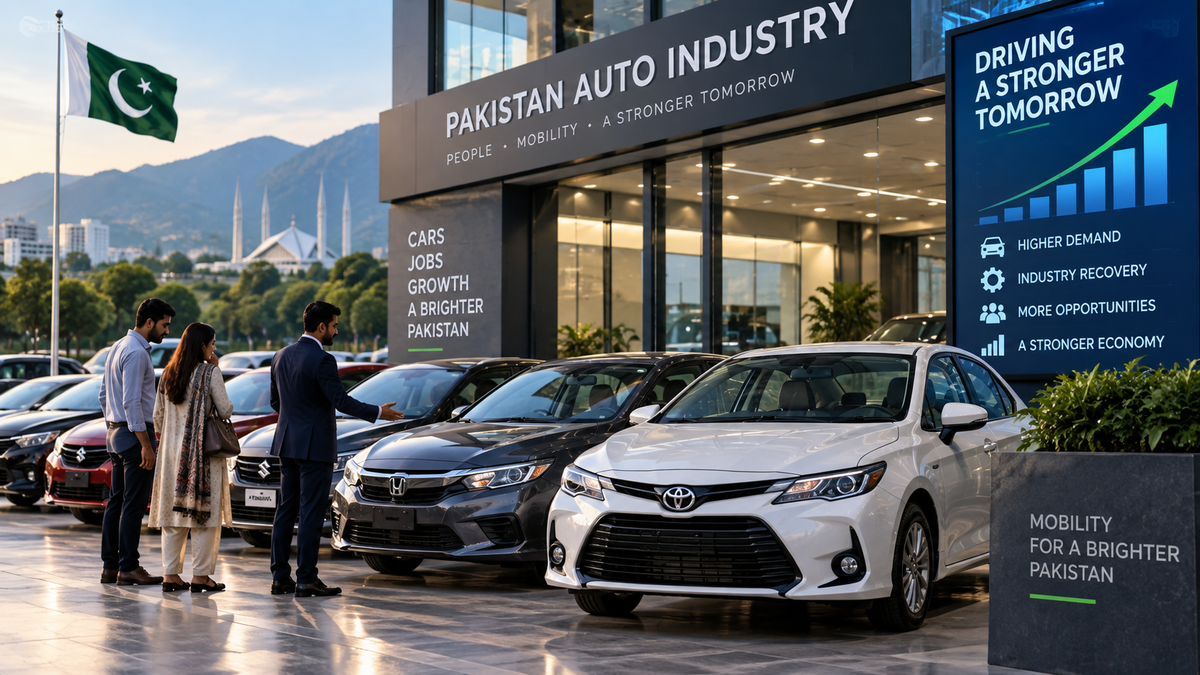
Pakistan’s passenger-car market has begun the new fiscal year far ahead of last year’s sales pace, although a sharp month-on-month decline in August shows that the recovery is not proceeding in a straight line.
Passenger-car sales reached 30,933 units in July and August 2026, up 79.9% from 17,192 units during the same two months a year earlier, according to figures based on Pakistan Automotive Manufacturers Association data.
August alone produced a more mixed picture.
Passenger-car sales stood at 13,717 units, 36.4% higher than the 10,057 units sold in August 2025 but 20.3% below the 17,216 units recorded in July 2026. Passenger-car production similarly declined to 13,267 units in August from 17,307 in July.
The result is an auto market showing strong annual recovery while losing some of the momentum seen at the beginning of the fiscal year.
Different segments are moving in different directions
The recovery has not been uniform across the industry.
Sales of jeeps and pickups totalled 4,443 units during July-August, down about 44% from the comparable period a year earlier. By contrast, two- and three-wheeler sales reached 351,492 units over the two months, about 29% higher year on year.
August’s passenger-car figures also show substantial differences between manufacturers and models.
Toyota’s Corolla, Yaris and Corolla Cross range recorded 3,079 sales during August, while Honda’s City and Civic reached 2,553 units. Suzuki Alto remained a major volume model, with 5,339 units sold during the month.
Policy uncertainty clouds the recovery
Industry representatives have linked the recent monthly slowdown partly to uncertainty surrounding Pakistan’s next automotive policy and the treatment of hybrid and other electrified vehicles.
The Pakistan Automotive Manufacturers Association has argued that the expiry of the previous Automotive Industry Development and Export Plan without a replacement framework has left manufacturers and buyers waiting for greater policy clarity. Passenger-car production fell 23% month on month in August, while sales declined 20%.
That makes the year-on-year numbers important but insufficient on their own to describe the state of the industry.
A market can be substantially larger than it was during a weak comparable period while simultaneously slowing from the previous month. Pakistan’s latest figures show both trends at once.
Why it matters
Vehicle sales are one indicator of household demand, financing conditions and confidence in big-ticket purchases. The near-80% increase in passenger-car sales during the first two months of FY27 therefore represents a meaningful improvement from the corresponding period last year.
But August’s decline suggests the industry’s next phase will depend partly on whether stronger demand can persist and whether the government resolves policy uncertainty affecting manufacturers and buyers.
What happens next
September sales will provide a clearer test of whether August was a temporary cooling after a strong July or the beginning of a more sustained slowdown.