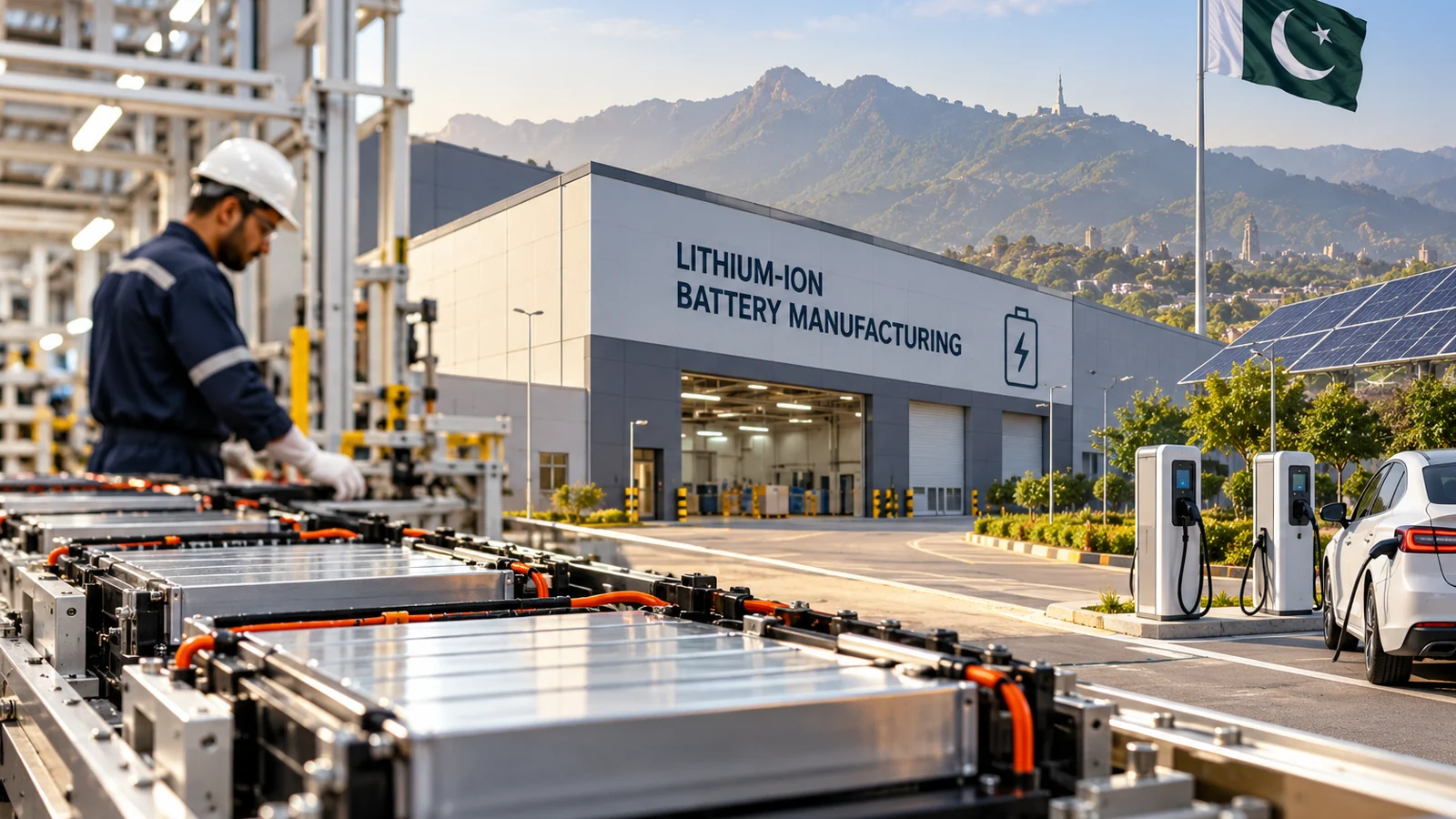
ISLAMABAD, October 27, 2026: A proposed $2.25 billion lithium-ion battery manufacturing project in Rawalpindi remains dependent on government policy approval before commercial production can begin.
Engineering Development Board chief executive Hamad Ali Mansoor said Margalla Heavy Industries Limited had reached an agreement with Chinese and Pakistani investors to establish the facility.
Speaking in an interview with Arab News, Mansoor said feasibility studies were complete and manufacturing equipment had been installed.
He estimated that production could start six to eight months after approval of the government’s lithium-ion battery manufacturing policy.
The proposed factory would initially manufacture battery cells with a capacity equivalent to approximately 200–300 megawatts, before expanding towards a planned annual capacity exceeding 1,000 megawatts, according to the official.
Domestic battery production could support electric vehicles and electricity storage, particularly as Pakistan expands solar power and other renewable energy technologies.
The investment also has implications for Pakistan’s industrial supply chain, where local battery-cell manufacturing could reduce dependence on imported components and create opportunities for related industries.
Pakistan’s Finance Division has separately discussed regulatory opportunities associated with battery energy storage, electric mobility and private-sector investment.
The Rawalpindi project brings these policy priorities into focus, linking manufacturing investment with the country’s growing demand for energy storage and electric transport.