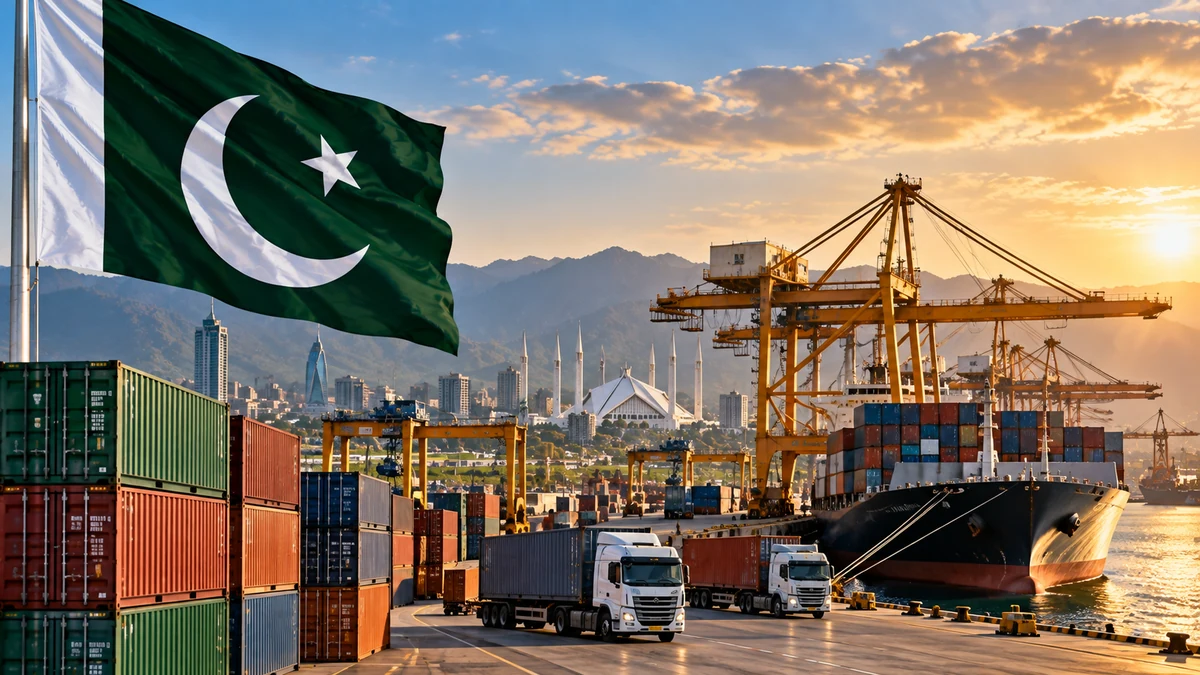
Pakistan needs to raise exports to $100 billion by 2035 as part of its drive towards a $1 trillion economy, Planning Minister Ahsan Iqbal has said, while calling for denser vertical development to address the country’s growing urban and housing pressures.
Iqbal made the remarks on Wednesday while chairing the eighth National Economic Mission meeting under the Uraan Pakistan framework, focused on housing, construction and real estate market activation.
The $100 billion figure is a government target for 2035, not a current export level or an official forecast that the target will necessarily be achieved.
According to the Planning Ministry, Iqbal said sustainable economic growth would require a significant and sustained increase in exports as well as greater productive capacity.
He linked the export goal to the government’s wider ambition of building a $1 trillion economy by 2035 and reducing dependence on external support.
The government has repeatedly used the $100 billion export objective across its sectoral planning work, including discussions covering technology, pharmaceuticals, agriculture and regional connectivity.
Wednesday’s meeting placed that wider economic ambition alongside Pakistan’s housing and urban-development challenge.
A presentation at the meeting said construction supports 72 allied industries and accounts for approximately 9.5% of national employment.
It also highlighted the widening gap between housing demand and supply. Pakistan’s urban population increased from about 76 million in 2017 to 94 million in 2023, while annual housing demand was estimated at around 700,000 units against supply of approximately 250,000.
That implies an estimated annual shortfall of about 450,000 housing units, according to figures presented at the meeting.
Iqbal called for greater vertical development and more efficient use of limited urban land, arguing that unchecked horizontal expansion was putting pressure on agricultural land.
The policy direction would require cities to accommodate more housing and commercial activity through denser development rather than continuing to spread outward at the same pace.
The minister also called for modern construction practices and stronger activation of the real estate and construction sectors, which the government views as important sources of employment and demand across associated industries.
The discussion reflects two different but connected parts of the Uraan Pakistan strategy: increasing the economy’s capacity to earn foreign exchange through exports while changing the way domestic urban growth is accommodated.
Neither objective is automatic. Reaching $100 billion in exports would require a large expansion in productive capacity, competitiveness, value addition and access to international markets over the remainder of the decade.
Similarly, a shift towards vertical urban development would depend on planning rules, infrastructure, financing, construction standards and the ability of cities to support higher-density development.
The government has increasingly presented export expansion as central to its long-term economic programme. In recent Planning Ministry discussions, officials have asked sectors including automobiles and pharmaceuticals to develop export strategies and have explored an export accelerator programme with the Asian Development Bank.
Those initiatives indicate that the 2035 target is being used as a benchmark across multiple policy areas rather than being tied to a single export sector.
Wednesday’s housing and construction meeting did not announce a new export package or provide a year-by-year path to $100 billion.
Its immediate policy emphasis was on activating construction and real estate, improving housing supply and encouraging vertical development while placing those measures within the government’s broader 2035 economic ambitions.
The test for the strategy will be whether sector-specific plans translate the headline targets into measurable gains in exports, investment, housing supply and productivity over the coming years.