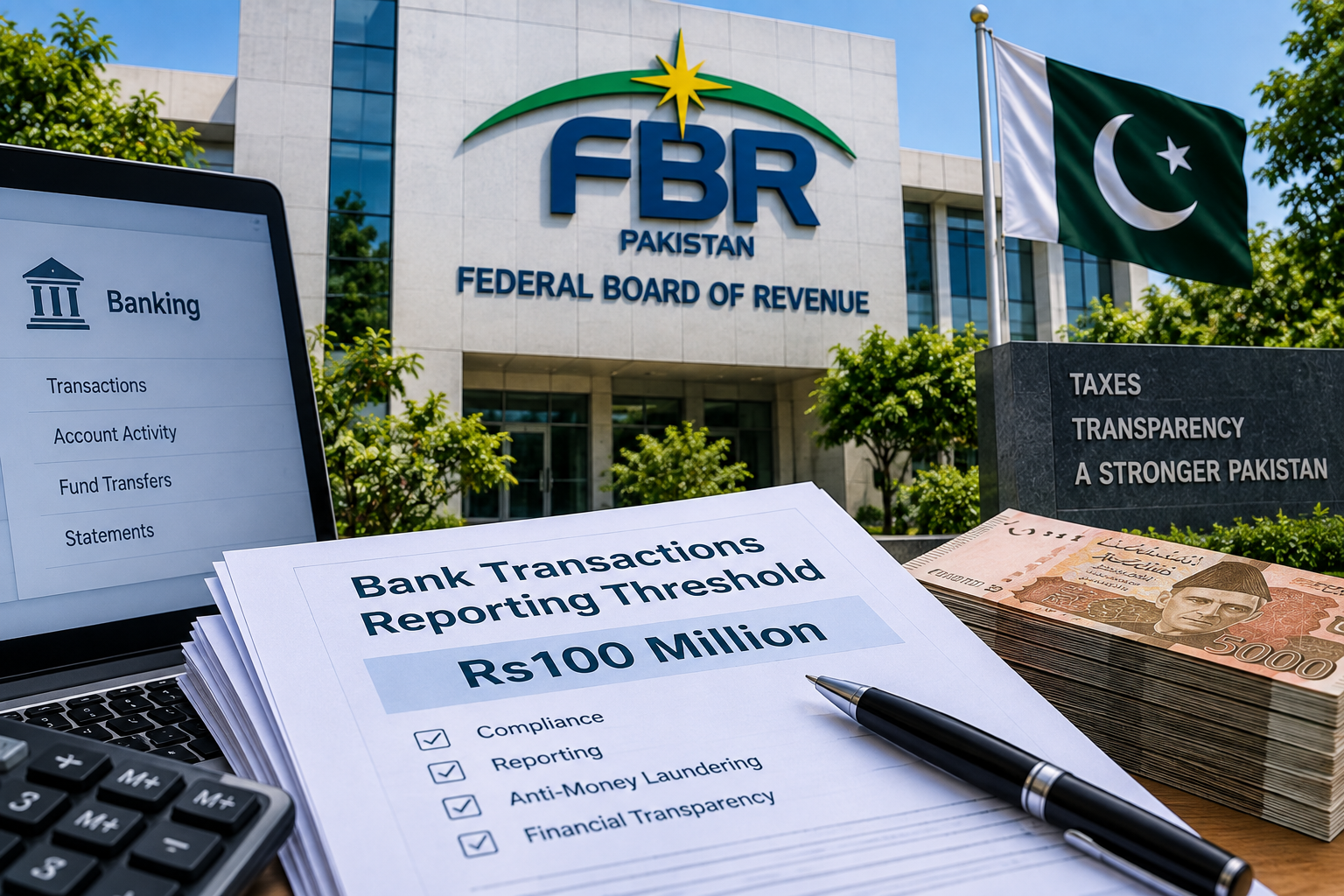
The Federal Board of Revenue has explained the legal requirement for banks and electronic money institutions to report information about account holders whose deposits or withdrawals exceed Rs100 million during a six-month reporting period.
The framework is in force under the Finance Act 2026. FBR’s Circular No. 02 of 2026-27, dated September 8, explains the amendments; it does not create a new requirement taking effect on September 10.
The Act and circular establish the legal obligations, but do not by themselves establish when live uploads or automated matching began in practice.
What the threshold covers
The new section 165AB of the Income Tax Ordinance places the electronic reporting obligation on banking companies and electronic money institutions.
Under the Finance Act, the threshold concerns deposits or withdrawals exceeding Rs100 million during the reporting period in any or all accounts maintained by an account holder.
It is not simply a test of the account’s closing balance, nor does it necessarily require one transaction above Rs100 million. The relevant measure is activity during the reporting period across the accounts covered by the provision.
Those periods run from July 1 to December 31 and January 1 to June 30. The information specified includes opening and closing balances, peak credits and total credits.
The section also defines corresponding “specified dates” of January 31 and July 31. These definitions should be read alongside the operative requirements and applicable directions when determining submission obligations.
How the information is handled
FBR’s circular explains that information is to be uploaded to the Central Data Hub for automated comparison with tax records. During that matching process, the information is not to be visible to income-tax authorities.
Where a gross mismatch arises, relevant information is to enter FBR’s Compliance Risk Management system, with further proceedings handled through the National Faceless Centre. The framework also requires confidentiality safeguards. FBR circular, section 12.
Crossing the reporting threshold is therefore not itself a tax charge or a finding of wrongdoing. Reporting supplies information for comparison; any subsequent proceedings are a separate stage.
Who maintains the data?
The Act defines the Central Data Hub as a virtual repository maintained by FBR through PRAL. Separately, the amendment to section 175AA authorises SBP to establish and maintain a secure centralised repository of prescribed banking information.
These are distinct provisions. Describing the entire arrangement simply as an SBP database would obscure the responsibilities set out in the legislation. Finance Act, printed pages 570–572.
Why it matters
The framework connects significant banking activity with tax-record verification while imposing limits on how information is accessed and used.
For reporting institutions, accuracy and confidentiality are central obligations. For account holders, the important distinction is between being included in a report and having a discrepancy that leads to further proceedings.
Operational directions on submission procedures and technical formats will help institutions apply the framework consistently. For readers assessing the rules, the key points are the six-month threshold, the institutions responsible for reporting and the separate process for handling mismatches.
Sources
- Finance Act 2026, Act No. XLIII of 2026, gazetted June 26, 2026: printed pages 570–572, inserting section 165AB and amending section 175AA.
- FBR Circular No. 02 of 2026-27 — Explanation of Important Amendments Made in the Income Tax Ordinance, 2001, September 8, 2026: section 12, printed page 5.