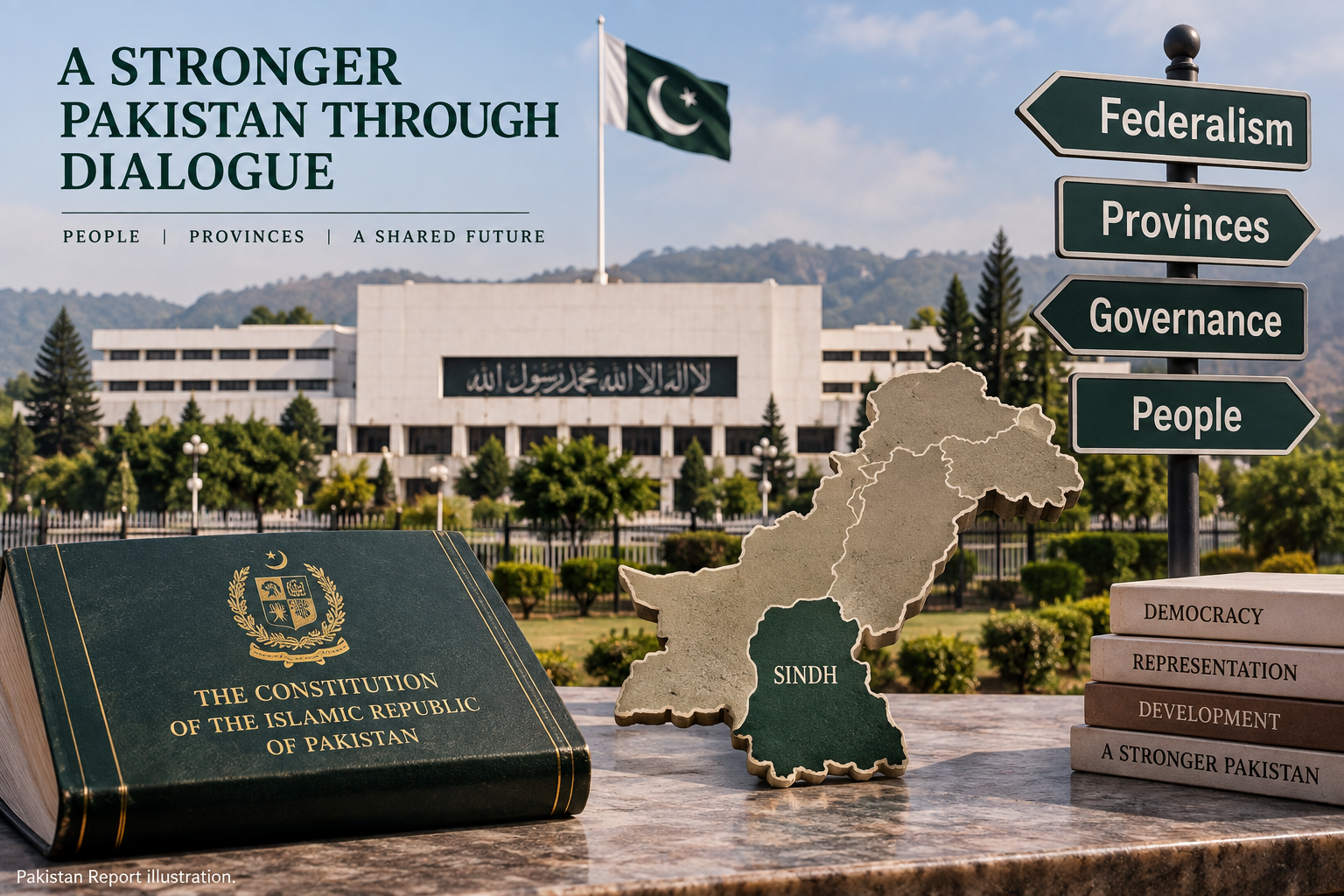
Pakistan’s debate over creating new provinces and administrative units is intensifying, with political leaders calling for the issue to be discussed in Parliament while the Sindh Assembly has formally rejected any attempt to alter the province’s existing territorial boundaries.
The Sindh Assembly has communicated its position to the country’s top federal institutions after unanimously adopting a resolution opposing proposals that would divide Sindh or detach any district, division or territory from the province.
The development highlights an important constitutional reality: creating a new province from the territory of an existing province cannot be accomplished simply through an administrative decision.
What the Sindh Assembly has done
The Provincial Assembly of Sindh has formally sent its resolution to the President, Prime Minister, Senate and National Assembly.
The resolution rejects proposals that would divide Sindh, alter its territorial limits or place part of the province under a separate administrative arrangement.
It also states that the Assembly would use its constitutional authority to oppose any such change.
The resolution was adopted unanimously.
What does the Constitution say?
Article 239 of Pakistan’s Constitution governs amendments to the Constitution.
Under Article 239(4), a constitutional amendment that would alter the limits of a province cannot be presented to the President for assent unless it has also been passed by the assembly of the affected province with the votes of at least two-thirds of its total membership.
That creates an important additional hurdle for proposals involving the territory of an existing province.
In practical terms, Parliament alone cannot simply redraw a province’s boundaries without the constitutionally required support of the affected provincial assembly.
Why are new provinces being discussed?
The latest debate forms part of a wider discussion about governance and whether Pakistan’s existing administrative structure adequately serves a large and growing population.
Interior Minister Mohsin Naqvi has previously argued for a broader review of the country’s governance structure and additional administrative units.
Supporters of creating more provinces or administrative units have historically argued that smaller units could bring government closer to citizens and improve administration.
Opponents have raised concerns about provincial identity, territorial integrity, political representation and control over resources.
Those competing considerations mean that any serious proposal would involve political as well as constitutional negotiations.
Bilawal calls for debate in Parliament
PPP Chairman Bilawal Bhutto-Zardari said on Wednesday that the issue of new provinces should be debated in Parliament.
His comments came amid disagreement between PPP figures and federal officials over the governance debate.
The PPP has particularly resisted suggestions that could result in the division of Sindh.
Bilawal’s position nevertheless leaves room for a national parliamentary debate over governance and administrative reform rather than treating every discussion about reform as an immediate constitutional proposal.
Why this matters beyond Sindh
The debate is not only about provincial boundaries.
Pakistan’s federal structure determines how political representation, administrative authority and public resources are distributed between the federation and the provinces.
Creating a new province could therefore affect parliamentary representation, provincial finances, administrative institutions and the distribution of resources.
It could also raise questions about the National Finance Commission, which determines how a major share of federal revenues is distributed among the provinces.
Any proposal would consequently require considerably more detail than a general call for “more provinces.”
What happens next
At present, Pakistan is witnessing a political debate rather than a completed constitutional process for creating a new province.
No province can be carved out of Sindh merely because a political figure or government official proposes the idea.
A concrete proposal would have to navigate the constitutional amendment process, including the special requirement that applies when the territorial limits of an existing province would be changed.
For now, the Sindh Assembly has placed its opposition formally on record, while political leaders continue to debate whether Pakistan’s broader governance structure needs reform.
Pakistan Report will track any concrete legislative or constitutional proposals that emerge from the debate.