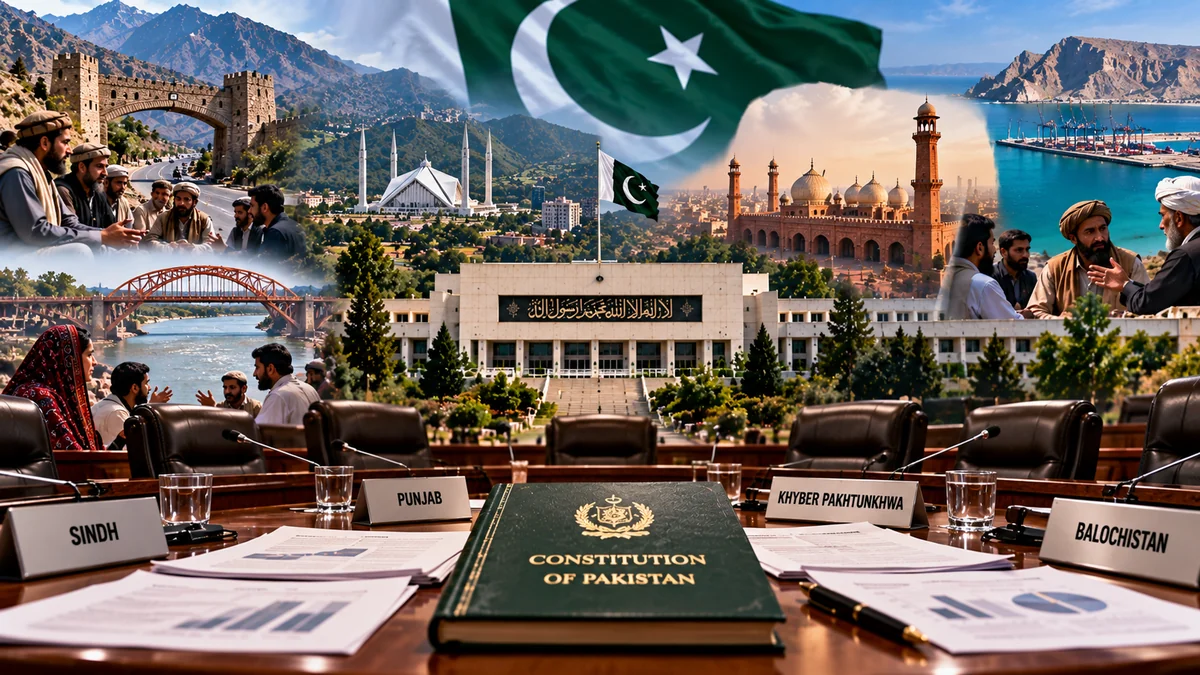
Pakistan’s renewed debate over creating additional provinces has revived a fundamental constitutional question: how can administrative boundaries be changed without bypassing the consent of the provinces affected?
The issue has drawn attention from federal politicians, coalition partners and provincial assemblies. Advocates have raised arguments about representation and public-service delivery, while opponents warn that territorial changes could deepen political and identity-based tensions.
What the Constitution requires
Article 239 of Pakistan’s Constitution sets the procedure for constitutional amendments. Under Article 239(4), a bill altering the limits of a province cannot be presented to the president for assent unless the assembly of the affected province has passed it by a two-thirds majority of its total membership.
The bill also needs approval by at least two-thirds of the total membership of each house of Parliament under Article 239. That provincial safeguard sits alongside the supermajority requirements for constitutional amendments in Parliament. A political announcement, ordinary resolution or proposed referendum does not by itself create a new province.
Why Sindh is central to the debate
On 3 September, the Sindh Assembly unanimously passed a resolution rejecting proposals that could divide Sindh or alter its territorial limits. The assembly secretariat published the resolution on 7 September. The resolution illustrates how a nationwide administrative debate can become a question of provincial consent and identity.
The debate also involves different political positions within the governing coalition. Public discussion should distinguish a party’s openness to debating new units from formal support for a specific map or constitutional amendment.
Administrative arguments and objections
Proponents of additional provinces argue that smaller units could bring decision-making closer to residents and improve access to government services. Critics question whether redrawing boundaries would solve administrative weaknesses without stronger local government, fiscal accountability and effective implementation of existing constitutional powers.
Neither outcome is automatic. Creating a province would raise practical questions about revenue distribution, institutions, representation, assets, liabilities and the status of linguistic and regional communities.
What happens next?
Federal Parliamentary Affairs Minister Tariq Fazal Chaudhry said in September that Parliament would debate the issue in October. A debate is not equivalent to an agreed constitutional amendment, and the sources reviewed do not establish that a final provincial map or amendment bill has been adopted.
The key test is whether any proposal moves from public argument to a published constitutional text capable of securing the required parliamentary and affected-provincial support.
Sources: Provincial Assembly of Sindh, resolution of 3 September 2026; Express Tribune, parliamentary debate proposal; Arab News, coalition positions; The Friday Times, constitutional analysis, 16 October 2026