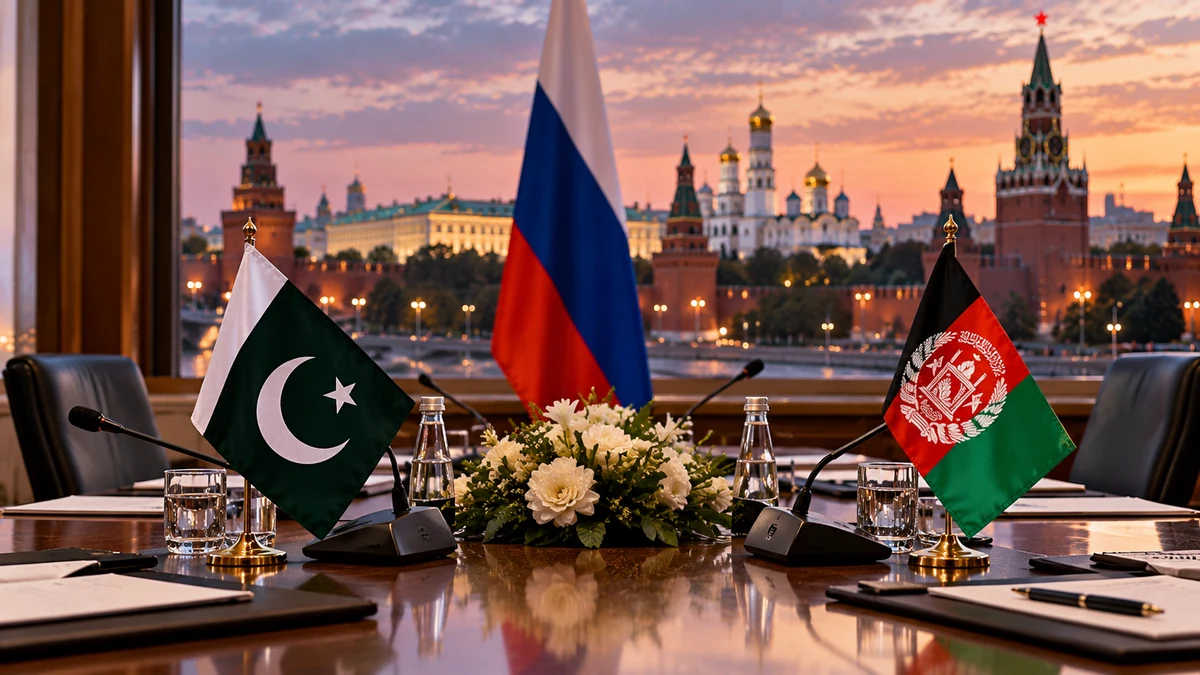
The eighth Moscow Format consultations on Afghanistan ended without a joint statement after the Pakistani and Afghan delegations failed to agree on the wording of the proposed document.
Russia’s special representative for Afghanistan, Zamir Kabulov, confirmed after the October 5 meeting that differences between Pakistan and Afghanistan prevented participants from adopting the statement.
According to Kabulov, the Afghan delegation objected to language in the draft that it believed referred too frequently to Afghanistan in the context of terrorism.
He said similar language had appeared in the previous Moscow Format statement, but the Afghan side argued that circumstances in bilateral relations had changed and that the wording was no longer acceptable.
The disagreement is significant because participants had been expected to conclude the meeting with a joint document.
Pakistan entered the consultations with terrorism at the centre of its position.
Pakistan’s Special Representative for Afghanistan Mohammad Sadiq told the meeting that terrorism remained at the core of Afghanistan’s challenges and reiterated Islamabad’s position that it would take appropriate measures to protect its citizens in accordance with international law.
Afghan Foreign Minister Amir Khan Muttaqi, meanwhile, said problems between Afghanistan and Pakistan could be addressed through diplomacy and dialogue.
The two countries have traded competing accusations over cross-border militancy and military action. Those claims remain disputed and should be attributed to the respective governments rather than treated as independently established facts.
Despite the failure to agree on a final statement, the Moscow Format itself remains in place.
Kabulov said the forum was designed to coordinate regional approaches to Afghanistan rather than resolve bilateral disputes between individual participating countries.
He also said participating countries called on Afghanistan and Pakistan to refrain from military action against each other and expressed willingness to help seek political and diplomatic solutions.
The wider meeting included representatives from Afghanistan, India, Iran, Kazakhstan, Kyrgyzstan, China, Pakistan, Russia, Tajikistan and Uzbekistan, with Belarus and Egypt participating as guests.
Participants continued to support regional engagement with Afghanistan and called for regular humanitarian assistance without politicisation, according to Russia’s Foreign Ministry.
For Pakistan, the outcome is more consequential than simply attending the meeting. It demonstrates that Islamabad’s security concerns over Afghanistan were substantial enough to become a point of disagreement in negotiations over the forum’s final text.
At the same time, failure to adopt a joint statement should not be interpreted as the collapse of the Moscow Format or the end of Pakistan-Afghanistan diplomacy.
The immediate outcome is narrower: regional consultations continued, but the participating countries could not issue their traditional joint statement because the Pakistani and Afghan delegations could not agree on its language.