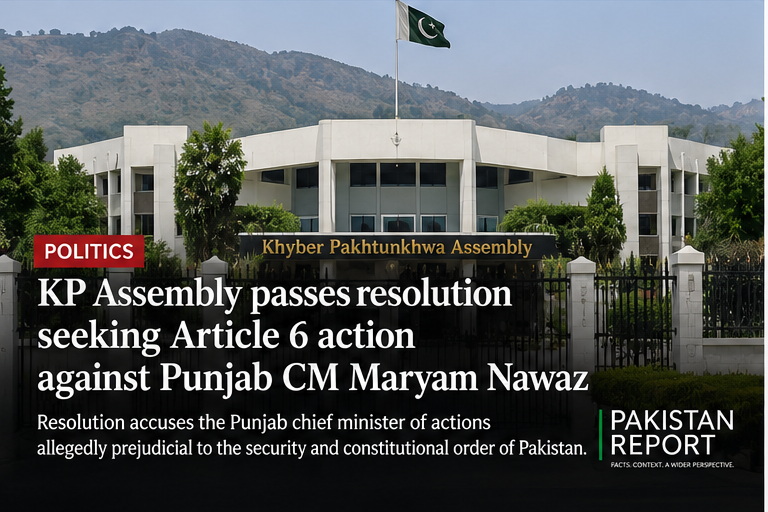
The Khyber Pakhtunkhwa Assembly has passed a resolution seeking action under Article 6 of the Constitution against Punjab Chief Minister Maryam Nawaz, escalating a political dispute over remarks concerning security threats from neighbouring provinces.
The resolution criticised the Punjab chief minister’s remarks and described them as harmful to national unity. Its passage turns what had been a political controversy into a formal position adopted by a provincial legislature.
Article 6 deals with high treason involving the abrogation, subversion, suspension or holding in abeyance of the Constitution, or attempts or conspiracies to do so. A provincial assembly resolution does not by itself establish that such an offence has occurred.
What changed
The significant development is the KP Assembly’s formal adoption of a resolution calling for Article 6 action.
That raises the political stakes between governments and parties already divided over security, governance and the treatment of political opponents. It also places unusually serious constitutional language into an inter-provincial political dispute.
Why it matters
Relations between Pakistan’s federal and provincial political actors have remained highly contentious, particularly where security and opposition politics overlap.
Invoking Article 6 is especially significant because the constitutional provision concerns one of the country’s gravest categories of wrongdoing. Its political use therefore attracts scrutiny even when a resolution has no immediate legal effect.
The dispute also matters beyond the personalities involved. Statements linking security threats to neighbouring provinces can become politically sensitive in a federation where counterterrorism, policing and movement across provincial boundaries require cooperation.
What happens next
The resolution itself does not automatically initiate or determine an Article 6 case. Any legal process would require steps beyond a provincial assembly vote and would be governed by Pakistan’s constitutional and statutory framework.
The more immediate consequence is political: the resolution is likely to deepen confrontation between the KP and Punjab leaderships and could generate responses from the Punjab government, federal political parties and other institutions.