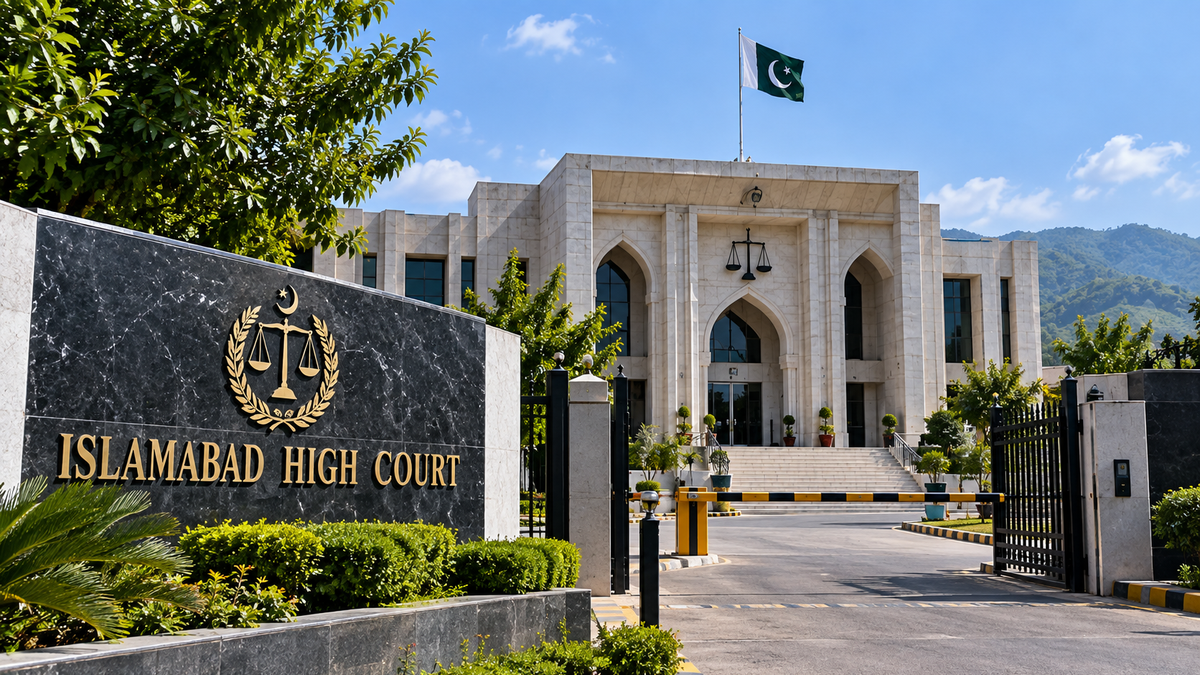
The Islamabad High Court has ruled that political parties and public office-holders have no lawful authority to block roads, highways, interchanges, toll plazas or buildings in the federal capital, while directing provincial governments to keep official resources out of political protests.
A three-member larger bench headed by Islamabad High Court Chief Justice Sardar Muhammad Sarfraz Dogar, with Justice Muhammad Azam Khan and Justice Muhammad Asif, issued the directions while disposing of a petition concerning a planned Pakistan Tehreek-e-Insaf long march and protest in Islamabad on September 27.
The ruling puts the court’s focus on two related issues: citizens’ freedom of movement and the use of government machinery for partisan political activity. The court directed the chief ministers of all provinces to ensure that government resources and official machinery are not used for political gatherings.
The case had also drawn assurances from Khyber Pakhtunkhwa officials. Reporting on the judgment said affidavits were submitted by the province’s chief secretary and inspector general of police stating that provincial resources would not be used for the planned demonstration.
The court’s directions go beyond the immediate dispute over a single planned march. They establish a clear judicial position that political activity does not confer authority to obstruct public infrastructure in Islamabad. The ruling also places responsibility on senior provincial authorities to prevent state resources from being drawn into party protests.
The judgment comes in a political environment in which marches and demonstrations in the capital can affect major roads and entry points. By framing access to roads and public places as a matter of lawful public movement rather than simply protest management, the court has set a standard that authorities and political parties will have to consider when planning future demonstrations.
The decision does not amount to a general prohibition on political protest. Its operative emphasis, as reported, is on blocking roads and public infrastructure and on the use of official machinery and resources. That distinction will matter when authorities apply the ruling to future gatherings.
For the planned September 27 protest, the immediate next step is implementation. Provincial chief ministers and senior administrative and police officials will be expected to ensure that official resources remain separate from political activity, while authorities in Islamabad will have to manage any demonstration in line with the court’s directions.
The broader test will be how consistently the ruling is enforced when large political gatherings take place in the federal capital.