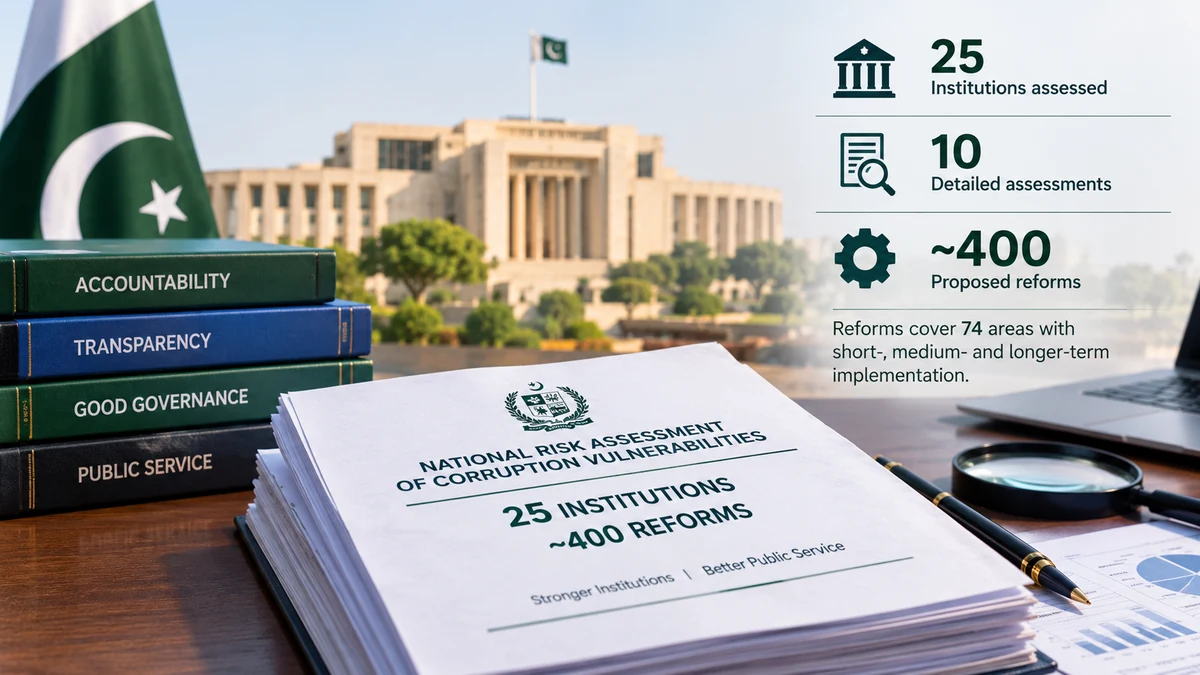
ISLAMABAD: The federal government has proposed approximately 400 reforms to address corruption risks and administrative weaknesses identified in an assessment of 25 federal institutions.
Law Minister Azam Nazeer Tarar presented the findings of the National Risk Assessment of Corruption Vulnerabilities on Friday, November 20, during a news conference attended by Information Minister Attaullah Tarar and Minister of State for Finance Bilal Azhar Kayani.
Prepared through coordination between the Ministry of Law and Justice and other government departments, the assessment used more than 300 indicators to examine institutional procedures, financial controls and oversight mechanisms.
Ten institutions underwent detailed examination because of their financial operations and exposure to potential irregularities.
The institutions named included the Federal Board of Revenue, Pakistan Railways, the National Highway Authority, Sui Northern Gas Pipelines, the Benazir Income Support Programme and electricity distribution companies.
The assessment identified weaknesses in internal controls, accountability arrangements and administrative procedures that could create opportunities for misuse of authority or financial losses.
The law minister clarified that the findings did not constitute allegations of corruption against any institution or individual. He described the exercise as a preventive measure intended to strengthen transparency and institutional performance.
The government has proposed approximately 400 corrective measures across 74 reform areas. According to the official announcement, 146 measures are intended for completion within two years, 159 within five years and 91 involve longer-term legal and institutional changes.
The initiative forms part of Pakistan’s governance reform commitments under its programme with the International Monetary Fund, which has previously identified weaknesses in public financial management and institutional oversight.
Officials also highlighted ongoing efforts to digitise government procedures, including tax administration, customs clearance, welfare payments and electricity monitoring.
The government plans to share the assessment with relevant institutions and international organisations, while provincial administrations may also use its methodology.
The effectiveness of the proposed reforms will depend on their implementation and the government’s ability to address the institutional weaknesses identified in the assessment.