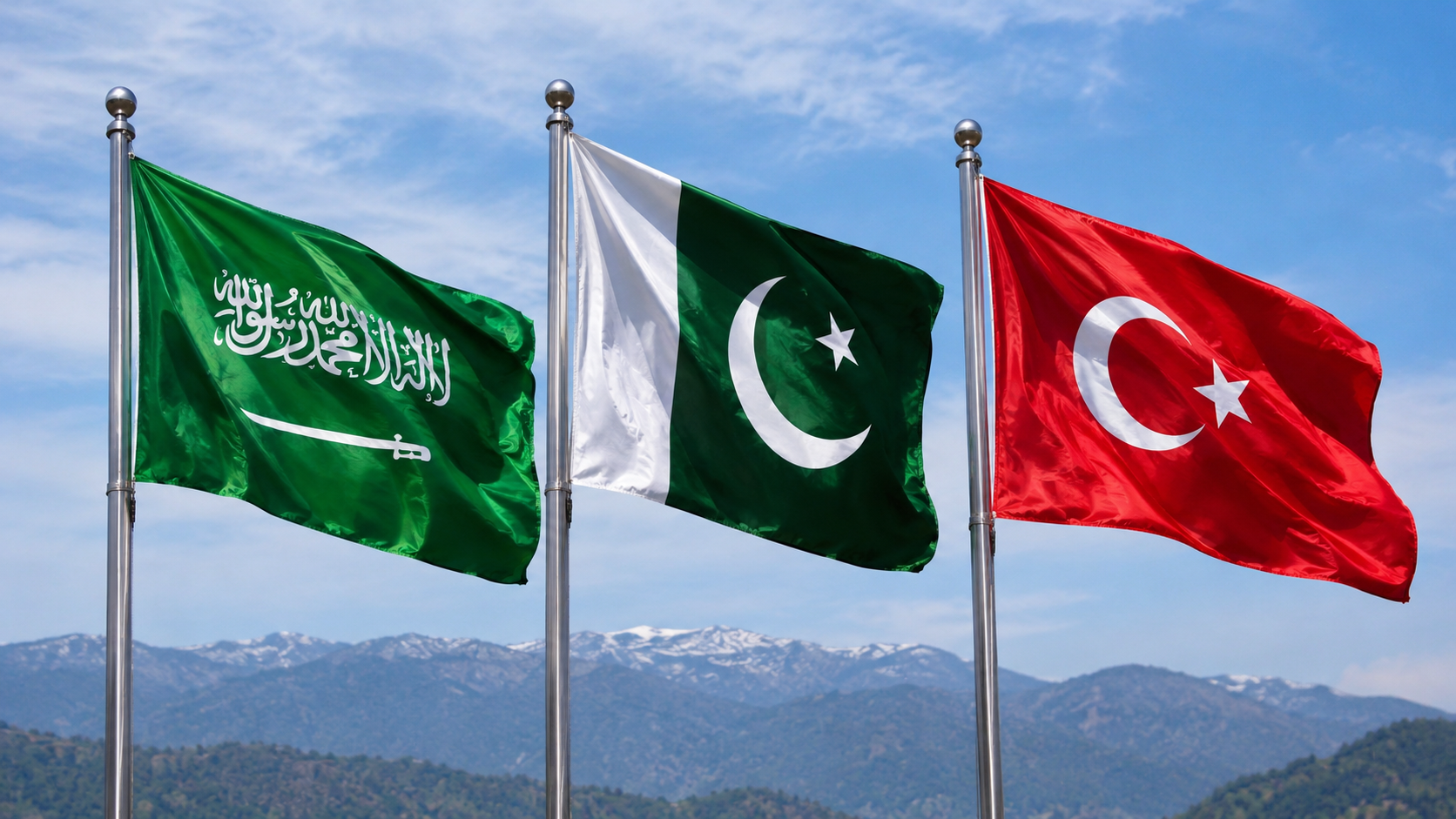
ISLAMABAD, 17 November 2026 — Pakistan is expected to host the next high-level meeting of its trilateral defence alliance with Saudi Arabia and Türkiye later this month, as the three countries work to establish a permanent regional security framework.
Deputy Prime Minister and Foreign Minister Ishaq Dar confirmed the plan on Monday during a press briefing following the Economic Cooperation Organisation’s Council of Ministers meeting in Islamabad.
The meeting of the Strategic Political and Defence Committee (SPDC), the alliance’s highest coordinating body, is expected to take place towards the end of November. A final date has not been publicly announced.
The committee brings together the foreign and defence ministers and senior military officials of the three countries.
Third meeting of the defence committee
The planned Islamabad session will be the committee’s third meeting since Pakistan, Saudi Arabia and Türkiye signed the Makkah Joint Defence Agreement on 7 August 2026.
Its inaugural meeting took place in Istanbul on 31 August, followed by an emergency meeting in Riyadh on 5 October amid escalating attacks on Saudi Arabia.
At the Riyadh meeting, the three governments agreed to advance their collective defence commitments and take steps towards the rapid deployment of agreed military capabilities in Saudi Arabia, subject to national laws and approved arrangements.
The agreement establishes a collective defence framework under which an armed attack against one participating country is treated as an attack against all three. The nature and extent of any assistance are to be determined collectively in accordance with the circumstances.
The pact has gained significance amid continuing instability in the Middle East, including attacks by Yemen’s Houthi movement on Saudi infrastructure and wider regional tensions.
Alliance could expand beyond three countries
Dar indicated that the alliance may eventually admit additional countries once its organisational arrangements are established.
He said the three founding members were not seeking to restrict membership permanently and that requests from countries accepting the agreement’s principles could be considered after an initial period of institutional development, estimated at around one year.
Dar also described the arrangement as a possible starting point for a regional security system developed by countries within the region.
He maintained that the agreement was intended for collective self-defence and was consistent with Article 51 of the United Nations Charter, which recognises the right of individual and collective self-defence.
Permanent structures under development
The three governments are working to establish the alliance’s administrative and operational arrangements, including a permanent secretariat in Riyadh and the office of its secretary general.
A working committee comprising representatives from the foreign affairs, defence and military establishments of each country has already held discussions on procedures and implementation.
Dar said further technical work was expected during November to settle detailed operating arrangements.
These discussions are important because the agreement’s collective defence commitments must be translated into procedures for consultation, decision-making and any military assistance.
Ratification and implementation
Pakistan and Saudi Arabia had completed their domestic approval procedures by October, according to Pakistan’s Foreign Office.
Türkiye’s parliament subsequently approved legislation ratifying the agreement on 5 November, with 279 lawmakers voting in favour and 119 against.
The Islamabad meeting is expected to build on these developments and would mark another stage in the effort by Pakistan, Saudi Arabia and Türkiye to develop a coordinated defence mechanism while regional security conditions remain uncertain.