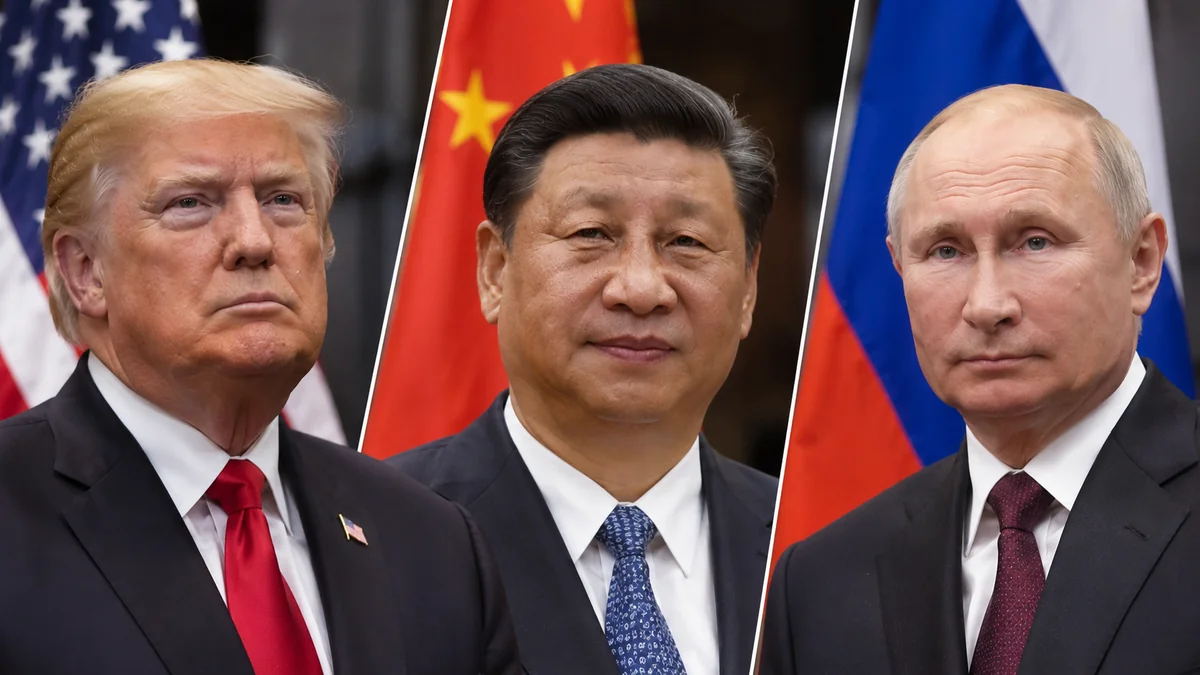
WASHINGTON, November 14, 2026 — US President Donald Trump is set to meet Chinese President Xi Jinping and Russian President Vladimir Putin in China next week for an unprecedented three-way summit focused on nuclear arms control and international security.
The White House confirmed that the meeting will take place on November 19 on the sidelines of the Asia-Pacific Economic Cooperation (APEC) summit in Shenzhen.
The discussions are expected to focus on reducing nuclear weapons, with Trump seeking to bring China into a new arms-control framework alongside the United States and Russia.
The proposed talks follow the expiry of the New Strategic Arms Reduction Treaty (New START) in February, which removed the last remaining treaty limits on the world’s two largest nuclear arsenals.
Washington has called for a broader agreement involving Beijing, although China has previously shown limited interest in joining negotiations because its nuclear stockpile is considerably smaller than those of the United States and Russia.
According to Pentagon estimates cited in international reporting, China possesses more than 600 nuclear warheads, compared with more than 5,000 each held by Washington and Moscow.
A senior US official said the meeting was intended to begin discussions rather than produce an immediate agreement.
The ongoing conflict involving Iran is also expected to feature in the talks, reflecting the different diplomatic relationships maintained by the three countries with Tehran.
However, US officials indicated that Russia’s war in Ukraine would not form part of the planned trilateral agenda, as Washington is pursuing separate diplomatic discussions concerning the conflict.
Trump is also scheduled to hold a bilateral meeting and working lunch with Xi before the three-way summit, with trade arrangements and access to rare-earth minerals among the issues expected to arise.
The meeting comes amid continuing tensions between the major powers over security, trade and regional conflicts.
While the gathering could open a new channel for nuclear negotiations, substantial differences between the countries’ arsenals and strategic priorities remain obstacles to a comprehensive agreement.